








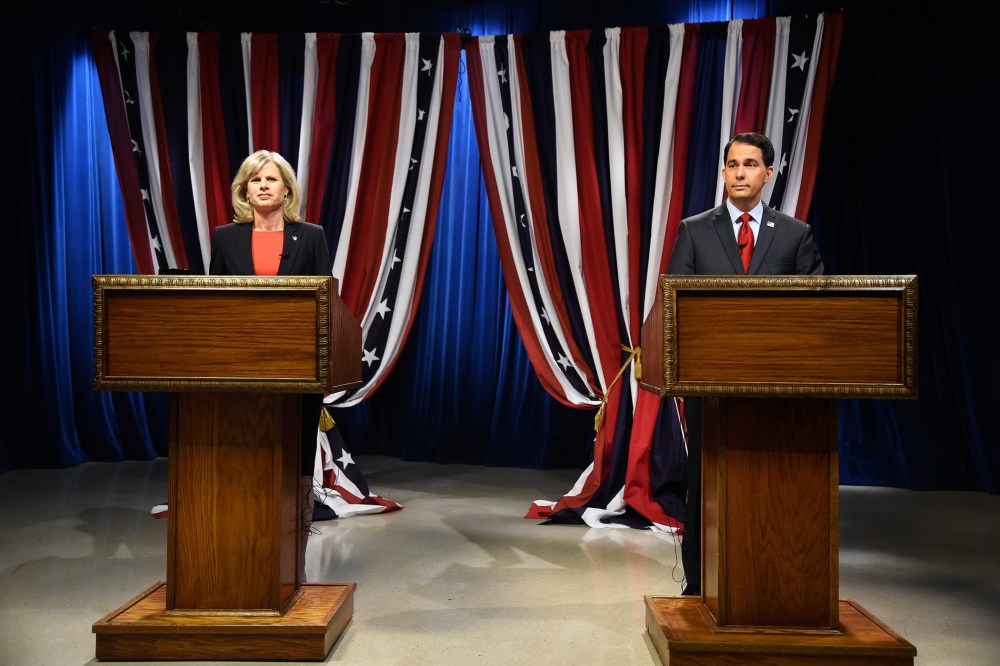
No one landed a decisive blow in Friday night’s debate between Wisconsin Gov. Scott Walker and Democratic challenger Mary Burke. And while an early malfunction by the timer offered an opening for a Florida-style meltdown over technology, the candidates opted to spend their final debate of the 2014 campaign focused on jobs and the state economy.
RELATED: Is a Scott Walker presidential run doomed if he loses governorship?
Instead of labor rights, minimum wage increases, higher education, reproductive rights, shadowy campaign donations, the environment, or any of the other hot-button issues that have divided the state since Walker took office in 2010, the debate panelists zoomed in on economic questions that affect the lives of millions of Wisconsinites but gave nothing to observers looking for clues about the election’s national implications.
Both Walker and Burke kept close to their talking points on economic issues, with Walker pointing out recent, positive jobs and unemployment numbers, and Burke on Walker’s failure to make it halfway to his goal of creating 250,000 jobs during his first term.
And while Walker appeared more at ease while delivering answers smoothly and personalizing his anecdotes, his attacks were weak. The most he could muster was to criticize lackluster job growth under former Gov. Jim Doyle, under whom Burke served as Commerce Secretary.
Walker, Burke responded, “would rather be running against [Doyle], but the hair alone should tell you we’re two very different people.”
RELATED: Wisconsin Gov. Scott Walker: Minimum wage has no ‘purpose’
Walker and Burke have been locked in the tightest contest of 2014, with the campaigns fighting over a handful of independent and undecided voters in the highly polarized state. Neither candidate has found a way to hold onto any meaningful lead; the state’s most reliable poll has shown them within the margin of error for much of the year. The most recent poll has Burke and Walker completely even at 47%, with Burke ahead 45-44 among independents, a jump from trailing Walker 54-40 just two weeks ago.
The question of whether to change the state’s notoriously lax drunk-driving laws is a huge one for state voters in this election, but it’s not one that sheds any light on what sort of candidate Walker would be if he runs for the Republican nomination in 2016.
There is no shortage of topics that could have been fodder for the candidates. Walker is already trying to minimize fallout related to several controversial positions. On Oct. 7, his campaign released an ad that appeared designed to make voters think he believes women should be able to make choices about abortion with their doctor when he has long supported banning the procedure without exceptions. Walker has avoided saying whether he has changed his mind since 2012.
And on Tuesday, Walker told the Milwaukee Journal Sentinel’s editorial board that he didn’t believe the minimum wage “serves a purpose.” Sixty-one percent of likely voters in the state support raising the minimum wage, and only 35% oppose an increase. None of the panelists at Friday’s debate asked about either question. Burke has also had to overcome potentially damaging issues in recent weeks. She fired a campaign consultant after it was reported that he had plagiarized himself while writing portions of her jobs report, the centerpiece of her campaign. While Burke continues to stand by the substance of the plan, the plagiarism conversation appeared to hurt her in the polls, when she began October trailing Walker by five points. RELATED: Women could decide Scott Walker race for governor in Wisconsin Speaking about it Friday, Burke reiterated that she fired the person responsible and said the fact that the ideas were being reused was a plus. “Great economic plans are about great ideas,” Burke said. “The more they are used elsewhere and proven successful,” the more it makes sense to use them. Milwaukee, the state’s biggest city and home to most of the state’s non-white residents, was the focus of many of the night’s questions, from the fact that African-American men see an unemployment rate of over 50% to worries that the Milwaukee Bucks will move to another city. But it will also be the epicenter of potential problems on Election Day. After multiple appeals and reversals, the state’s controversial and restrictive voter ID law will not be in effect on Nov. 4.
Meredith Clark
Meredith Clark is a freelance writer and editor. She was previously a senior news producer for "Patriot Act with Hasan Minhaj," a reporter with MSNBC.com, the digital politics and culture editor at Glamour and a senior news and politics editor at Refinery29. She has written for Vulture, Rolling Stone, Self, Marie Claire, Cosmopolitan, The Daily Beast and Bustle. Recommended


