








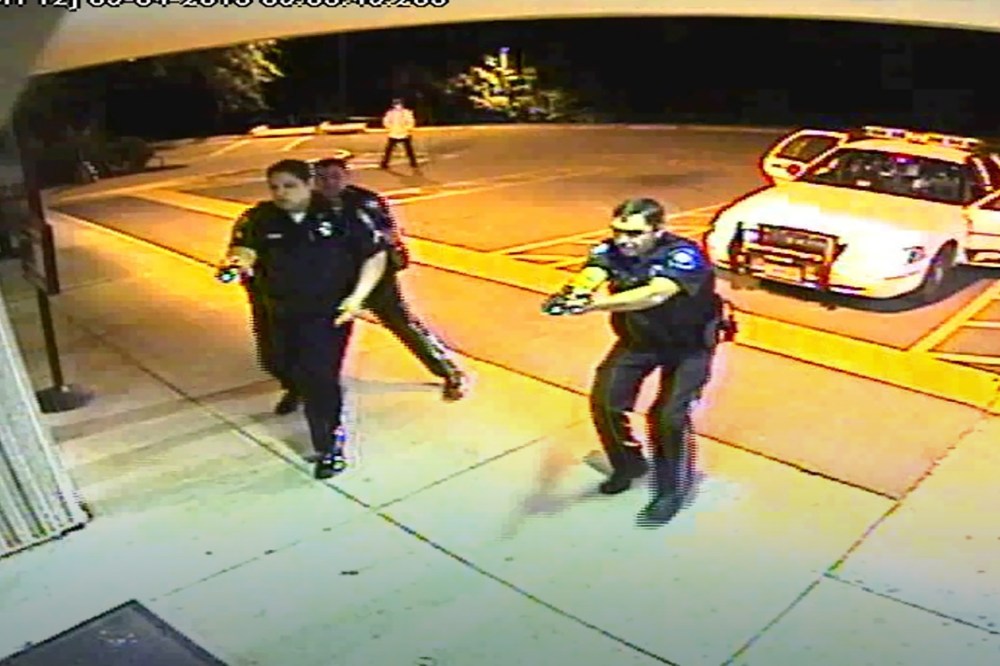
Prosecutors on Tuesday will explain in a report their decision to not charge three officers in the 2013 repeated tasing of a Virginia man who later died in police custody, concluding that the officers acted incompetently and negligently, but did not commit any felonies.
Prosecutors said they evaluated the incident for potential major felonies, such as murder and manslaughter, and lesser felonies such as malicious wounding, which is punishable by up to five years in prison. But while the detailed, 76-page report cites the officers’ defense of their conduct, it makes no reference to officer statements that were contradicted in video footage first revealed by MSNBC last November — and which ultimately led to widespread condemnation.
The videos showed officers offering Virginia man Linwood Lambert a ride to the hospital for medical care. After Lambert broke the squad car window, the officers discharged their Tasers 20 times, while Lambert was handcuffed, and removed him from the hospital entryway. He died soon after in police custody.
The decision and report released by prosecutors Tracy Quackenbush Martin and Michael Herring comes a day before the three-year anniversary of the incident. Local civil rights groups are planning a demonstration for the anniversary.
AN EXAMPLE OF “HOW NOT TO POLICE”
The report repeatedly and sometimes harshly criticizes the officers’ conduct.
“Once Mr. Lambert had been placed in the patrol car, in handcuffs and leg shackles, he was no longer a threat,” the report found, but officers “unreasonably” continued tasing him.
Police departments around the country could “use the incident footage as a training tool on how not to police,” the report noted, and “citizens may cringe” when watching the officers repeatedly tase a mentally unstable man whose hands and feet were bound.
Citing the actions of the three officers, Cpl. Tiffany Bratton, Officer Clifton Mann and Officer Travis Clay, the report found their conduct “fell below acceptable policing standards” and they negligently “failed to perform” their duty to provide medical care to Lambert. The report stated their decision to remove Lambert “from the hospital” was “heart-rending,” but legally “reasonable.”
“What began as a constructive intervention for a citizen experiencing a mental health crisis evolved into a series of forcible seizures, for which [the officers] were miserably unprepared,” the report concluded, noting they did not exhibit the “competence and proficiency to use tasers.”
RELATED: No charges for police in Virginia man’s death after repeat tasings
The officers’ repeated Taser use on a restrained subject violated their own rules and federal guidelines, and prosecutors also analyzed why the officers were so aggressive, suggesting they “became frustrated” and “perhaps even angry” with Lambert. One officer, Clinton Mann, “audibly joked about his bleeding” shortly before his death, the report noted, a reference to Mann saying Lambert was “bleeding like a hog” when they removed him from the E.R.
Despite those findings and judgments, the prosecutors concluded the officers’ conduct was not the direct cause of Lambert’s death, nor did they display criminal intent to support any felony charges.

The officers “all believed” Lambert posed a threat during the interaction, even if they acted unreasonably in response, the report noted, finding “there was no evidence of collusion in their statements to investigators.”
Several officers, however, told state investigators that Lambert tried to grab a Taser and repeatedly “got back up” during the tasings.
That did not happen on the video.
Indeed, Lambert’s hands were cuffed behind his back the entire time – making it physically unfeasible for him to grab an officer’s taser.
Under Virginia law, it is a crime to deliberately mislead state investigators, but the prosecutors’ report suggests they did not focus on officer statements contradicted by the video.
Tom Sweeney, a lawyer for Lambert’s family, told MSNBC he is “surprised” the report “failed to address the witness statement of Ofc. Bratton, where she claimed Linwood Lambert grabbed her taser.”
“There’s no evidence anywhere in the record that supports that,” Sweeney said, “it appears that the Commonwealth’s Attorney glossed over it, while giving tremendous credence to all the other statements the officers made it.”
The officers in the case have denied any wrongdoing, stressing that Lambert posed a danger throughout the interaction. Their attorney, Jim Daniel, did not immediately respond to a request for comment on the report Tuesday.
DEADLINES AND THREE-YEAR DELAY In the report, the prosecutors also strained to address the lengthy delays in their investigation. Three years is an unusually long time to keep this kind of case open, and the delay alone had been criticized by Virginia’s governor, both senators, and even state police investigators who reported to the prosecutor, according to files obtained by MSNBC. The lead prosecutor, Tracy Quackenbush Martin, retained a second prosecutor to assist with the investigation, which took additional time. The report also noted she could not “secure appropriate funding” from the local government to hire an independent pathologist for the investigation, suggesting difficulties in the investigation. The report also stated, however, that prosecutors could not pursue a misdemeanor assault charge because the statute of limitations had expired. Yet the reason that deadline passed was because prosecutors took so long to complete their inquiry. To address that issue, the report asserted that pursuing such charges before the deadline passed “may have foreclosed the more important opportunity to investigate the officers’ conduct for felony charges.” In other words, prosecutors said they declined to pursue lesser charges before the deadline, in order to potentially pursue more serious charges later, which they are now ruling out. The report also stated that “given the gravity of what happened to Mr. Lambert, misdemeanor assault charges would hardly have been appropriate.” That statement appears to suggest the incident warrants more serious charges, although the prosecutors concluded felony charges were not warranted. The report also includes an extensive medical and scientific analysis of Lambert’s cause of death. RELATED: Death of man in police custody caught on video The initial autopsy, which did not include a review of the tasing video, determined acute cocaine intoxication was the cause of death. Prosecutors conclude, however, that even factoring in the tasings, cocaine use and “excited delirium” was the “direct cause of his death.” Noting the “controversy” surrounding whether excited delirium is a “bona fide medical diagnosis,” the report reviews medical and scientific debates on the issue. The report determined that Lambert was “exposed only” to three tasings in probe mode – the type of tasing that punctures the skin – while he was also “repeatedly” tased in drive- stun mode – the type of tasing that includes direct skin contact. The prosecutors state that the drive-stun tasings were less harmful, so they only count the probe tasings to calculate Lambert’s total electrical exposure. “Lambert’s total exposure to an electrical current” was about 15 seconds, the report determines under this calculus, which “falls within the recommended safety limits” for taser use. The video shows extensive tasing in both modes, and taser logs indicate the officers discharged their tasers a total of 20 times, though not every discharge automatically makes contact with a suspect. With the Commonwealth attorney’s report and announcement, the local criminal inquiry into the incident is over. The F.B.I. began an inquiry late last year, which remains open.
Ari Melber
Ari Melber, an Emmy Award-winning journalist, writer and attorney, is the host of “The Beat with Ari Melber” airing nightly at 6 p.m. ET on MSNBC. He also serves as MSNBC’s chief legal correspondent and an NBC News legal analyst. Before joining MSNBC, Melber practiced First Amendment law and served as a legislative aide in the U.S. Senate. He received a J.D. from Cornell Law School and is a member of the New York Bar. Recommended


