








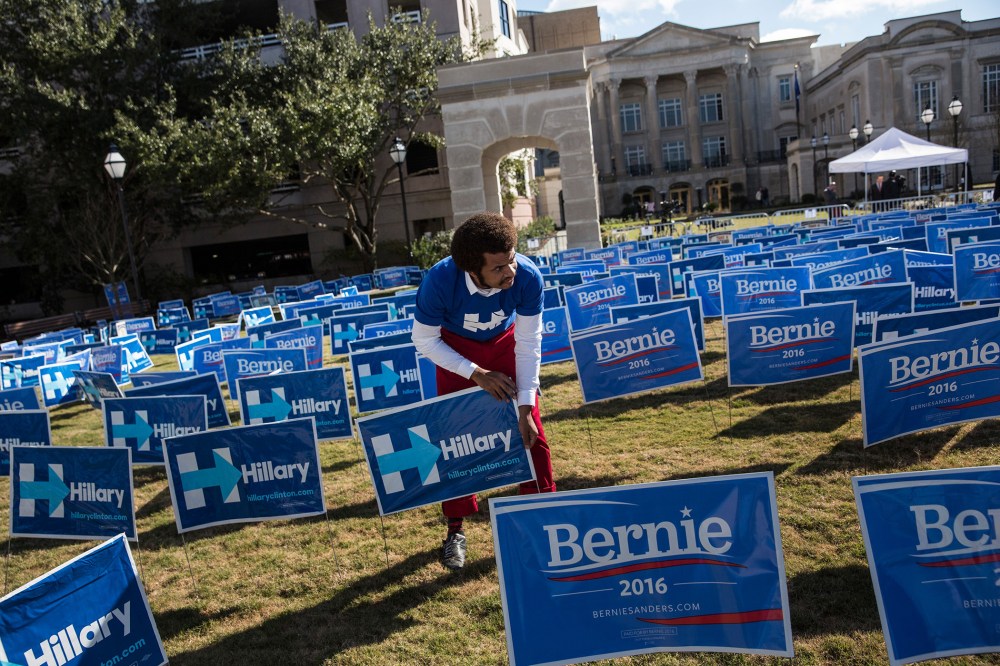
If everything goes according to plan for Bernie Sanders next week, he’ll finish the first week of March with a major accomplishment: Winning more states than Hillary Clinton in the Democratic presidential primary. But while that might be a nice moral victory, PR coup and fundraising catalyst, it won’t necessarily get him any closer to the Democratic Party’s presidential nomination.
States don’t win nominations, delegates do, and Hillary Clinton is likely to finish ahead of Sanders next week even under the rosiest of scenarios for the Vermont senator.
A Clinton campaign official readily conceded that Sanders could win eight contests in the first seven days of March. But the campaign feels confident they would still win more delegates, and it’s not hard to see why.
Sanders is strong in small states, while Clinton is stronger in bigger states. Sanders and his team are targeting five states on Super Tuesday, the day next week when 11 states will hold primaries or caucus all at once. And the senator’s team is also hoping to pick up wins in three caucus states that hold contests the following weekend. If things go well, Sanders could win eight states to Clinton’s seven (her six Super Tuesday targets plus Louisiana).
But all states are not created equal when it comes to winning the Democratic nomination. Not only is Clinton stronger in larger, more delegate-rich states, but she’s ahead by larger margins in those places, which could allow her to rack up delegates under the Democratic Party’s proportional allocation system.
Sanders’ targeted Super Tuesday states have a combined 288 delegates. Clinton’s six have 571.
Much of this dynamic is due to a familiar challenge for Sanders. “Most of the Democrats’ delegates are in places that are more diverse,” said David Wasserman, who has been tracking the Democratic delegate map for the Cook Political Report. “If Hillary Clinton performs as well as her current trends among African-Americans, Latinos and whites would indicate, then she will be on track to win between 75-100 more delegates on Super Tuesday.”
Texas is the biggest prize on Super Tuesday, with 222 delegates at stake. Four new polls out this week show Clinton with an average lead of 30 points or more ahead of Sanders. That’s a margin that not only makes it nearly impossible for Sanders to close the gap in time, but also suggests she can put away a disproportionate amount of delegates in the most delegate-rich state of all the March contests.

The next biggest Super Tuesday state is Georgia, with 102 delegates, where polling averages have Clinton 38 points ahead of Sanders. And the third biggest state is Virginia, with 95 delegates, where a new Monmouth University survey has Clinton up 27 points.
Sanders is looking strong in the fourth biggest Super Tuesday state, Massachusetts, which has 91 delegates. But polls suggest a close race that could end in Sanders only scoring a handful more delegates than Clinton. The delegate allocation system only begins to award massive wins for margins above about 20 percentage points.
Top Sanders strategist Tad Devine said earlier this week that simple delegate calculations miss the dynamic nature of contemporary campaigns, which he said are “driven by higher forms of math than arithmetic.” His team is hoping for a game changer in the race that would shake up current assumptions and give Sanders another real opening for the nomination, and that remains a clear possibility. But on Tuesday, even assuming the most optimistic scenario, it will be hard for Sanders to win more delegates than Clinton. If Sanders wins all the delegates from his home state of Vermont; carries his target states of Massachusetts, Colorado, Minnesota and Oklahoma by an unlikely large margin of 15 percentage points; and performs 5 percentage points above current polls in the remaining states, Clinton could still walk away with as many as 50 more delegates, a rough estimate of delegates suggests. If you include the weekend contests in the three caucus states that Sanders is eyeing — Nebraska, Kansas and Maine (83 combined delegates) — and the primary state Clinton expects to win (Louisiana and its 51 delegates), the gap narrows slightly, but not nearly enough: 622 delegates in Clinton-friendly states to 371 in Sanders-friendly states. Of course, delegates are awarded proportional to vote count in the Democratic primary, so no candidate will win all the delegates from any state (outside perhaps Vermont). And that’s before Clinton’s massive lead among so-called super delegates gets added to the equation. The Southern-heavy map is particularly unfriendly to Sanders, and his team is hoping to pick up wins in more populous states like Michigan, Ohio and Missouri later in the month, but they’ll need a better-than-good performance there to make up for the Super Tuesday hole.
Alex Seitz-Wald Recommended


