During elections, polling companies create a multitude of snapshots of how potential voters would vote if the election were held that day. But, the U.S. does not call snap elections; the first votes will not be cast for 75 days. And those people who answer polls are not necessarily the same people who show up on blustery February nights in Iowa or at later caucuses and primaries.
While the latest polling data provides a snapshot of the electorate’s current sentiment, political prediction market data helps form a meaningful picture of what will happen 75 days from now in Iowa, or 356 days from now across the country. These markets sell contracts on outcomes that may or may not occur; the price of these contracts closely mirrors the crowd’s expectation of the likelihood of the outcome occurring. For instance, you can go on to Betfair or PredictIt right now and buy a contract that is canonically worth $1 if Marco Rubio is the Republican nominee and $0 if he is not. The current market price for that contract is about $0.45, meaning the collective wisdom of the market indicates Rubio has about 45% likelihood of becoming the Republican nominee.
Prediction markets have a strong track record of predicting elections. To give one example, polls had Rick Perry, Herman Cain, Newt Gingrich (Newt Gingrich again) and Rick Santorum leading Mitt Romney in 2012, but prediction markets had Romney (the eventual winner) winning at every stage of the race.
Participants in political markets certainly read the polls, but they also think about how the respondents differ from the expected voters and they examine the endorsements and donations that will affect voters (even if the voters do not know that yet). They consider the probability of misstatements from various candidates and the unique trajectory of the primary system. They may even consider unknown information, such as scandals that already occurred but have yet to surface. Because they trade on all of this, the market prices reflect a lot more information about the expected outcome than the latest polls.
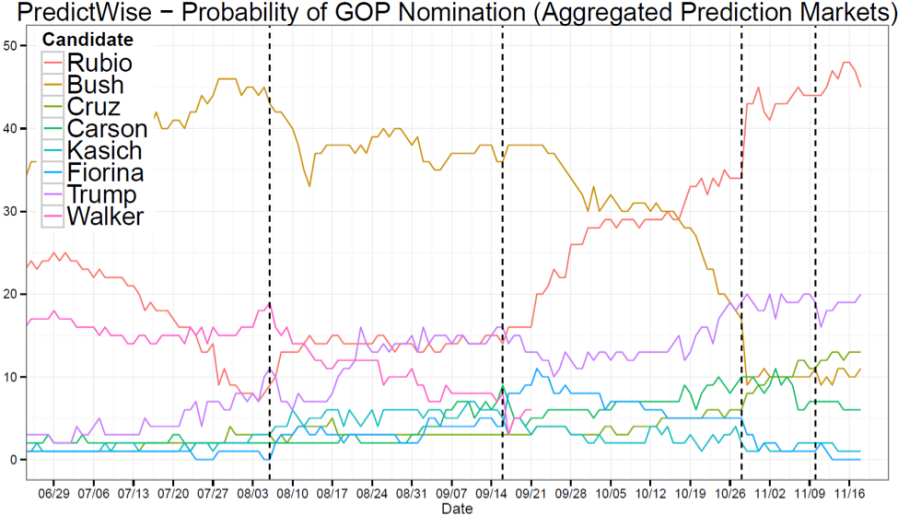
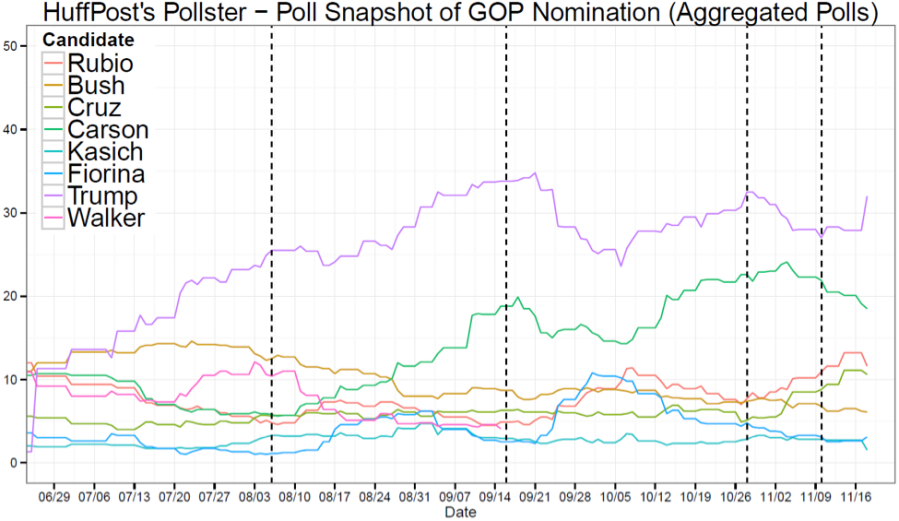
As they ask different questions, it is unsurprising that markets and polls paint very different pictures of where the Republican primary battle has been, where it is now, and where it is going. Below are two charts: the PredictWise probability of victory, which is created from aggregated prediction market data, and The Huffington Post’s Pollster aggregated polling snapshot. Both charts have dashed vertical lines marking the debates.
From the beginning, the markets have considered this to be a race between establishment candidates—Jeb Bush, Marco Rubio and Scott Walker—while the polls have highlighted a race between non-establishment candidates—Ben Carson and Donald Trump. The markets assume that, despite the current support behind Carson and Trump, the establishment will eventually coalesce around an establishment candidate. Thus, with Walker out and Bush continuing to struggle, the markets consider Rubio the strong favorite at this point. At the same time, the polls, focused on the current sentiment of the GOP primary voters, are still dominated by an increasingly tight Carson and Trump juggernaut. While polling usually unfolds in the days and sometimes weeks after a major event, markets unfold within minutes or hours. You can see how the steady rise of Rubio and the fall of Bush between the second and third debates turned dramatic following the third debate on October 28. So, as the drama unfolds in the next weeks and months you can check to see how polls react in the days and weeks that follow major events or, if you want instant objective data, the markets never sleep! David Rothschild, PhD, is an economist at Microsoft Research.
David Rothschild Recommended