With just four days to go until the Iowa caucuses, Donald Trump has pulled ahead of Ted Cruz with a 7-point lead among likely Iowa GOP caucus-goers, while Hillary Clinton remains just 3 points in front of Bernie Sanders on the Democratic side, according to a trio of new NBC News/Wall Street Journal/Marist polls.
In New Hampshire, where voters will head to the polls on February 9, Sanders has expanded his lead over Clinton from 4 points in early January to nearly 20 points now. On the Republican side, Trump still has a double-digit lead over Cruz, who finished second in the Granite State survey.
And in South Carolina, where NBC/WSJ/Marist conducted its first survey of likely primary voters this election season, both Trump and Clinton hold commanding leads, with Clinton besting her Democratic competitor 64 percent to 27 percent.
“Trump is positioned to run the house in these first three states. His supporters are committed and plan to turn out,” said Lee Miringoff, director of The Marist College Institute for Public Opinion. “Will it happen? The answer depends on when or if anti-Trump sentiment will coalesce to interrupt his march to the nomination.”
For Clinton, Miringoff said the data underscored the importance of the Iowa contest next week. “If Clinton carries Iowa, she can absorb a defeat to Sanders who has a home field advantage in New Hampshire and then move on to South Carolina. But, if Sanders carries Iowa and then New Hampshire, this contest will, indeed, be a marathon.”
Iowa
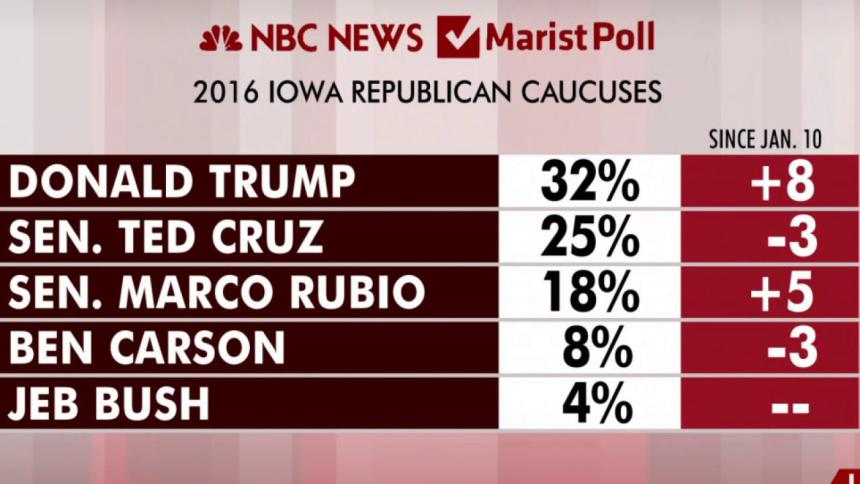
In the Hawkeye State, real estate mogul Donald Trump now leads the GOP pack with 32 percent support from likely GOP caucus-goers. Texas Sen. Ted Cruz gets 25 percent, Florida Sen. Marco Rubio has 18 percent, retired neurosurgeon Ben Carson has 8 percent and former Florida Gov. Jeb Bush has 4 percent. All other Republican candidates get just 2 percent backing apiece from likely caucus-goers.
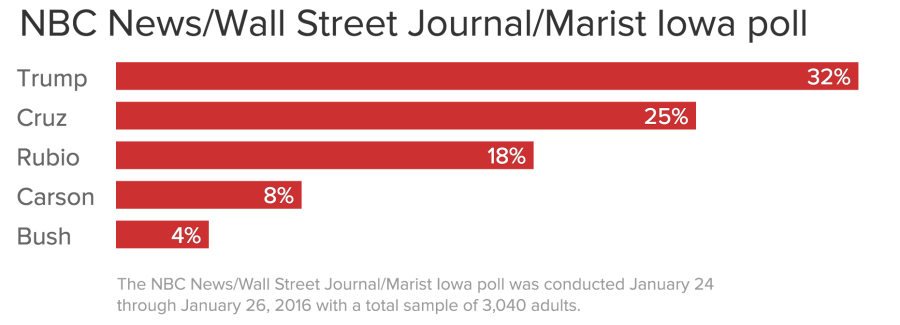
The results are an improvement for Trump, who trailed Cruz 24 percent to 28 percent in the same poll less than three weeks ago.
The poll also shows Trump in a close race with Cruz among likely voters who are white Evangelical Christians, 31 percent to 28 percent. The two candidates have been battling over the influential bloc of voters in the state, with each touting endorsements from Evangelical heavyweights in recent days.
As he has throughout the campaign, Trump has a big advantage with non-college graduates, winning 42 percent of their support compared to 24 percent for Cruz and 12 percent for Rubio.
Among likely caucus-goers who are Republican college graduates, Trump receives 20 percent, while Cruz gets 26 percent and Rubio gets 24 percent.
On the Democratic side, Clinton and Sanders are at 48 percent and 45 percent, respectively, within the margin of error of +/- 4.7 percent for likely Democratic voters. Former Maryland Gov. Martin O’Malley receives the backing of just 3 percent of Democratic likely caucus-goers in the state.
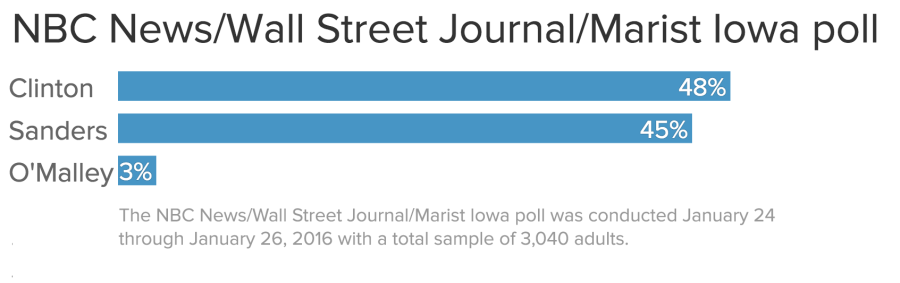
A significant gender gap divides the two Democratic rivals. Men support Sanders by a margin of 58 percent to 35 percent, while women favor Clinton 57 percent to 37 percent.
Age also divides the core supporters of both Democratic candidates. Sanders has the backing of 70 percent of caucus-goers under 45, while Clinton wins a majority — 60 percent — of those over 45 years old.
New Hampshire
In New Hampshire, Sanders has increased his lead among likely Democratic primary voters, now besting the former secretary of state 57 percent to 38 percent. That’s up from his 4-point lead (50 percent to Clinton’s 46 percent) earlier this month.
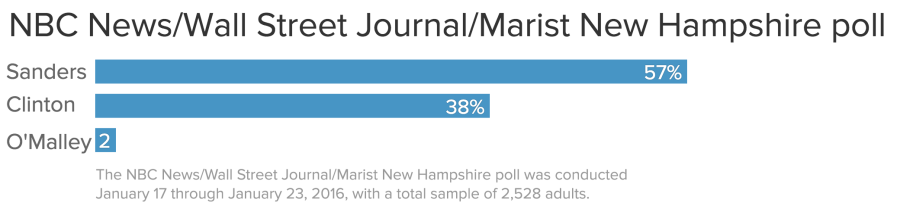
O’Malley received just 2 percent support in the most recent poll.
Among likely voters who identify as independents, Sanders wins 66 percent to Clinton’s 27 percent.
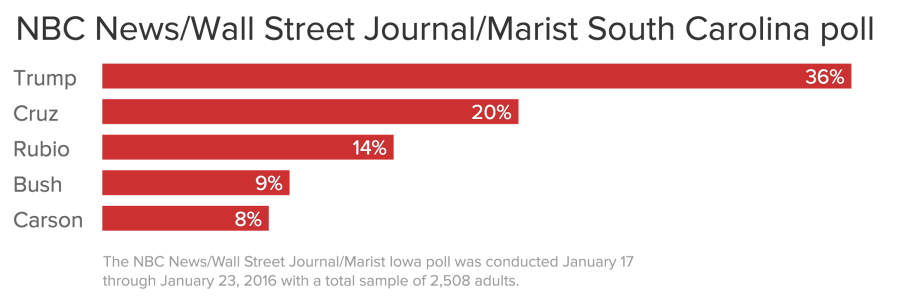
On the other side of the aisle, Trump remains the dominant frontrunner in New Hampshire, getting 31 percent support compared to 12 percent for Cruz, a margin largely unchanged from polling earlier this month. Rubio and Ohio Gov. John Kasich tie for third place at 11 percent, while Bush garners 8 percent and New Jersey Gov. Chris Christie gets 7 percent. No other Republican candidate polls at more than 5 percent in the state. Again, Trump runs the table with key voting groups, leading with young voters (37 percent), Tea Party supporters (34 percent), independents (26 percent) and with white evangelicals (26 percent – although the share of evangelicals in New Hampshire is much smaller than in Iowa.) South Carolina In South Carolina, Clinton – largely fueled by the support of African-American voters – beats her Democratic rival by more than a two-to-one margin. Clinton gets 64 percent of likely Democratic primary voters’ support, compared to 27 percent for Sanders. O’Malley stands at just 2 percent, while 7 percent say they remain undecided in the race. Clinton receives the backing of 74 percent of African-American likely voters, compared to just 17 percent for Sanders. For white voters, it’s 52 percent for Clinton and 41 percent for Sanders. She leads handily with voters of all income levels, and she performs better than Sanders by double-digit margins with both men and women. Trump wins 36 percent of likely Republican primary voters, 16 points ahead of Cruz, who finishes second at 20 percent. Rubio garners 14 percent support, Bush gets 9 percent, and Carson gets 8 percent. All other candidates receive 2 percent support or less. Among white evangelicals in the Palmetto State, Trump wins 33 percent, while Cruz receives 25 percent. The Iowa survey of 3,040 adults was conducted January 24 through January 26, 2016. The margin of error for 450 likely Republican caucus-goers is +/- 4.6 percentage points. The margin of error for 426 likely Democratic caucus-goers is +/- 4.7 percentage points. The New Hampshire survey of 2,528 adults was conducted January 17 through 23, 2016. The margin of error for 612 likely Republican primary voters is +/- 4.0 percentage points. The margin of error for 568 likely Democratic primary voters is +/- 4.1 percentage points. The South Carolina survey of 2,508 adults was conducted January 17 through January 23, 2016. The margin of error for 718 likely Republican primary voters is +/- 3.7 percentage points. The margin of error for 446 likely Democratic primary voters is +/- 4.6 percentage points. Sam Petulla contributed to this article.
Carrie Dann Recommended