








SIMI VALLEY, California — Fifteen Republican candidates will soon head to The Ronald Reagan Presidential Library to stand in front of the former president’s Air Force One for Wednesday’s debate. As they fight to differentiate themselves from a field so crowded it requires two separate events, most will likely be tempted to invoke the legacy of the party’s beloved patriarch.
“Everyone wants to be Reagan’s successor because, through the veil of time, everyone remembers only good things of Reagan,” explained University of California Berkeley’s Alan Auerbach, an expert in Reagan’s impact on federal budgets and tax policies. But there’s a lot about the Republican president’s policies that the modern GOP doesn’t want to talk about — like tax hikes and expanding a woman’s right to choose — because much of his legacy would be downright blasphemous in today’s GOP.
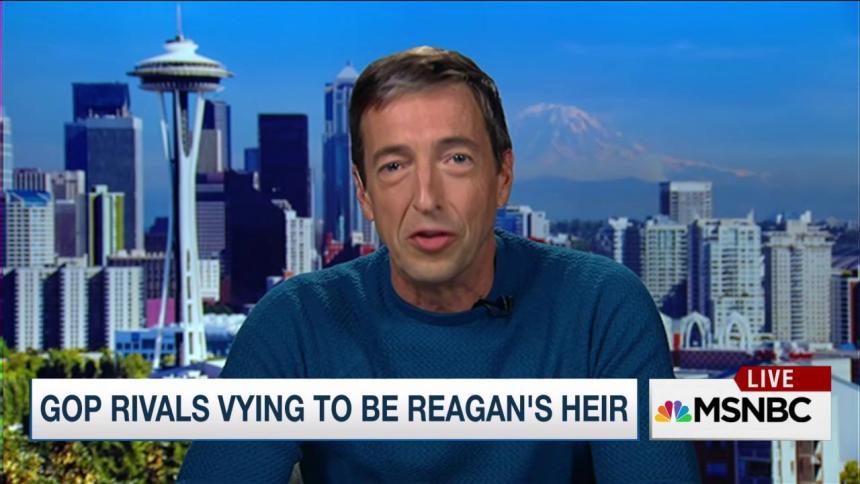
“Every guy, these guys want to be my father,” the former president’s son, Ron Reagan, told MSNBC’s Chris Matthews on Tuesday. “It’s kind of ridiculous. He left office over a quarter of a century ago. We don’t even know what Ronald Reagan would be now as a politician 25 years later.”
Though we’ll never know whether Reagan could have won the 2016 presidential race, let’s take a look at the parts of Reagan’s legacy that you definitely won’t hear mentioned at the debate on Wednesday night.
He raised taxes — a lot.
Reagan is widely credited for dramatically slashing taxes, which he did: By the time he left office, the top marginal tax rate had dropped from 70% to 28%.
But a year after his biggest cut — his signature Economic Recovery Tax Act of 1981 — came the Tax Equity and Fiscal Responsibility Act of 1982, in which he hiked taxes to deal with the skyrocketing deficits, resulting in the largest tax hike in modern history, according to the Treasury Department’s 2006 assessment. He raised taxes again in 1983 and 1986.
RELATED: 7 big debate questions that could divide the GOP field
“He had a more nuanced view on taxes. He was certainly in favor of tax cuts overall but the specifics things he was willing to do made his position somewhat more flexible,” Auerbach, a professor of economics and law, told MSNBC. That included raising taxes on capital gains and corporations — two actions the modern GOP regards as heretical.
“The tax reform act of 1986 was essentially accomplished by a coaltion of Reagan, the Republicans in the Senate and the Democrats in the House,” Auerbach continued. “It’s kind of hard to imagine that happening right now. President Obama and the Republicans in Congress? Or a future Republican president and the Democrats in Congress?”
He tripled the national debt — and grew government.
The national debt rose from $900 billion to $2.6 trillion while the father of the modern GOP was president.
“He changed the storyline for the Republican party,” Auerbach said. “The Republican party had been the party of sound money and balanced budget, and he made it into the party of tax cuts.”
Reagan also grew the federal workforce in a big way during his two terms in office: The number of federal employees shot up from 324,000 to 5.3 million. Mother Jones reports that in 2012, there were nearly a million fewer government employees than in the final year of Reagan’s presidency. He made it easier for women to get an abortion in California. While serving as governor of California in 1967, Reagan both hiked taxes and signed the state’s Therapeutic Abortion Act, effectively legalizing abortion in the state. Despite changes he added to soften the bill, legal abortions skyrocketed. RELATED: The revolution that could undo the GOP Reagan later campaigned on a constitutional amendment prohibiting abortions except when necessary to save the life of a mother, but it wasn’t one of his top legislative priorities during his two terms. He gave undocumented immigrants citizenship. In 1986, Reagan granted amnesty to 3 million undocumented immigrants, selling it as a crackdown that would increase border security in addition to bringing people out of the shadows. The bill’s enforcement mechanisms were largely stripped from it to ensure passage, and it was widely considered unsuccessful in reforming the immigration system. “At the end of the day, Reagan had very strong views on issues like tax cuts and military build-up, but on the other hand he was willing to make deals,” Auerbach said. “As much as Reagan criticized the policies of his predecessor and criticized the policies of Democrats, he wasn’t going to shut the government down.”
Jane Timm Recommended


