The massacre of nine African-Americans by an avowed white supremacist in Charleston, South Carolina, last week appears to have marked a point of no return for the Confederate flag, which may soon be removed from statehouse grounds.
The actual history of the battle flag encompasses some of the South’s most ignoble traditions. It is a flag born of a rebellion launched in defense of slavery, and revived by a movement launched in defense of segregation. And yet the full history of the banner is also richer and stranger than either its defenders or opponents may realize.
Birth of a battle flag
The Confederate Army was created out of the South’s commitment to white supremacy, as The Atlantic‘s Ta-Nehisi Coates has exhaustively documented. But the flag that came to represent that army was born out of battle-field confusion.
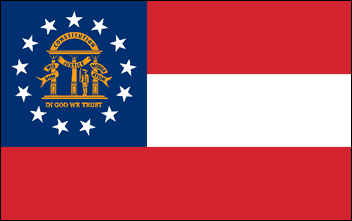
The diagonal, star-studded St. Andrews cross known today as the Confederate flag never served as the national banner of the Confederate states. The national flag of the Confederacy bears a much closer resemblance to the American flag, only with 13 stars arranged in a circle instead of 50 in a grid, and three red and white bars in place of our 13 stripes.
RELATED: 5 signs America is ready to abandon Confederate emblems
That resemblance created a strategic nightmare during the Civil War’s first battle at Bull Run in July 1861. Historian Alan Gevinson wrote that in the heat of that fight, Confederate soldiers and commanders struggled to distinguish their “stars and bars” from the “star-spangled banners” waved by the Union boys. Compounding this confusion was the fact that some Confederate regiments had fashioned their own individual flag designs.
Confederate General Pierre Gustav Toutant Beauregard demanded his troops pick a single, distinct flag to rally behind, according to Gevinson.
The initial battle flag design featured a blue St. George’s cross, but that symbol was deemed too religiously divisive to represent the cause of white supremacist rebellion, according to historian John Coski.

Coski writes that Charles Moise, a friend of the designer and a self-identified “Southerner of Jewish persuasion” asked that “the symbol of a particular religion not be made the symbol of the nation.” The cross was then swapped out for the diagonal X.
The new flag was never adopted by the entire Confederate Army, but in November 1861, Robert E. Lee’s newly organized Army of Northern Virginia made the flag its own.
Civil Rights-Era revival
Lee’s battle flag only became the universal symbol of the Confederacy after the war, when it became the copyrighted emblem of The United Confederate Veterans. But as The Atlantic’s Yoni Applebaum reported, the flag fell from prominence in the decades immediately following the war’s end.
It wasn’t until the middle of the 20th century that the battle flag became a ubiquitous symbol of “Southern heritage.”
In 1948, the discrepancy between the racial attitudes of the North and South sparked a civil war in the Democratic Party. At their national convention that year, the party adopted civil rights as a plank in its platform. Thirty-five southern delegates walked out, making headlines in The New York Times the following day.

Those delegates reconvened in Birmingham, Alabama, to nominate South Carolina Gov. Strom Thurmond as the presidential nominee of the newly organized State’s Rights Democratic Party, better known as the Dixiecrats.
Newspaper accounts of that convention describe its crowds rallying behind the battle flag as their unifying symbol. Segregationists of all stripes (though, typically, a single skin color) quickly joined them, and sales of the battle flag exploded. According to Coski, the month after the convention, “a Dallas store reported a three thousand percent increase in Confederate flag sales and a Richmond store a ten thousand percent increase.” As the battle over civil rights raged in the ensuing decades, Confederate flags continued to fly off of store shelves and then over state capitols. In 1956, Georgia merged the battle flag into it’s own state flag, as part of Gov. Marvin Griffin’s platform of “massive resistance” against the school integration mandated by Brown v. Board of Education. South Carolina hoisted the flag above its capitol in 1961, the same day that Thurmond fought in Congress to maintain federal funding for segregated schools. The battle flag in the new millennium In 2000, after years of pressure from the NAACP and local business leaders, South Carolina’s state legislature reached a compromise to remove the battle flag from its capitol dome — and move it to a monument for Confederate soldiers on the statehouse lawn. In Georgia, Gov. Roy Barnes pushed his legislature to remove Confederate imagery from the state’s flag in 2001. He succeeded, but many believe that his victory cost him re-election: After rejecting Barnes in 2002, the voters of Georgia repudiated his flag in 2003, when they reinstated a Confederacy-themed flag by popular referendum. RELATED: Rand Paul weighs in on Confederate flag: It’s a symbol of slavery Meanwhile, on the other side of the Atlantic, the flag took on new meanings. Southern Italians came to associate the flag with their own lost independence, and the region’s soccer fans adopted the battle flag as a banner of the Napoli Football Club, according to The Washington Post. Swedish vintage car enthusiasts began displaying the flag as a symbol of their admiration for kitsch Americana. In the U.S., the country is currently engaged in a significant debate over the flag. Following Gov. Nikki Haley’s call for the flag to be removed from statehouse grounds, the governor of Virginia, the state whose army first brought the battle flag to prominence, announced plans to ban the emblem from state license plates on Tuesday. North Carolina Gov. Pat McCrory quickly followed suit.
Eric Levitz Recommended