








Democrats have a new enemy in the fight against inequality and stagnant wages.
It’s not rapacious bankers, greedy corporations, or obstructionist Republicans. It’s resignation, disillusionment, and hopelessness—the sense that ordinary folks are subject to economic forces beyond their control, and little can be done to change that reality.
%22Low%20wages%20are%20not%20structural%2C%20they%20are%20not%20inevitable%20%E2%80%94%20they%20are%20choices.%22′
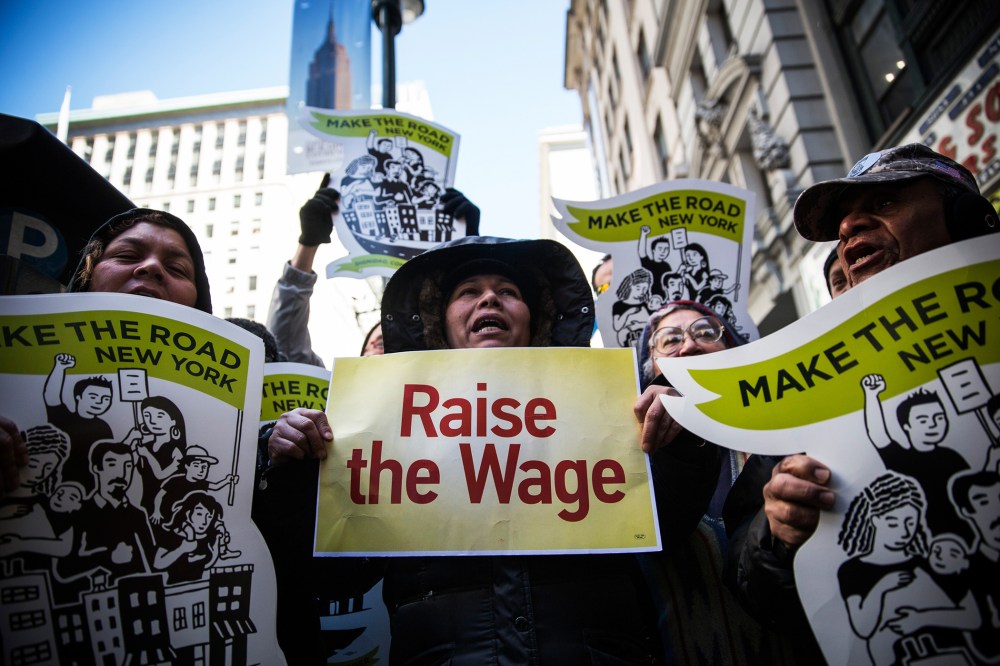
Progressive leaders and officials are converging around a new message of empowerment to counter the notion that inequality is intractable and inevitable.
“Low wages are not structural, they are not inevitable — they are choices,” Tom Perez, Obama’s Labor Secretary, said at an AFL-CIO event last week.
“These are not trends that we should be fatalistic about,” added Neera Tanden, president of the Center for American Progress. “There’s the kind of story out there that stagnating wages in the United States are just the way it is. That is false.”
“Stagnation in wages and middle incomes is a choice, not a necessity, and a different choice is possible,” economist Larry Summers said Thursday, unveiling a new report laying out ways to boost wage growth from a commission of experts convened by CAP.
RELATED: Democrats’ latest plan to close the income gap
It’s a departure from the combative, Elizabeth Warren-style populism that has gained momentum on the left, seeking to empower rather than enrage. But it’s also rooted in the fundamental argument for progressivism: The U.S. government can be a positive force for liberation rather than obstruction, giving citizens the agency and power to reform a country that has been hollowed out by broad economic forces.
But among ordinary Americans, confidence has fallen both in the economy and government alike, leading to a self-destructive loop in which the government’s inability to act has actively hurt the country’s economic prospects—fueling yet more pessimism in the government.
The report from CAP’s commission makes the case for restoring faith in government, saying it is the best way to restore Americans’ faith in the economy. And with trust in U.S. institutions at a low, it turns overseas for inspiration. With input from British, Australian, Swedish, and Canadian leaders, the report compares the U.S. to other advanced, industrialized countries that have done a better job at boosting workers’ wages, even while facing similar economic pressures. While wages of the bottom 90% have stagnated over for decades in the U.S., they’ve grown substantially in Australia and rebounded in Canada.
“There is considerable evidence that certain national policies can produce vastly different outcomes,” the report said. “Canada, Australia, and Sweden, for example, have access to the same automation and are at least as exposed to trade and low-wage competition as other countries, but they have maintained a closer link between productivity and wage growth in the face of these pressures.”
RELATED: Beyond the minimum: What’s next for raising wages? The report credits a whole host of government interventions for keeping wages up in Canada and Australia, despite facing similar economic challenges as the U.S.: paid caregiving and sick leave, higher minimum wages, lower-cost college, and apprenticeship programs. Workers also have more bargaining power compared to the U.S. which has significantly lower unionization rates compared to similar industrialized nations. So the commission recommends ways to improve and strengthen collective bargaining, and encourages companies to give workers a greater share of profits, moving away from a system that puts shareholders first. They’re all policy ideas that have long been popular among progressives, and Democrats have hit on many of them as part of their post-recession agenda. In recent days, President Obama has unveiled new proposals for free community college and mandatory paid sick leave. This week, Rep. Chris Van Hollen released a new middle-class tax plan that would also support a new apprenticeship program. But having a laundry list of policy ideas isn’t enough to inspire hope in post-recession America. And Democrats seem to have recognized that they need to make a more fundamental case for the transformative power of government in the first place. “The citizens of industrial democracies continue to value their freedom and their opportunity to participate in the task of self-government,” the report said. “But they also count on their political systems to create circumstances in which they can use their talents and their labor to provide a decent standard of life for themselves and their families.” To fix the country’s economy, in other words, we need to fix the country’s politics — and believe that citizens can make government work again. Otherwise, the commission warns, the health of the democracy itself is at risk, empowering those who argue that America’s very form of government can no longer deliver on its promises.
Suzy Khimm Recommended


