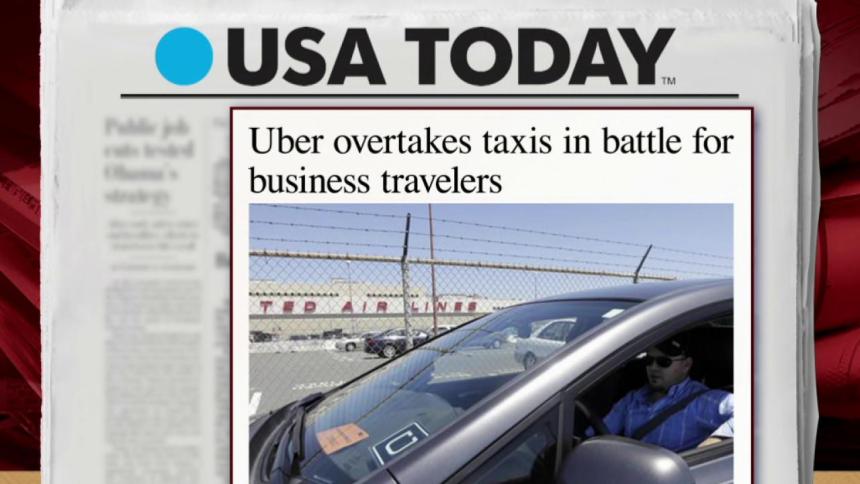
The Democratic mayor of New York City is at war with a smartphone app – and his party’s presidential hopefuls don’t want to pick a side.
Mayor Bill de Blasio’s long-simmering feud with Uber boiled over this past week, as a bill to cap the number of cars the rideshare service operates within the city came before the City Council. De Blasio has argued that the rapid growth of Uber’s fleet in Manhattan is creating congestion problems, and that the city needs to research the company’s effect on traffic patterns and labor standards before deciding whether or not to let the fleet grow unchecked.
Uber claims that de Blasio isn’t concerned about congestion, but about the profits of the city’s taxi industry — one of the mayor’s largest campaign donors – and they’re taking that argument directly to the people, with a series of aggressive attack ads.
The most recent ad targets one of de Blasio’s core constituencies – middle-class minorities who live outside Manhattan. Over soft piano music, the advertisement shows a montage of harried black- and brown-skinned outer-borough residents, as the voice-over says, “While taxis often refuse people in minority neighborhoods, Uber is there … but Mayor de Blasio is pushing the agenda of his big taxi donors to limit Uber cars and drivers. And a vital service for thousands of New Yorkers may vanish.”
The company has also provided its users with a preview of the nightmare they will suffer should the City Council limit Uber’s growth. A normal Uber app provides users with three options – UberX, UberPool, and UberBlack – but this past week they debuted a New York-only special feature: the de Blasio option. If a user opts for the mayoral treatment, she’s immediately presented with the specter of a 25 minute wait, and a link to a petition calling on de Blasio to withdraw his proposed cap.
The mayor pushed back in a New York Daily News op-ed, elevating the dispute to a fundamental conflict over his citizens’ right to democratic oversight, writing, “While most businesses recognize the role of the city to set basic standards and look out for the broader public interest, Uber — a $40 billion corporation — is out with multi-million dollar ads trying to convince New Yorkers that it doesn’t need more oversight.”
As many reporters have noted, de Blasio needs to frame this fight as a referendum on the progressive view of government, because while his city is home to plenty of “big government” liberals, it houses very few people who see Uber’s growth as a problem, and quite a few who adore the car service.
This conflict, between progressives’ commitment to government regulation of labor/safety standards and the bi-partisan appeal of a cash-free, speedy ride-service, has national Republicans singing Uber’s praises while national Democrats avoid saying its name.
In her first major economic policy address, Hillary Clinton never referenced the app, but she did address the growing “on-demand” economy to which it belongs.
“This on-demand or so-called ‘gig economy’ is creating exciting opportunities and unleashing innovation, but it is also raising hard questions about workplace protections and what a good job will look like in the future,” Clinton said.
Later in the speech, Clinton seemed to indicate her own answer to one of those hard questions, promising that she would “crack down on bosses who exploit employees by mis-classifying them as contractors.”
RELATED: The Democratic primary has officially begun
Several reporters interpreted Clinton’s words as a veiled threat against Uber, which classifies all of its drivers as independent contractors, “and the Republican presidential field leaped to the app’s defense.
For GOP candidates, Uber is a political godsend — a private company founded by an Ayn Rand-devotee that consistently outperforms government subsidized taxi-services and highlights the conflict of interest between consumers and regulators. And while Democrats are constantly accusing conservatives of living in the past, Uber allows Republicans to turn the tables.
In a recent interview with CNN, Republican presidential hopeful Sen. Marco Rubio of Florida accused Clinton of “trying to apply 20th century constructs to a 21st century innovative industry.” Fellow candidate Sen. Rand Paul of Kentucky tweeted, “America shouldn’t take advice on the sharing economy from someone who has been driven around in a limo for 30 years,” in response to Clinton’s speech. But one of Uber’s strategic advisers defended Clinton, tweeting, “HRC didn’t attack Uber. She praised it, then said innovation raises important q’s on what the future of work looks like. I agree.” So does former Maryland governor and Democratic presidential candidate Martin O’Malley, who told The New York Times that he was “optimistic about companies like Uber because of their role in revitalizing cities across the country,” but that “as companies like Uber grow and expand, we need to update our labor laws.” The trouble with that nuanced postion is that Uber’s business model may not be compatible with traditional labor standards. Right now, the company classifies all of its drivers as independent contractors instead of as employees — even those who work full-time on the company’s platform. That classification allows Uber to save money by not having to finance workers’ social security benefits or worker’s compensation insurance. In California, Uber is fighting a class-action lawsuit brought by drivers who claim that they qualify as employees under existing U.S. law. If Uber is forced to treat all of its California drivers as workers, it will cost the company $208.7 million-a-year in added expenses, according to an estimate by Re/code. Whether Uber could take on such costs and retain its current size and affordability is unknown. Thus, to former Obama adviser and current Uber employee Dan Pfeiffer, voicing concern over labor standards is apparently tantamount to an attack on the sharing economy’s very existence. Progressive politicians are making a major error by positioning against the sharing economy.We need to be shaping the future not opposing it But if Democrats want to reduce inequality and improve the living standards of American laborers, they can’t just allow a sector that sells itself as the future of American employment to deny workers the benefits and protections enjoyed by previous generations. So while D.C. residents may find the app convenient, Uber isn’t making life any easier for Democrats looking for a ride to the White House in 2016.
Eric Levitz Recommended