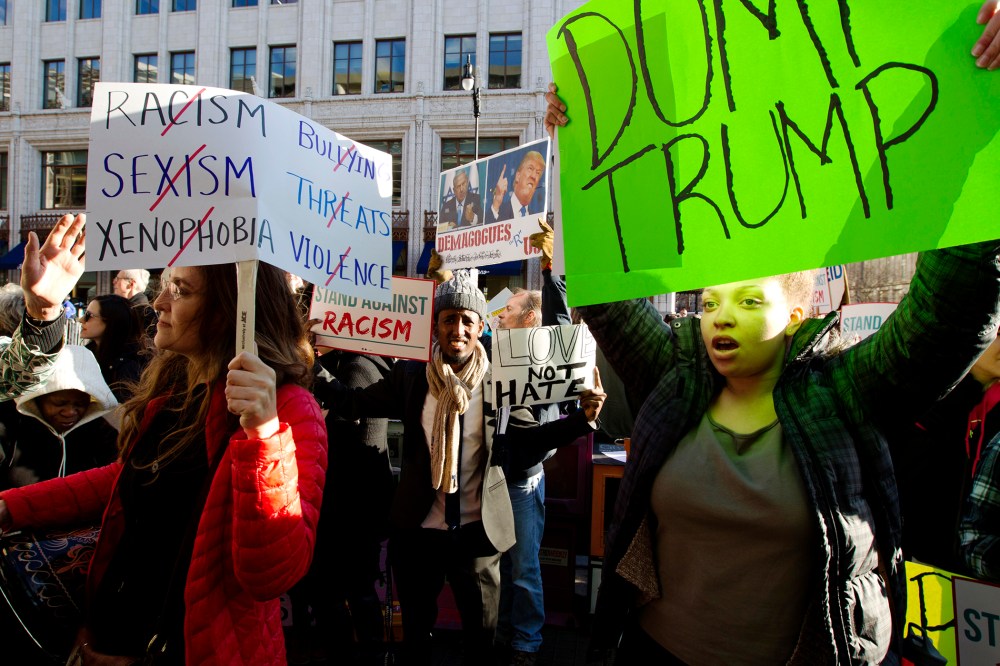
The protest movement against Donald Trump has evolved from a mostly localized phenomenon to a nationally orchestrated effort that has drawn a diverse alliance of players who’ve found a common foe in the front-runner.
Over the last several months, as Trump’s popularity among Republican primary voters has grown, the massive rallies he’s held across the country have become targets for protests and disruption. At first, those disruptions included one or two people heckling him, denouncing his often incendiary and exclusionary messages aimed at immigrants, women and racial or religious minorities.
But as the size of Trump’s rallies has swelled, so have the number of protesters infiltrating and disrupting them. In recent weeks the events have devolved into stuttered spectacle, with a red-faced Trump unable to get through a speech without some form of protestation, often coupled with an angry or violent response from his supporters.
“Get them out of here!” has become a common refrain, as much a call for security to escort protesters out as a sort of rallying cry to whip Trump’s hordes into frenzy. Protesters have been punched, pummeled and jeered at, sometimes with racial epithets, according to witnesses.
The scenes outside of these events have featured much of the same, with protesters and supporters clashing, sometimes physically.
Though there remains a very local, organic push back against Trump and his anti-everyone else rhetoric, the Republican front-runner’s alienation and angering of such a wide array of people with different political agendas has created a united front with efforts to organize, support and expand the protests.
That front includes protesters and organizers from key progressive blocs, including feminists, Iraq War Veterans, Jewish and Muslim groups, those in the immigrant rights and Latino movement, Black Lives Matter and a wide conglomeration of white progressives. National organizations among that spectrum are actively providing training, logistical support and network building to local counterparts and affiliates. Organizers are leaning on their own national networks to connect protest groups to each other and with resources when possible. They’ve offered media training for novices and offered insight and tips on how to record and document their protest actions for wider play in the media.
RELATED: The Stop Trump effort will play in Wisconsin
“All politics to us is local, but local is more powerful when you tie together national and local,” said B. Loewe, with MiJente, a national organizing collective that builds around immigration and Latino advocacy. “I think Trump, it’s fair enough to say, is the right enemy. That makes room for people to work together where before they may not have. Now we can be unified in whatever it will take to stop Trump.”
MiJente recently lent support to protesters who planned to shutdown a Trump rally at the University of Illinois at Chicago. Trump cancelled the event after protesters swarmed the arena and several violent clashes between his supporters and protesters broke out. MiJente also aided the migrant justice group Puente Arizona, which last weekend shutdown a main highway leading to a Trump rally outside of Phoenix by chaining themselves to cars they parked on the road.
Loewe described the synergy between various factions of the social justice community as a wide effort to blunt the “Trump Effect.”

“There’s that dynamic that happens when you go and focus on the ugliest parts of the debate. What you’re actually doing is moving the whole debate in that direction,” Loewe said.
That level of coordination is part of a maturing of forces that oppose Trump’s candidacy and the prospect of his presidency.
Last week, MoveOn.org released an open letter in which it described the rise of Donald Trump as a “five-alarm fire to our democracy” and his candidacy as “alarming and dangerous.”
“Donald Trump’s candidacy is a threat to the America we love, and we must respond to him and what he is stoking as such — with a nonviolent movement grounded in love and community that ensures that he never comes anywhere near the White House, and perhaps even more importantly, makes clear to every other politician and every person in the United States that racist demagoguery is a dead-end political strategy that most Americans reject,” read the letter, signed by dozens of progressive leaders.
“That’s why today we are calling for a massive nonviolent mobilization of working people, students, immigrants, children of immigrants, great-great-grandchildren of immigrants, people of color and white people, the unemployed and under-employed, people of faith, retirees, veterans, women, and men — anyone who opposes bigotry and hate and loves freedom and justice — to stand up to Trump’s bullying and bigotry.”
RELATED: Online criticism of Donald Trump draws harassment and violent threats
MoveOn.org called for non-violent organizing, teach-ins on the importance of confronting hate, prayer vigils, phone banks and asking media, corporations and office-holders to “condemn Trump’s racism, misogyny and xenophobia.”
Many organizers, black, white and Latino, say that after more than a year-and-a-half of mostly African Americans and Latinos across the country leading protest movements against police brutality and systemic racism, so-called “white allies” have stepped up in a major way to combat what they see as a political campaign fueled by hate, racism and fascism. “I had a tweet about a week ago,” Loewe said, “that white people are afraid that they’ll be treated under a Trump presidency the way people of color have been treated under every presidency in the history of the country.”
But whereas many progressive white protesters may have felt uneasy or uncomfortable joining the ranks of the big and small “b” Black Lives Matter groups, which have focused particularly on police violence as racism, Trump offers a more equal opportunity target.
“This is the time of the political season when Americans take stock of what they need from our government and where they want our country to go. I think what you’re seeing in the Trump protesters, black and brown leadership for sure, but other Americans, including white Americans, waking up to the idea that we need to confront racism in our society,” said Todd Zimmer, a protester with the Stop Trump National Network, a small ad hoc group of veteran organizes and protesters from across the country that have aided local protesters.
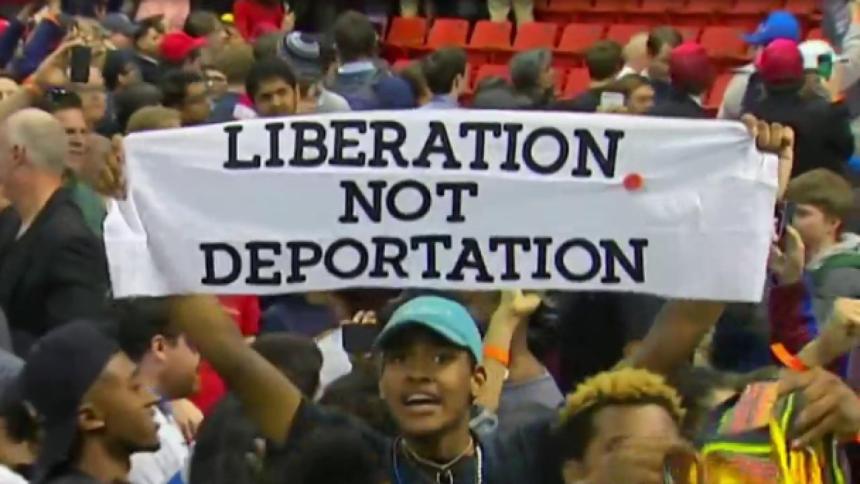
“The fact that a candidate can become the front-runner almost strictly on racial animus, inflaming racial tension, and may rise to the GOP nomination, that gives us the indication that we all have a responsibility to build an anti-racist America and that effort has to include white people like myself.”
Recent messages on the Stop Trump National Network Facebook page include queries like this one from March 18:
“Are you planning to protest Trump? Need help figuring out details, or understanding what to expect?
We have a team that wants to support you. Message us to get connected.”
And this one from March 22:
“This can’t just be about stopping Trump. This is about stopping the Trump effect. This is about confronting racism wherever it shows up. New Yorkers — Ted Cruz will be in your city tomorrow spewing his hateful rhetoric against muslims and immigrants. What will you do? #TimeToEscalate”
Rashad Robinson, executive director of ColorofChange.org, a civil rights organization, said the unification of anti-Trump organizers has been a natural progression.
“I think a lot of this has been brewing for months and years in terms of the growing network from the Black Lives Matter network to SURJ (Showing Up for Racial Justice) and all of these groups that have been growing their infrastructure over the last several years,” Robinson said. “Some of this is just coalescing in an important moment where everyone’s attention could be focused on this figure that has animated everyone’s animosity.” RELATED: Examining Donald Trump’s problem with women voters Robinson said his group has focused on supporting campaigns that put pressure on politicians and corporations that support Trump, including Coca-Cola, a sponsor of the upcoming Republican National Convention in Cleveland, as well as Republicans who have at once condemned Trump but say they will support him if he becomes the Republican nominee. ColorofChange has also offered up its popular and effective petition platform, iam.colorofchange.org to help engage and activate voices from across the country. “For us, this simply can’t be about just Donald Trump because to do so we would be lowering the floor of what’s acceptable,” he said. Robinson likened the unity against Trump to the coalition that emerged following the passing of Proposition 8 in California in 2008. At the time Robinson was leading program work at GLAAD. He said he recalled seeing straight allies showing up at protests in the West Village and West Hollywood and urging them to show up not just at the picket line, but also the family dinner line. “I’ve really been pushing these organizations both publicly and privately. This is an opportunity. There is work to be done that is progressive and it is their responsibility to act. And that this is a moment to organize folks and their families,” Robinson said. “Thanks for showing up but it’d be great to have a conversation (about progressive values) with Aunt Edna over Thanksgiving dinner.” Perhaps adding momentum to the growing anti-Trump movement among protesters is a hitch in Trump’s relatively wide support among Republican primary voters. As the New York Times recently noted, “Young people generally don’t like him.” RELATED: Ben Carson struggles to defend Trump in combative interview Recent polls show that Trump’s appeal among Republican voters skews older. According to a recent USA Today/Rock the Vote poll of voters under 35, a hypothetical Clinton v. Trump election would have Trump being smashed by a 52 percent to 19 percent margin in favor of Clinton. The poll showed that those young whites supported Clinton by nearly 2 to 1. Every other racial group of respondents in that age bracket also supported Clinton by wide margins: African Americans 67 percent to 5 percent, Hispanics 61 percent to 14 percent and Asian Americans 60 percent to 11 percent. While there have been a number of recent reports and articles mulling whether or not young Americans are more or less racist than previous generations, many young voters especially have decried what they’ve described as Trump’s outmoded, outdated form of radicalized rhetoric. And that they’d been offended by Trump’s willingness to play on the fears and fragility of working and middle class whites who are struggling economically, and with a slipping sense of identity. Young people have become increasingly engaged in social and political activism, particularly in the age of social media. And young people in this country are a diverse group and include some among the demographics most often targeted by Trump’s flaming rhetoric. About 43 percent of millennial adults are non-whites, “the highest share of any generation,” according to a Pew Research Center report. Young people of color, long on the front lines of various social justice fights in their own communities, are now joining forces with their white counterparts. At a recent protest outside of a Trump event in Kansas City, with his supporters lining one side of the street and protesters lining the opposite side, protesters formed what looked like a radical Benetton ad circa the 1980s and 90s. One Latino protester hoisted signs that read “I’m a Mexican American against Trump. I’m not a rapist or a drug dealer.” A white woman held up another that read “Hate is Not the answer to America’s problems.” Another protester, a black woman, raised a sign that said “Making America Hate Again!” a clap back to Trump’s campaign slogan. Eventually, as the protesters pushed from the sidewalk into the street, police directed pepper spray into the crowd. “In some ways Trump’s candidacy and supporters is a backlash from certain segments of the white community to black and brown leadership,” said Zimmer, with the Stop Trump National Network. “And as a white person, his dangerous appeal, his racist appeal is designed to mobilize me and my community. White folks who may have legitimate economic concerns or criticism of the government broadly, but also are holding onto fear of differences and old racist attitudes.” “I think it’s really crucial that white people who oppose Trump take responsibility for what’s happening in the white community and move to bring in and talk to our friends and neighbors,” he said. “It’s important to talk about why Trump’s vision of the future is unacceptable, but also move into a place of action.” Zimmer said the support his group has offered to protesters on the ground so far has not been financial. “There is no money. There are just folks talking to folks. And the main way groups have been supporting each other is on the tactical side,” he said. “The Trump rallies themselves can be a pretty toxic environments. We’ve seen all manner of violent assault on protesters. We coach people through what to expect.” RELATED: Can the GOP survive with Trump as the nominee? Tactically protesting a Trump rally can get tricky, he said. In recent weeks the rallies have become increasingly violent. Protesters who’ve crashed Trump events and managed to engage in protest actions have mostly been removed without physical harm, but not always. A young black woman in Louisville, Kentucky was pushed, grabbed and shoved through a crowd of thousands. A young black man was sucker punched by a 78-year-old white Trump supporter in Fayetteville, North Carolina. In Kansas City, a white protester holding up a placard with a photo of her family and deported Latino husband said she was yanked to the ground by her hair while being escorted out of the rally there. And last Saturday during a Trump rally in Tucson, Arizona, a black Trump supporter and a member of the Air Force punched a protester to the ground and then repeatedly kicked him. The protester in that case was a white man. “Knowing that you’re going to do something and there’s a chance you might get sucker punched, it’s a pretty high barrier to entry. We are literally preparing people to take body blows,” Zimmer said. “But people are willing to take great risks to stop what would ultimately be much more dangerous than a Trump rally, which would be a Trump presidency.”
Trymaine Lee
Trymaine Lee is an NBC News correspondent. Recommended