








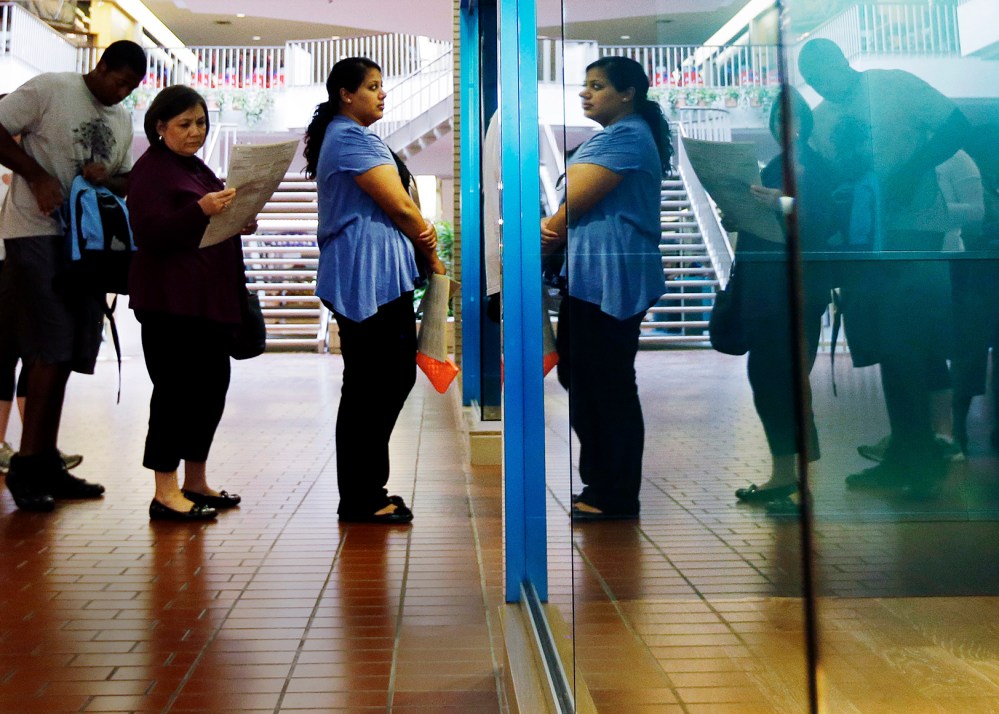
HOUSTON – For years, Stephanie Cochran has voted without any problems. But when she went to the polls Tuesday in her upscale, diverse neighborhood here, things went a lot less smoothly—thanks to Texas’ strict new voter ID law.
On the voter rolls, she’s listed as Stephanie Gilardo Cochran, while on her driver’s license, she’s Stephanie G. Cochran—a mismatch common to married or divorced women including Wendy Davis, the likely Democratic candidate for governor next year. As a result, Cochran faced what she described as a barrage of questions from poll workers about the discrepancy.
In the end, Cochran was able to vote by signing an affidavit in which she swore, on penalty of perjury, that she was who she claimed to be. But the experience left her angry: She told msnbc that she sees the law as an attempt to keep women from the polls.
“It’s against us,” Cochran said. “It’s to keep us from voting for Wendy.”
In the same boat was Leah McInnis, who even had her voter registration card with her. Nonetheless, thanks to a similar mismatch involving her maiden name, McInnis had to sign an affidavit to cast her ballot.
That experience appears to have been typical statewide. Tuesday’s off-year election was a dry run for Texas’ controversial voter ID law. On the surface things went pretty smoothly, with few voters forced to cast provisional ballots. That was enough for the law’s Republican supporters to claim vindication. But there were signs of potential trouble to come. There are no hard statistics yet, but a massive number of voters appear to have had to sign affidavits—a relatively simple procedure, but one that could cause problems in higher turnout elections. And of course, with one in ten Texans lacking ID by one estimate, it’s all but impossible to measure the number of people who were deterred by the law from voting.
Most important, with turnout at just 6% for the off-year election, many of the voters most likely to be disenfranchised by the ID law liikely never tried to vote.
Next year’s highly anticipated governor’s race and the 2016 presidential election will offer a far tougher test for the law, which was passed in 2011, blocked last year by the Justice Department under the Voting Rights Act, then reinstated after the Supreme Court weakened the VRA in June. For now, it looks to be acting simply as one more factor, among several, to complicate the process and discourage potential voters—especially those likely to have trouble meeting the law’s requirements.
In all, 2,354 provisional ballots were cast this year, representing 0.2% of total turnout, according to Alicia Pierce, a spokeswoman with the Texas Secretary of State’s office. That’s compared to 738 provisional ballots, or 0.1% of turnout, in 2011, and 1,459 provisionals, or 0.14% of turnout, in 2009.
The law’s supporters say numbers like those decisively rebut concerns about the measure. “I haven’t ever seen anything that was overhyped as much as some partisan efforts to overhype concerns about this, when in reality, there has been no problems whatsoever,” Attorney General Greg Abbott, a supporter of the law and Davis’ likely GOP opponent for governor, said Wednesday.
“There hasn’t been any impact on people not having access to the ballot,” Hector De Leon, a spokesman for the Harris County elections office, told MSNBC as he stood outside a polling place in a heavily minority Houston neighborhood. “People have been able to vote.”
Still, a huge number of voters—disproportionately women, it appears—had to sign affidavits just to cast a ballot. Marianna Cline, the election judge at Cochran’s Houston precinct estimated that one in five voters there had to do so, thanks to name mismatches or similar discrepancies. An election clerk in San Antonio put the number at roughly one in three, Jonathan Bernstein of The Washington Post reported. And an election administrator in Fort Bend County put the number as high as 40%, The Texas Tribune reported. Along with Davis, Abbott too had to sign an affidavit.
Mostly, poll workers appear to have been aware of the affidavit option—which exists thanks to Davis’ own efforts—rather than forcing voters with mismatched names to cast a provisional ballot, most of which aren’t counted. But that wasn’t the case everywhere.
Gabriella Lucero, 34, told msnbc that a worker at her Dallas polling place noticed a similar names mismatch, and told her she’d have to vote provisionally. To make her vote count, Lucero was told she’d need to go to a government office to get a state ID, and return within a week. Because she was departing for a business trip Wednesday morning, she left without voting. “I was really upset when I got home,” said Lucero, who is Hispanic. “My rights were violated as a woman and as a minority.” Lucero, who has a master’s degree and works for the state in victims’ services, said if she can be disenfranchised so easily, she worries about less savvy voters. “I’m pretty in-the-know in terms of election stuff,” she said. “What happens to others who maybe aren’t as educated?” Other Texans faced similar serious obstacles thanks to the law—including at least one bold-faced name. Jim Wright, a former Speaker of the U.S. House, was unable to get a state ID for voting in Fort Worth last week because he hadn’t brought a copy of his birth certificate. Wright, 91, told msnbc he made a second trip to the state ID office Monday where he eventually obtained an ID. But he, too, worries about those who might be more easily deterred. The law’s supporters note that in addition to the low number of provisional ballots cast, turnout was nearly twice as high this year as in 2011. But experts caution that it’s difficult to use turnout comparisons to draw conclusions about barriers to voting, because turnout can be driven by numerous other factors. In addition, most of the voters prone to be affected by the law likely weren’t drawn to vote in an off-year, when only state constiutional amendments and local races were on the ballot, leading to a particularly well-educated electorate. That won’t be the case next year when Davis is on the ballot, or for the 2016 presidential race. Those elections will attract a far larger cross-section of voters, creating a far larger chance of disenfranchisement. There were also reminders Tuesday that the ID requirement is just one of several barriers to voting, especially for racial minorities and non-English speakers. Two elderly Hispanic women left a polling place in a heavily Hispanic Houston neighborhood in frustration after being told there were no Spanish-speaking poll workers to help them with the voting machines.
Zachary Roth Recommended


