








In 2001, Texas made a statement with its compassionate approach toward DREAMers brought into the U.S. illegally as children. In one of the deepest-red states along the southwest border, non-citizen students were allowed for the first time to receive in-state college tuition benefits. Since then, 17 other states have passed their own version of the DREAM Act extending financial help to undocumented students.
But now, nearly 15 years later, some lawmakers in the birthplace of the the state DREAM Act want to see it all rolled back.
RELATED: DREAMers confront Jeb Bush on immigration
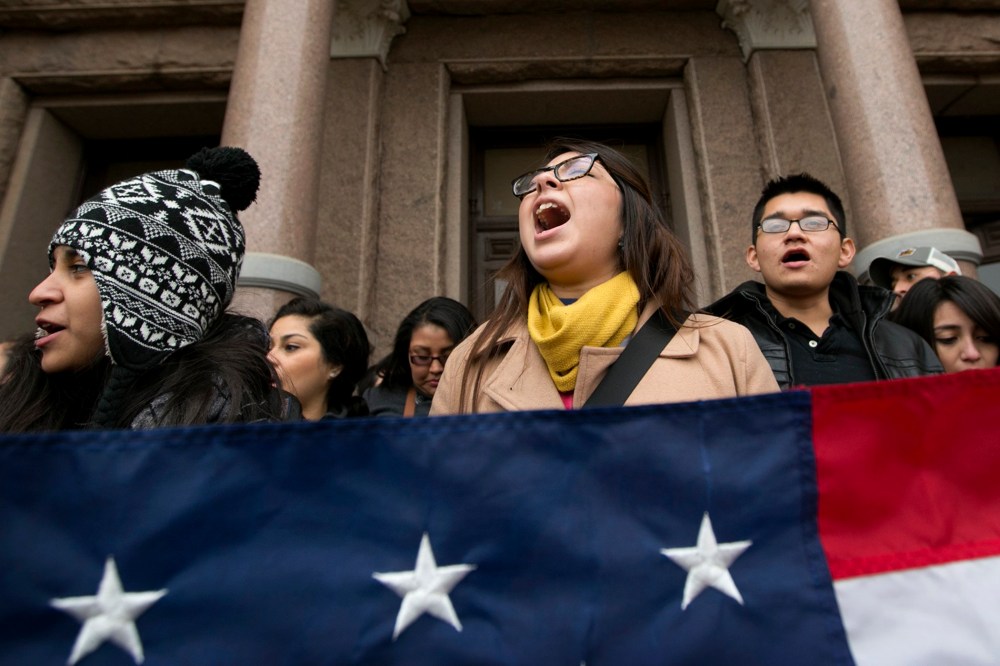
The Republican-dominated Texas Senate held a hearing Monday to consider repealing the state’s DREAM Act, which extends in-state tuition benefits to non-citizens who lived in Texas for at least three years prior to graduating from high school. Nearly 160 people — including many DREAMers dressed in graduation gowns — showed up to the Texas legislature to testify before the Senate panel.
Appearing at the hearing in her purple graduation gown, Lissette Moreno said she was the first DREAMer to testify nearly 15 years earlier during the creation of the Texas Dream Act. Moreno, 31, has since earned two college degrees thanks to the DREAM Act. But on Monday, she was back to defend it. “Unfortunately, it’s in danger of being repealed,” she said, adding that she could barely make ends meet to put herself through college. “Two jobs, sleeping in the car, and all because I was determined to fulfill my dreams.”
Republican state Rep. Donna Campbell, who sponsored the bill to repeal the legislation, said that by rolling back the in-state tuition law, Texas would “end incentives” for illegal immigration.
“It’s just bad policy that rewards illegal immigration in perpetuity,” she said at the hearing.
The legislation has little standing in its way in the state Senate, but it will likely face some opposition in the House. From there, it’s likely that Texas Gov. Greg Abbott would sign any legislation brought to his desk. During his election campaign last fall, Abbott was cagey when asked whether he would champion bringing down the state’s DREAM Act. When pressed, Abbott said he would not stand in the way if the legislature voted for a full repeal.
RELATED: DREAMers vent anger over immigration ruling
Unlike a federal version of the DREAM Act that has languished in Congress, state-level DREAM Acts only deal with secondary education for undocumented immigrants. In recent years, the in-state tuition law currently on the books in Texas has benefited nearly 25,000 students a year. According to the Austin-based, non-partisan group the Center for Public Policy Priorities, non-citizen residents accounted for 1.9% of all Texas students that paid in-state tuition for 2013.
Debate over the DREAM Act in Texas is bound to have ripple effects into 2016, putting Gov. Rick Perry squarely in the hot seat. The three-term Republican governor and likely 2016 contender routinely stuck his neck out in support of the DREAM Act in the more than a decade since he first signed the legislation into law in 2001. But in recent weeks, Perry has kept mum on efforts to repeal the bill, a sign of a yet another shift on pro-immigrant views that were once seen as uncontroversial. Perry made waves in during his first shot at running for president by not just forcefully defending the DREAM Act, but going a step further to condemn those who do not support the efforts. “If you say that we should not educate children who come into our state for no other reason than that they’ve been brought their through no fault of their own, I don’t think you have a heart,” Perry said at a 2011 GOP primary debate. Perry’s not alone — the issue may dog a number of 2016 hopefuls. New Jersey Gov. Chris Christie was the last potential presidential contender to back in-state tuition benefits for non-citizen students. Christie hailed the “inspirational“ children of immigrants as he signed his state’s own version of the DREAM Act last January, calling out his critics as “cold-hearted” for not recognizing the economic benefits of offering the tuition break to immigrant students. RELATED: Steve King confronted by DREAMers in Iowa That same year, former Florida Gov. Jeb Bush threw his support behind the DREAM Act coming to his state. “It is not only the right thing to do, but it will fulfill an economic imperative to keep and capitalize on the talent in our state, making our future workforce more globally competitive than ever,” Bush said in a statement at the time. So far, none of the 2016 contenders has spoken out about efforts to repeal the Texas DREAM Act. Through a spokeswoman, Perry told The New York Times that it was “a decision for the Texas Legislature.”
Amanda Sakuma Recommended


