








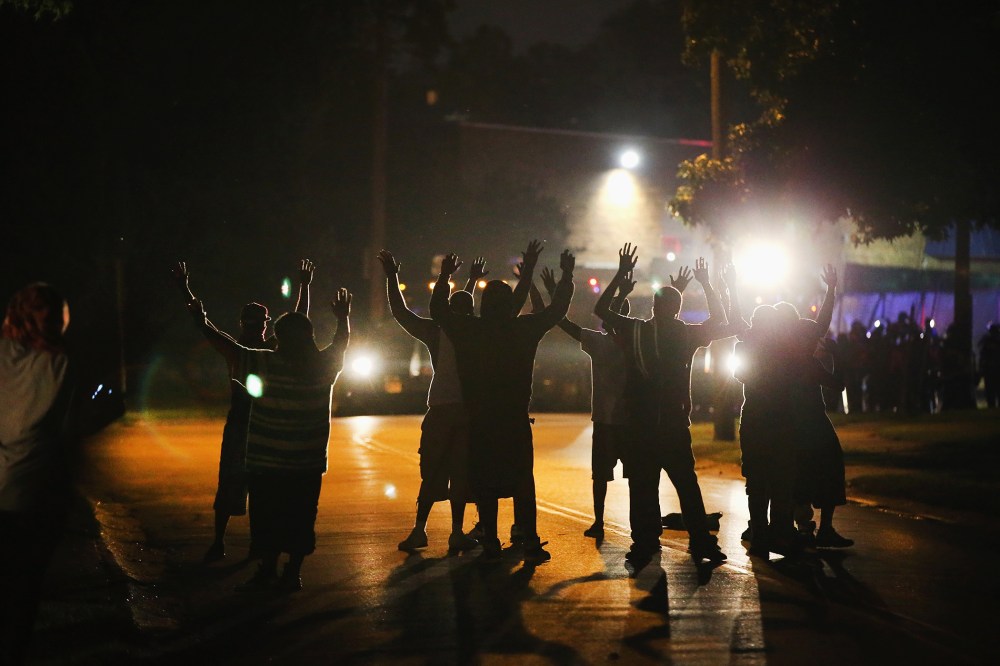
FERGUSON, Missouri — Chris Hardy could hear the sounds of percussion grenades booming from his living room sofa. Tear gas would waft through his apartment complex, as a few blocks away, police launched canister after canister of the stuff at protesters.
Officers toting machine guns would set up blockades all across the neighborhood when night fell, locking down neighborhood residents in a kind of Pandora’s Box filled with police and protesters.
“When they put that curfew down, that’s when it all went really bad,” Hardy, 49, said. “You couldn’t get out. You couldn’t leave your house.”
When protests erupted in the streets of Ferguson in the days and weeks following the shooting death of 18-year-old Michael Brown Jr. by a Ferguson police officer, whole sections of the city were taken over by police and by mostly peaceful yet angry protesters. While the massive crowds have long since dissipated, many local residents — some trapped in their homes during the demonstrations — are still paying the price.
“I done lost my job behind all of this,” said Hardy, a truck driver who lives in the apartment complex where police officer Darren Wilson shot and killed Brown on Aug. 9. “I just couldn’t get out. You’re hearing bullets all the time at night. They had tear gas shooting out. I was just kind of paralyzed.”
For some — it’s unclear how many — gainful employment became one of many casualties in the fallout from the unarmed teen’s death. Some quit paying gigs for non-paying positions on the frontlines of the protests. Others say they were hemmed in by police activity or by fear and lost their jobs because they couldn’t make it to work on time. Still others say their jobs have been threatened because of their support for Michael Brown and his family. A number of officers, some caught aiming weapons at unarmed protesters and the press, have lost their jobs as well.
In Ferguson, tales of employment woe are easy to find.
Stances Taken, Repercussions Felt
A local real estate agent-turned-protester said people, including a police officer, have called her job to complain about her involvement in protests. A former bill collector for a health care company said his boss gave him an ultimatum — either full-time hours at the office or with protesters in the streets. And a dentist hundreds of miles away in Tennessee said her private postings to social media in support of Brown have angered the partners at her dentist office, so much so that she claimed she was squeezed out of the practice.
“I had taken it upon myself to write a few posts on my own social media account about how I felt about it, and that enough professional people weren’t stepping up about it and instead were leaving it to people to take to the streets,” Dr. Misee Harris, the dentist from Tennessee, told msnbc.
RELATED: Hip-hop’s anthem in Ferguson
Harris, 29, said about a month after Brown’s shooting her bosses pulled her into a tense meeting that felt more like an ambush.
“Do you think we are all like this?” Harris, the only black dentist in the office, recalled one of the partners asking. At the end of the meeting Harris said she was told either to stop commenting publicly or privately about Ferguson, or resign.
She chose to resign.
Leigh Maibes, a Ferguson-area real estate agent said she’d been demonstrating in Brown’s name for months and that she received email threats and people have told her they wouldn’t use her as an agent because of her involvement in the protests. Others have threatened to expose her as anti-cop to the community and to her employers, who surely wouldn’t appreciate the bad publicity, she said.
Users on one pro-police message board, St. Louis Cop Talk, have been particularly active and aggressive in denouncing Maibes.
In one post from as recent as last week, a poster embedded a photo of Maibes along with her contact information at work under text that read: “As a public service we would like to advise all St. Louis City employees, especially first responders, not to use this Realtor. She does not support us. We should not support her.”
In another post last week, one person used insulting language to describe Maibes physical appearance. On Oct. 21, yet another poster, who suggests that he is a police officer, wrote that officers should protest outside of her employer’s office during working hours.The post concludes with: “We can even support officer Wilson and make signs saying ‘Leighs gotta go, fire the stinky hoe.’”
A police officer recently went as far as to call Maibes’ boss to flag him about posts she had placed on her personal Twitter account that were critical of the police response to protesters.
“I’m not sure how being pro-First Amendment and anti-tear gas and anti-military tactics makes me anti-police,” said Maibes, 33, who has helped organize supplies and donations for protesters in addition to taking part herself. “But I’m willing to do whatever it takes to be on the right side of history.”
RELATED: Governor unveils plan for the future of Ferguson
After she got word that an officer had contacted her employer, Maibes reached the officer by telephone and recorded the conversation. The officer, identified as St. Louis city police officer Keith Novara, acknowledged he had contacted Maibes’ boss.
In a video of the conversation posted to Youtube, Novara is heard saying he had warned Maibes’ boss that local business owners were upset about her activism around the Brown case and might be “blowing up” her phone line. Maibes now says the officer’s actions were nothing short of harassment and that she fears for her safety.
Maibes employer declined to comment for this article. The St. Louis Police Department Internal Affairs are now investigating her claims.
After Maibes posted the video of her conversation with Novera on social media, the St. Louis Police officers Association released a statement responded to her allegations. “We’ve confirmed that a complaint was filed with Internal Affairs against our member, Keith Novara,” Jeff Roorda, the union’s business manager said.
The police union said it has hired an attorney that specializes in First Amendment rights to represent Officer Novara.
“It is confounding to us as an organization of law enforcement professionals that apologists for the so-called ‘peaceful protestors’ in Ferguson … defend throwing bricks, bottles and rocks at police officers as ‘freedom of speech or freedom of expression,’” Roorda said. “Then, those very same people feign righteous indignation when a police officer who is fed up with the corrosive, anti-police rhetoric that this particular agitator has made in a public forum on social media, exercises his freedom of speech and freedom of expression in a truly peaceful manner.”
“Police officers are not second-class citizens,” Roorda added in the statement. “They enjoy First Amendment rights and every other right that is enjoyed by every other citizen and we will aggressively defend those rights to our last breath.”
‘Seems Like We Are Stuck’
Long before Brown’s killing, Ferguson had struggled with stubbornly high unemployment — a problem that has only gotten worse as poverty in nearby St. Louis has spread into the suburbs.
Unemployment in Ferguson rose from less than 5% in 2000 to more than 13% in 2012, an analysis by the Brookings Institution found. Over the same time the poverty rate skyrocketed with a quarter of the population living below the poverty line. Between 2000 and 2010, the number of households in Ferguson using federal Housing Choice Vouchers climbed from about 300 to more than 800. Unemployment for black residents is about three times that of white residents.
The recent events in Ferguson have exacerbated many of the economic and social issues facing Ferguson’s most vulnerable. The start of the school year was delayed for a number of area schools. Many stores closed voluntarily or were looted or burned, leaving employees and store owners temporarily without income.
A state program set up to help small businesses affected by the unrest in Ferguson has awarded more than $200,000 in zero-interest loans to 17 small businesses, 15 of which state officials say are owned by minorities or women.
RELATED: How Ferguson unfolded seen in photographs
The St. Louis chapter of the National Urban League recently held a job fair at St. Louis Community College’s Florissant Valley campus, located just three miles from where Brown was killed. The job fair attracted more than 100 employers and about 5,000 job seekers showed up. Demand for face time with employers was in such demand that the job fair ran an hour late.
The Urban League, expressing concern over the Brown case’s economic impact on the St. Louis area, has launched Save Our Sons, a partnership with area businesses to find jobs in the area for 500 black men.
“It just seems like we are stuck,” job seeker Damon Williams told the St. Louis Post-Dispatch at the time. “People are getting fed up.”
Conflict Leads to a Decision
Larry Fellows III worked as a biller for a local healthcare company in the days before Brown was killed. After the incident, Fellows said he joined scores of protesters who’d poured into the streets. “I was out there every day all day talking to people, talking to politicians, talking to other protesters trying to strategize and organize,” Fellows said. “Then it became a full-time job.”
In the meantime, he was still employed by the health care company. He’d check in with work daily and give them updates. Fellows, 28, said he was honest with his employers. “I’d call and say, this is what I’m doing. I’m not calling in sick but mentally I won’t be able to come because I can’t focus,” Fellow said. “My mind is not at work — it’s outside.” Half-days turned into no days, he said. The longer and hotter the protests became the less he found his way back to his office. Then, about 10 days after the shooting, Fellows said he was arrested while protesting. After being released from jail he took the paperwork from his arrest to his manager. She told him to “take some time to get your life together and figure out what you want to do.” “I was going through a lot mentally trying to figure everything out,” Fellows said. A conversation with his mother helped him focus. “She said, ‘What do you want to do, because you’re about to risk a lot,’” he said she told him. At that moment Fellows said he knew exactly what choice he would make. “I thanked them for the job, the opportunity and I left,” Fellows said. Since then Fellows has become a leader among a group called Millennial Activists United, a young, engaged group of protesters who of late have led some of the more meticulously planned acts of civil disobedience in Ferguson and St. Louis. He has been arrested again and basically works full-time with activists organizations involved in ongoing protests. Fellow is still unpaid. “I’m good right now,” he said. “I’m not in negative standing or past due right now. But this is still just the beginning of the month.” He says he’s applied for various service jobs— Nordstrom’s, AT&T, Verizon, Nordstrom’s Rack— but hasn’t gotten any serious bites. “Every day people tell me, maybe you should look into a position where you can still do this kind of work,” Fellows said. “But at this point I can’t do a normal job because it’s hard to focus on normal work when I’m as focused as I am with this, with justice.” From Ferguson to Tennessee, Brown Supporters Stung Umar Lee, a local cab driver and veteran of the Ferguson protests, said he feels as if there’s an invisible target on his back. Lee said he went to renew his taxi driver’s license last week and that, when he walked into the office, he was greeted by a wave of smirks. Lee said someone even smiled wryly and said, “We know who you are, Mr. Lee.” He’s heard from management at his job that pro-police groups are putting pressure on the owner to fire him. %22I%E2%80%99ve%20been%20able%20to%20work%20enough%20to%20keep%20my%20head%20above%20water.%20But%20to%20have%20that%20threatened%20over%20political%20reasons%20is%20crazy.%22′ Like Maibes, Lee has been the target of online attacks. He is a white convert to Islam, and much of the insults he’s received have to do with his religion, race or his support of Brown, who is African-American. Lee shared a number of threatening messages he’s received via social media with msnbc. In one, a poster under the name Kenneth Flaig wrote that he hoped Lee would “chew on glass and [expletive] die. Another poster who sent a message under the name Melissa Dawn Duniphan, warned Lee to stay out of Troy, Missouri. The same person posted an image of seven black bodies — silhouetted and hanging by their necks from a tree under a setting sun — along with the words: “A system cannot fail those it was never built to protect.” “I haven’t been fired but the owner doesn’t want to lose any business,” said Lee, 40. “He feels the pressure.” Lee said anonymous antagonists have called his cab company, Laclede cabs, and even started an email campaign calling for a boycott of the company until he is fired. When reached by phone on Friday, Kenny Whitehorn, general manager at Laclede cabs where Lee is employed, said that he was not at liberty to comment at this point, acknowledging the “sticky” nature of the matter. Lee said he’s already losing income because he’s cut his time behind the wheel of his cab by more than half — from about 90 hours a week to 40 hours — so that he can continue protesting. “It’s difficult because I have kids, I have responsibilities, I have bills,” Lee said in a recent telephone interview. “I’m on a thin margin as it is because I’ve spent so much time with the movement, but I’ve been able to work enough to keep my head above water. But to have that threatened over political reasons is crazy. People act politically active on a thousand different issues. Why do law enforcement supporters think they can bully people at their whim?” RELATED: Amnesty International slams Ferguson over human rights abuses Three hundred and sixty-five miles from Ferguson in Columbia, Tenn., Harris, the dentist, said her troubles began when someone masquerading as a friend on Facebook had instead been spying on behalf of the partners at the dental practice. She said one post in particular riled the partners at her office. Harris said after being pulled into a hastily called meeting with the partners, one of them held up a printout of a cartoon drawing she’d posted to her Facebook page. The cartoon was of a young black boy holding a target over his chest just below the words “Open Season on Black Folks.” All around the little boy were other words, perhaps justifications for violence against blacks, including: Driving! Playing Music Too Loud! Wearing Saggy Pants! Going to School! Wearing a Hoodie! Car Broken Down! The partners pressed her on the meaning of it all and expressed their displeasure with her making her sentiments public, Harris said. She said she tried diplomatically to explain all of this to them. “This issue going on with African-American men and being unarmed and killed definitely hit home. I have two brothers,” Harris said. “I sympathize with these people and empathize with those families that are losing their children for these ridiculous reasons.” But after a few minutes the partners interrupted her, she said. “They thought it was inappropriate and that African-American news and controversial issues were not something they were going to deal with,” Harris said. Multiple calls to Harris’s former employer seeking comment on Harris’s assertions were not returned. Harris has since moved to Los Angeles and plans on filing a lawsuit against her former practice. “This makes me sad for all the people that don’t have the financially ability to just leave the way I did,” said Harris, who last year made news when she waged a publicity campaign to become the first black “Bachelorette” on ABC’s hit show. “They have to stay and keep their mouth shut because they are so afraid that they will get fired and won’t have their First Amendment rights.”
Trymaine Lee
Trymaine Lee is an NBC News correspondent. Recommended


