








In a unanimous opinion, the Supreme Court struck down a Massachusetts law Thursday that set a 35-foot buffer zone around abortion clinics, saying it violates the First Amendment. Massachusetts had argued that the buffer zone, which anti-abortion protesters said violated their free speech rights, keeps patients and clinic staff safer.
“The buffer zones burden substantially more speech than necessary to achieve the Commonwealth’s asserted interests,” Chief Justice John Roberts wrote on behalf of the court in McCullen v. Coakley. He conceded that Massachusetts has “legitimate interests in maintaining public safety on streets and sidewalks and in preserving access to adjacent reproductive healthcare facilities,” but ultimately “impose serious burdens on petitioners’ speech, depriving them of their two primary methods of communicating with arriving patients: close, personal conversations and distribution of literature.”
The immediate impact of the decision will be on Massachusetts, but advocates expect that similar fixed-distance buffer zones in other states, including one currently being challenged in Maine, will be next.
“If you were a betting man,” said Roger Evans, senior counsel at Planned Parenthood Federation of America, “you would bet that they would all go.”
The Supreme Court stopped short of declaring that the law discriminated against the anti-abortion viewpoint. Nor did it overrule its precedent in a 2000 case upholding a Colorado no-approach law. As such, said Evans, “the silver lining to the court’s opinion is that it does not set the stage for even further erosion of the protective measures outside abortion clinics.”
The ruling disappointed abortion rights advocates, but it did not surprise them. Less expected was the unanimity. Both Justice Ruth Bader Ginsburg and Justice Sonia Sotomayor had signaled sympathy for the law in oral arguments, with Ginsburg remarking that the state “doesn’t know in advance who are the well-behaved people and who are the people who won’t behave well. After the disturbance occurs, it’s too late.” But besides concurrences by Justice Antonin Scalia and Justice Samuel Alito, who complained that the court did not go far enough, the court spoke as one.
A decision in another case concerning access to reproductive health — Hobby Lobby v. Sebelius, taking aim at contraceptive coverage under the Affordable Care Act – is expected on Monday.
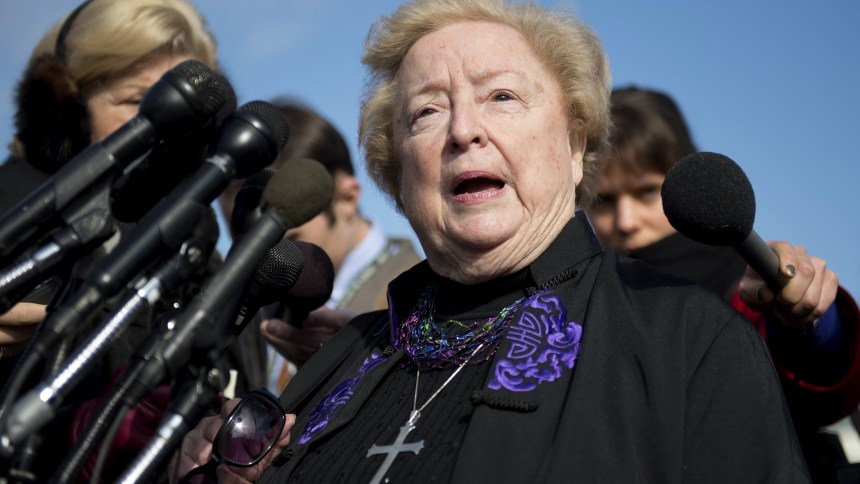
The main plaintiff in the buffer zone case, an elderly grandmother and self-described “sidewalk counselor” Eleanor McCullen said in a statement Thursday, “I am delighted and thankful to God that the court has protected my right to engage in kind, hopeful discussions with women who feel they have nowhere else to turn.”
The court’s decision accepted McCullen’s lawyers’ characterization that what was at stake was “personal, caring, consensual conversations with women,” which were harder to have at a distance. On Thursday, pro-choice activists and clinic workers begged to differ, using the hashtag #protectthezone to describe their experiences.
“Our patients are free to talk to whomever they wish to talk with about their medical care, but this is essentially compelling them to engage with the protesters, or be screamed at,” said Marty Walz, CEO of Planned Parenthood League of Massachusetts, who, as a state legislator, co-sponsored the law in question.
Abortion rights supporters had been pessimistic when the Supreme Court agreed to hear the case. There was no split in the lower courts, one usual prompt for the Supreme Court, and both the district court and the First Circuit Court of Appeals had ruled that the Massachusetts law was constitutional under the Supreme Court’s own precedent in a 2000 case. “The law does not require that a patient run a public-sidewalk gauntlet before entering an abortion clinic,” the three-judge panel of the First Circuit had concluded, adding, “First Amendment rights do not guarantee to the plaintiffs (or anyone else, for that matter) an interested, attentive, and receptive audience, available at close-range.” According to a survey of members of the National Abortion Federation, 51% of facilities with a buffer zone said they saw criminal activity drop after it was put in place. Three quarters said it had “improved patient and staff access to the facilities.” In the same survey, 92% of facilities said they are concerned about their patients’ safety approaching the facility, said the group’s president, Vicki Saporta. “No one should be forced to endure harassment, violence, obstruction, or intimidation when they visit a medical facility,” said Physicians for Reproductive Health board chair Nancy L. Stanwood in a statement, adding, “We respect the right of those who disagree with us to voice their opposition; however, we believe that the same respect should be afforded to the right to access health care services free from harassment and violence.” The American Civil Liberties Union was in a trickier place. It had come out against the last abortion buffer zone case before the Supreme Court, Hill v. Colorado, but supported the Massachusetts law as a balance between competing constitutional rights to free speech and to access an abortion. “We agree that a fixed buffer zone imposes serious First Amendment costs, but we also think the court underestimated the proven difficulty of protecting the constitutional rights of women seeking abortions by enforcing other laws – especially regarding harassment – outside abortion clinics,” said Steven R. Shapiro, the group’s legal director, in a statement.
Irin Carmon Recommended


