








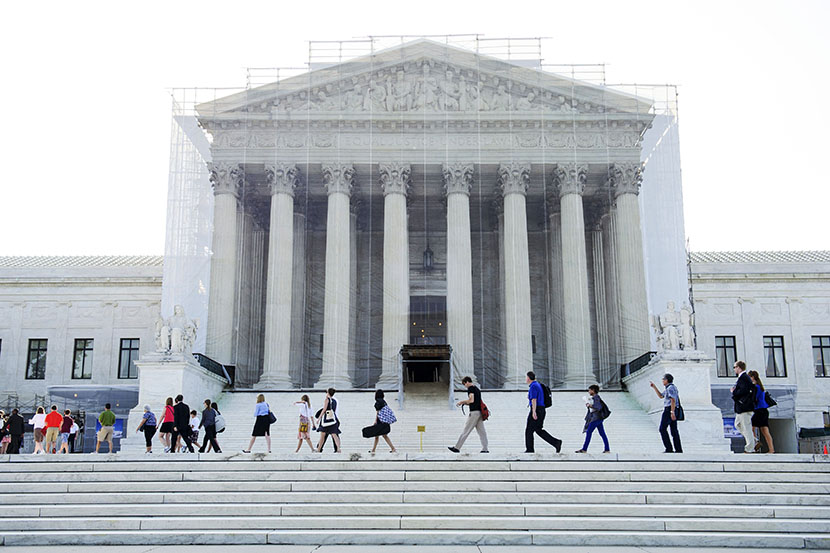
It took the Supreme Court eight months to punt on affirmative action.
“The court backed away from the edge of a cliff,” said David Gans of the liberal Constitutional Accountability Center. “I think everyone was expecting this was going to be a huge ruling that would cut back on what universities could do to use race to pick a diverse student body.”
The high court’s 7-1 decision, issued Monday, came as a surprise to longtime court watchers who expected the conservative majority on the court to strike down or further narrow the ability to use race as a factor in college admissions. With Justice Elena Kagan having recused herself, the Republican appointees could have easily commanded a majority. The case was heard in October, and yet, after all those months, the opinion was surprisingly narrow: a simple restatement of current law and and a demand for the lower federal court that originally heard the case to do so again. Justice Ruth Bader Ginsburg dissented, saying she would have sided with the lower court ruling upholding the University of Texas-Austin’s admissions policy.
“There’s no way it took eight months to write this 10-page opinion that mostly restates existing law,” said Adam Winkler, a professor at University of California-Los Angeles School of Law.
So what happened? The Supreme Court–unlike the NSA, apparently—is famously airtight when it comes to leaks, but Winkler had one idea. “I think the conservative justices were ready to write a radical opinion that rewrote half a century of case law, and [Chief Justice] John Roberts got cold feet,” he said.
The case involved a former University of Texas-Austin applicant, Abigail Fisher, who claimed that she didn’t get into UT-Austin because she was white. The university said her grades just weren’t good enough.
After implementing a “race-neutral” program called “Top Ten Percent,” which offered the top 10% of students from each public school in the state automatic admission, UT decided it needed to do more to diversify the student pool. The new process took account of race as one factor among many in an effort to ensure that it complied with strict rules set by the high court about how schools are allowed to seek diversity. Fisher’s challenge case was orchestrated by Edward Blum, a wealthy conservative whose crusade against race-conscious government policies includes the Voting Rights Act case the Supreme Court will soon decide.
Related: How Section 5 stopped a modern day ‘poll tax’
The court’s ruling Monday means that universities can continue using race as a factor in admissions–for now. It could take years for the Supreme Court to hear the case again, and even then, they could refuse to do so. The court is set to hear another affirmative action-related case this fall.
If Justice Clarence Thomas had his way, however, the court would have swept away decades of case law on affirmative action and struck it down entirely. In his concurrence, Thomas likens supporters of affirmative action to those who supported slavery, segregation in public education, and the Confederacy itself.
“Slaveholders argued that slavery was a ‘positive good’ that civilized blacks and elevated them in every dimension of life,” wrote Thomas. “Segregationists likewise defended segregation on the ground that it provided more leadership opportunities for blacks.” The conclusion? Supporters of affirmative action may be trying to help, but their arguments are comparable to those who favored keeping human beings as chattel or preserving the purity of the white race by keeping whites and minorities separate. This is based on Thomas’ view that the 14th Amendment, which mandates equal protection under the law, makes no distinctions between race-conscious policies that are designed to help minorities and those designed to hurt. Winkler and Gans point out that the framers of the 14th Amendment deliberately undertook race-conscious policies to better the economic status of freed slaves, such as the Freedman’s Bureau. They made a moral distinction between efforts to subjugate minorities and those meant to help them, even if Thomas doesn’t. “The framers of the 14th Amendment were the fathers of affirmative action,” explained Gans. “[At] the very same time the 14th Amendment was enacted, the framers of the 14th Amendment were writing the first race-conscious programs.” Thomas’ view, however, did not carry the day, and affirmative action will survive, at least for now. “It’s amazing that he would equate affirmative action policies with slavery, it’s so tone deaf and ahistorical,” says Winkler. “Thomas has once again proven himself an Originalist only in the sense that he has his own original view of the Constitution.”
Adam Serwer Recommended


