








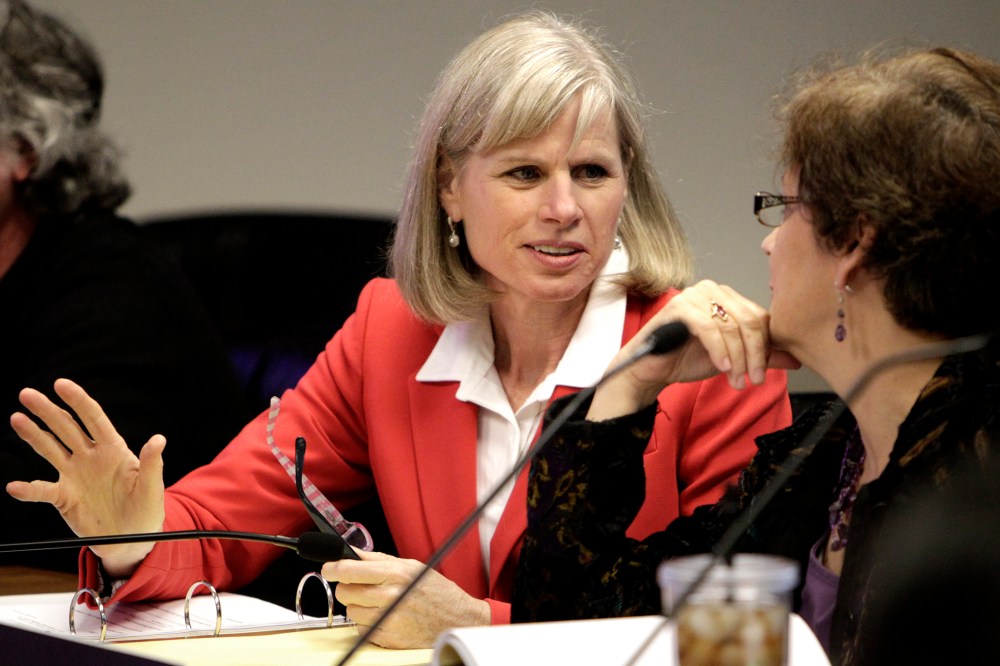
Wausau, WI – Mary Burke knows unseating Republican Gov. Scott Walker will take a lot more than just being an alternative to the controversial leader.
It’s something Burke, Walker’s all but certain Democratic challenger, hears a lot. Wisconsin voters first elected Walker in 2010 and rebuffed a labor-backed effort to recall him in 2012. But he remains a polarizing figure in the state, and the key question now is whether Burke can define herself and her vision clearly and passionately enough to pull off an upset victory.
“I would not have gotten into this if I didn’t think that I was going to win,” Burke, 54, told msnbc.
For his part, a tough re-election fight against a promising Democratic challenger certainly wasn’t what Walker had in mind.
After surviving the recall election sparked in part by his crusade against public sector unions, Walker became a GOP hero and likely 2016 contender whose home state borders Iowa, home to the kickoff presidential caucuses. A decisive re-election win was supposed to position his national takeoff; instead, polls have shown him neck and neck with Burke, a former business executive and relative political newcomer.
Speaking to a room of voters here at the 2510 Restaurant, a bakery and diner in Wausau, a river town of 38,000, Burke made clear she’s prioritizing problem solving over partisan spite. But with efforts still focused on small-scale meetings throughout the state with local leaders, it’s still too early to see if that pragmatic approach can connect more broadly.
With seven months until the election, Burke faces the challenge of convincing voters that she is “someone to vote for, instead of just someone not to vote for,” as one young activist at the early morning coffee event put it.
Howard Schweber, a professor of political science at the University of Wisconsin-Madison, echoed that view.
“Burke has an uphill road,” Schweber told msnbc. “She has to find a way to demonstrate that she has principles and character and a story of her own rather than permitting the race to be turned into a referendum on Walker.”
National organizations on both sides seem to be taking Burke’s bid seriously. The Republican Governors’ Association began airing negative TV ads against her in February. In just three months, Burke has amassed a $1.79 million for her campaign war chest.
But even with that strong start, not to mention her own personal fortune and the support of Emily’s List, Planned Parenthood and other progressive organizations, conservative interest groups are expected to pour millions into the race.
A graduate of Georgetown and Harvard Business School, Burke spent 12 years working for Trek Bicycle, a Wisconsin-based manufacturer her family founded and operates.
Burke’s experience at Trek is the best known part of her biography, but it’s been nearly a decade since she left the private sector. She served for two years as the state’s commerce secretary under Walker’s predecessor, Democratic Gov. Jim Doyle. Since 2007 she has focused on philanthropy, and she won a seat on the Madison School Board in 2012.
While details of Burke’s platform are still coming into focus, her resume suggests someone intelligent and thoughtful, if not a progressive heroine.
Burke has made education a centerpiece of her campaign, and she strongly opposes Walker’s effort to expand the state’s school voucher program.
“If we’re going to drain money away from our public schools to pay for an entirely different school system, we’re in trouble,” she told msnbc.
Burke also wants to tackle the cost of higher education and has proposed creating a state authority to help people refinance their student loans as they would other types of debt.
Burke is an unequivocal supporter of the Affordable Care Act and wants to expand Medicaid in the state, which Walker has refused to do. She opposes new laws that will drastically reduce access to reproductive health care services and could close two of the state’s four abortion providers.
“I just believe very firmly that women should have the freedom to make their own health choices,” Burke said in an interview last year. “I think we have to make sure that the freedoms that women have enjoyed are ones that they are able to enjoy in the future. This is just standing up for what that I think is right.”
The issue most likely to take priority in this year’s election is one that has already caused problems for Burke’s campaign: jobs. Burke has criticized Walker for falling down on job creation in the state and promises to jump start the state’s economy. She has also supports raising the minimum wage to $10.10 an hour. But her campaign was slow to release its own job creation plan, waiting to do so until just last week. Walker’s campaign had seized on the apparent delay in putting out specifics to attack Burke for not prioritizing middle class workers. Burke insists the economic plight of Wisconsin’s workers was too important to hurry. “This is a jobs plan that not only will I run on, but it’s the one that will provide my game plan when I’m governor. So it has to be well thought out and it isn’t something that I’m going to rush,” she told msnbc. Walker promised to create 250,000 jobs when he first ran in 2010 and has fallen well short of that number. Numbers released last week put Wisconsin 35th out of 50 states in private sector job creation, adding only 28,351 jobs between September 2012 and September 2013. Burke’s campaign may well be hampered by voting rights restrictions in the state that Walker has championed. He has signed into law a series of voting restrictions that could disenfranchise students, elderly and disabled residents, and communities of color. In addition to a voter ID law currently facing a court challenge, Walker signed a bill eliminating weekend and nighttime early voting on March 27. “It makes absolutely no sense to put barriers in front of people to vote,” Burke said. “We want people voting, we want people participating in our government and feeling like they have a voice.” Whether Burke is talking about jobs or education or the need for more cooperation during the legislative process, it is impossible to ignore the outcome of Walker’s war on public employee unions. Act 10, the 2011 law Walker championed that curtailed public sector unions’ rights drove hundreds of thousands of people to protest outside the state capitol in the middle of winter and spurred the recall effort. Walker is the only governor to survive a recall election. While Burke has said she does not want to revisit the issues of the recall, the law and its effects on Wisconsin’s economy will be a huge part of the campaign. While she says she would restore collective bargaining and other related rights in a way that “does not stand in the way of making sure our government is efficient and accountable,” she would not repeal the law because she supports the provisions that increased employee contributions to pensions and health care. If she wins in November, Burke would still be one of only a handful of women governors, and Burke says changing that balance could help change the political climate, both in Wisconsin and nationwide. “I think women approach issues and problems differently than men, we might be more open to working together,” Burke told msnbc. “Leadership is about bringing people together so we can do our best work. It’s about putting problem solving ahead of politics. That’s my approach, and I think it’s an approach that people appreciate.”
Meredith Clark
Meredith Clark is a freelance writer and editor. She was previously a senior news producer for "Patriot Act with Hasan Minhaj," a reporter with MSNBC.com, the digital politics and culture editor at Glamour and a senior news and politics editor at Refinery29. She has written for Vulture, Rolling Stone, Self, Marie Claire, Cosmopolitan, The Daily Beast and Bustle. Recommended


