








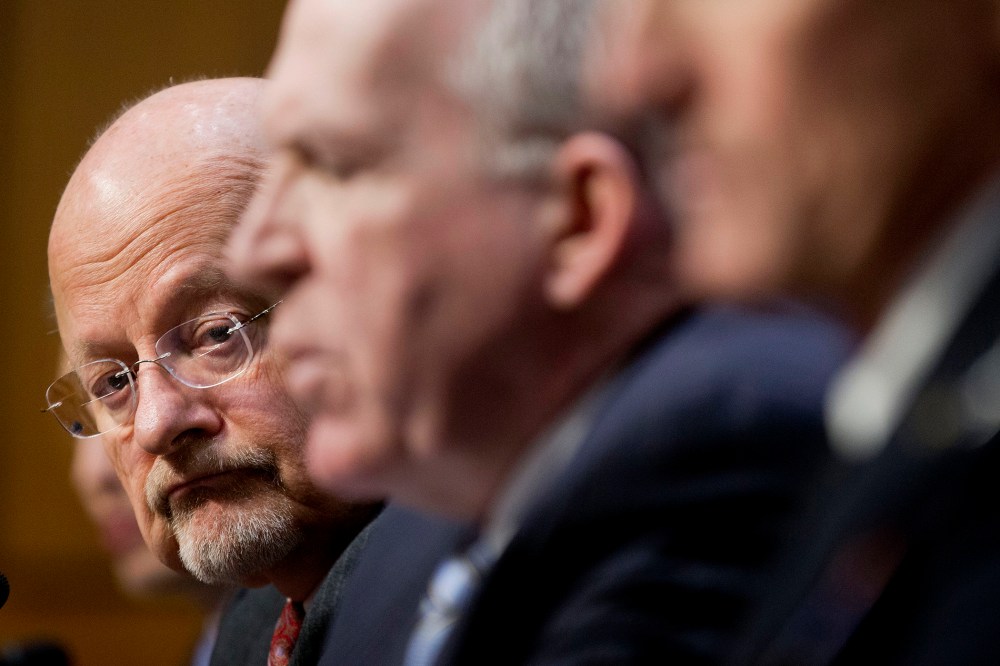
The head of the American intelligence community on Wednesday called on former National Security Agency contractor Edward Snowden and his “accomplices” to return the top secret documents Snowden had taken.
“Snowden claims that he has won and his mission is accomplished,” James Clapper, the director of national intelligence testified before the Senate at an intelligence committee hearing. “If that is so, I call on him and his accomplices to facilitate the return of the remaining stolen documents that have not been exposed to prevent even more damage to U.S. security.”
It’s unclear if by “accomplices,” Clapper was referring to journalists who had published stories related to the documents, which would include reporters at The Guardian, The Washington Post, and the New York Times, and other news organizations, or whether he was implying that Snowden had outside assistance in acquiring and leaking the information itself.
An attorney for Snowden, Jesselyn Radack of the Government Accountability Project, said Snowden was not in possession of any of the documents he took. “I can say absolutely, Edward Snowden is not in possession of any more information, he has not had the information since he left Hong Kong,” Radack said. The U.S. has charged Snowden with espionage. He is currently in temporary asylum in Russa.
Wednesday’s hearing was called to assess “projected national security threats to the United States. Hours before Wednesday’s special Senate intelligence committee hearing on worldwide threats, Republican South Carolina Sen. Lindsey Graham had already summarized the proceedings.
“The world is literally about to blow up,” Graham told The Hill Tuesday.
Senators presiding over Wednesday’s hearing didn’t quite go that far. But sensing that the public is growing increasingly skeptical of government overreach in the fight against terrorist groups, senators supportive of the National Security Agency’s surveillance programs framed the world as a dangerous place that would only grow more perilous if the agency’s authority is curtailed. With legislators in both chambers pushing legislation to either codify or reform laws related to spying, the undertone of the hearing was senators seeking to persuade their colleagues that attempts to narrow the government’s surveillance authorities could have dire consequences.
California Democratic Sen. Dianne Feinstein, the chair of the committee and a defender of the NSA, warned that the success of intelligence agencies had led to “a popular misconception that the threat has diminished. It has not.” In fact, Feinstein said, “terrorism is at an all time high,” pointing to statistics from the University of Maryland’s National Consortium for the Study of Terrorism and Responses to Terrorism (START) showing that “there were more than 8,400 terrorist attacks killing over 15,400 people in 2012.”
Feinstein noted that number included “attacks by groups like the Taliban against the U.S. military and our coalition forces,” but there’s more to it than that. According to START, three countries, Iraq, Afghanistan and Pakistan accounted for “more than half of 2012’s attacks (54%) and fatalities (58%).” The next most affected countries were “India, Nigeria, Somalia, Yemen and Thailand.” Terrorist groups have been less and less successful in targeting the West, let alone the United States.
Matthew Olsen, head of the CIA’s National Counterterrorism Center, acknowledged that most of these groups, whether connected to al Qaeda operationally or ideologically, are pursuing a “largely local or regional agenda, in other words they don’t pose a threat to us, at least not now,” Olsen said during the hearing.
Analysts disagree as to whether those more “regionally focused” groups can or will ultimately threaten the United States. Some, like al Qaeda in the Arabian Peninsula, have already tried to attack the U.S. The problem for supporters of maintaining the NSA’s current authorities, however, is that one of the key shifts in politics since publication of former NSA contractor Edward Snowden’s leaks began is that people are less likely to conflate a more aggressive government response to terrorism with an effective one. That is, even if Americans agree with Feinstein that the world is more dangerous now, it doesn’t necessarily mean that they think the NSA’s activities actually make America safer. The public debate sparked by Snowden has brought a level of scrutiny to the effectiveness of surveillance policy that hadn’t previously occurred. Two government panels of experts concluded that the NSA’s bulk collection of telephone communications metadata had not made a meaningful contribution to stopping terrorist attacks. A federal judge came to the same conclusion, and when a different federal judge said the program was effective, he relied on a list of terror plots supposedly foiled by the NSA that had already been picked apart by the media as misleading. Intelligence agencies are still fuming over those disclosures, which intel chiefs say have done irreparable harm to national security. For better or for worse, Snowden’s leaks have certainly altered the regular post-September 11th political calculus. In a different time, simply saying that the threat of terrorism had grown would be enough to persuade legislators to support reauthorization of broad national security laws without a second thought. That just isn’t true anymore.
Adam Serwer Recommended


