








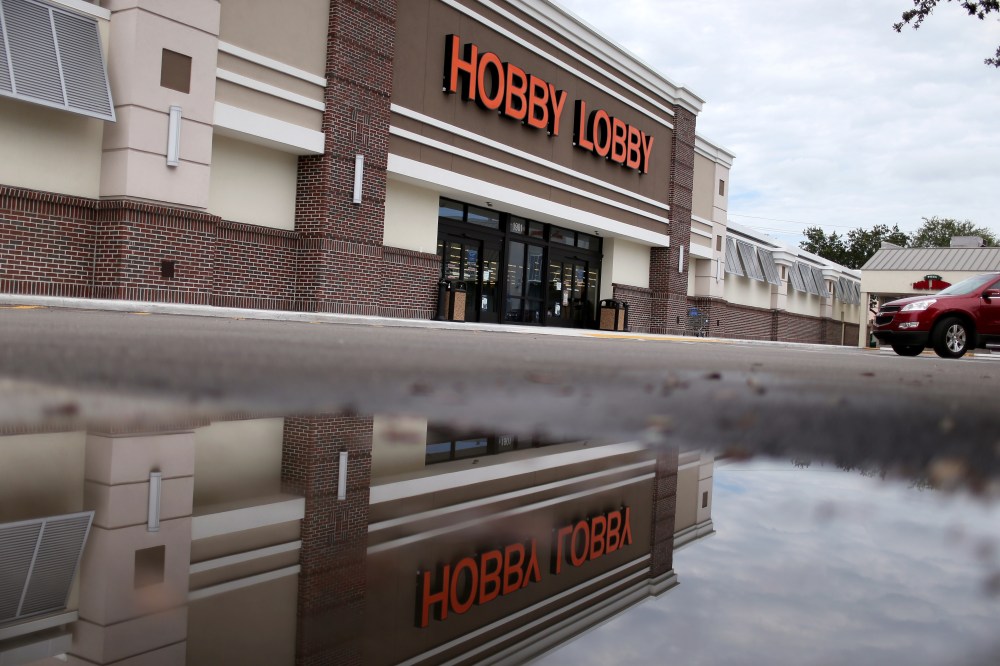
On Monday, the Satanic Temple drew headlines for declaring that, in the wake of the Supreme Court’s decision in Burwell v. Hobby Lobby Stores, it was “asserting a religious exemption from the burden of state mandated ‘informational’ abortion materials for those who share their deeply held beliefs.”
In other words, they wanted a conscience clause from laws intended to dissuade women from having abortions by mandating an ultrasound or that a doctor impart biased or medically-inaccurate information about abortion.
The Satanists stated that they believe “the body is inviolable subject to one’s own will alone,” and, they “strive to make all decisions regarding personal health based on the best scientific understanding of the world, regardless of the religious or political beliefs of others.”
“We will follow up with a legal suit if and when the exemption fails to be respected or recognized,” Lucien Greaves, a spokesman for the Satanic Temple, told msnbc. “We are not looking to proactively sue to have informed consent laws repealed.”
But the Satanists are hardly the first to use religion to make an affirmative argument for reproductive rights. For decades, pro-choice activists have been trying to make a religious claim for their view – and generally failing.
%E2%80%A6%20Pagans%2C%20Christians%2C%20Jewish%20women%2C%20Muslims%20%E2%80%93%20anyone%20religious%20who%20chooses%20an%20abortion%20as%20a%20matter%20of%20conscience%20%E2%80%93%20should%20claim%20exemption%20from%20laws%20that%20burden%20their%20choice.’
In fact, the Religious Freedom Restoration Act (RFRA), the law under which Hobby Lobby won, was originally opposed by anti-abortion activists and members of Congress who feared it would be used to make that very argument: That access to abortion, and the right of every woman to plan her family, was a matter of religious conscience.
The fear was such that in 1992, when the bill was first discussed, an “abortion neutral” amendment was offered. Stephen J. Solarz, one of the authors of the act, testified before the House Judiciary Committee that he opposed such an amendment, because “we would, in effect, be selecting among potential free exercise claims and choosing a higher level of protection for the ones a majority of Congress approves, and a lower level of protection for the less popular ones.”
The question was mooted when the Supreme Court affirmed the right to an abortion with Planned Parenthood v. Casey, later that year. The bill passed the following year, and was later embraced by the same opponents of abortion and contraception that had doubted it — including the United States Conference of Catholic Bishops.
Even before RFRA, pro-choice activists were trying their luck in the courts with religious claims. In 1980, they argued before the Supreme Court that the Hyde Amendment, the federal ban on funding abortion, violated the free exercise of religion, among other violations.
A lower court did take it seriously, noting that “the evidence makes clear that in the Conservative and Reform Jewish teaching the mother’s welfare must always be the primary concern in pregnancy, that the fetus is not a person, and that abortion is mandated to preserve the pregnant woman’s health. The American Baptist Church position recognizes that abortion should be a matter of responsible personal decision, and it envisages danger to the physical or mental health of the woman, evidence that the conceptus has a physical or mental defect, and conception in rape, incest or other felony as justifying abortion. The United Methodist Church affirms the principle of responsible parenthood and takes account, in the abortion context, of the threat of the pregnancy to the physical, mental and emotional health of the pregnant woman and her family; in that belief continuance of the pregnancy is not a moral necessity if the pregnancy endangers the life or health of the woman or poses other serious problems concerning the life, health, or mental capability of the child to be.” The Supreme Court didn’t bite, writing in Harris v. McRae that among the plaintiffs, “none alleged, much less proved, that she sought an abortion under compulsion of religious belief.” But now that the Supreme Court has opened the door to more robust religious exemptions under RFRA, there might be a new opportunity for supporters of abortion rights to try their luck. “I do think that religious women of all stripes, Pagans, Christians, Jewish women, Muslims — anyone religious who chooses an abortion as a matter of conscience — should claim exemption from laws that burden their choice,” Priscilla Smith, who argued two reproductive rights cases before the Supreme Court, told msnbc. “I would attack Medicaid funding bans first because of the enormous burden they place on women with limited resources.” Smith published a paper this year in the Journal of Law and Policy arguing that if Hobby Lobby won, “any attempt to deny claims brought under RFRA by those whose religious beliefs lead them to choose abortions or contraceptives, or those whose religious beliefs mandate they make abortions or contraceptives available to others, would be an unconstitutional application of RFRA under the Establishment Clause” — in other words, would involve the government impermissibly favoring one religious claim over another. “We await the Court’s move.”
Irin Carmon Recommended


