








Hillary Clinton’s strong march to the Democratic nomination has been powered largely by African-American voters, who have backed her by margins similar to the historic run by President Barack Obama in 2008. And that’s because most black voters — particularly older ones — aren’t interested in the revolution Bernie Sanders has promised.
Black voters have opted for the familiarity of Clinton the moderate over the lesser-known democratic socialist Sanders and his message of free college tuition and dismantling predatory banks, among other promises that would seem to appeal to a wide swath of poor, working and middle class black folks.
RELATED: Clinton crushes Sanders among black voters
Yet, Clinton has dominated the black vote while Sanders has netted a huge segment of white and young primary voters.
What’s behind the deep divide? Name recognition certainly tops the list. Sanders was a relatively unknown in the black community when he officially launched his campaign several months ago, and remains as much now. His talk of political revolution has appealed to and energized young whites especially, a voting bloc whose interest might only intersect with those of, say, older black women who are over-represented among Democratic voters, in very general ways.
Yet a closer look at the current Democratic Party may reveal a more nuanced set of factors behind the lack of stickiness of Sanders’ message with black voters. White Democrats have moved further to the left, while their black counterparts have remained mostly moderate.
“Part of the reason why American politics is so polarized right now is that it used to be that party coalitions had a wide range of ideological points of view,” said Andra Gillespie, an associate professor of political science at Emory University. “Your Democratic coalition had liberals and progressives, and Republicans had the same thing. Now, the center is gone. White Democrats are more liberal. And black voters, while there is some ideological sorting, not to the same degree.”
Between 1976 and 2014 party identity shifted largely along racial lines. The number of white people who identify as Democrats has continued to fall. The number of black people who identify as Democrats has remained mostly steady. The whites that remain in the party are more liberal than they were, according to the General Social Survey, which has measured race and political attitudes. According to a Washington Post analysis of the GSS data, black Democrats are actually “more likely to identify as moderate than liberal, compared to 40 years ago.”
Appealing to those moderate and conservative blacks, who have a strong pragmatic streak and see Clinton as the prohibitive favorite for the nomination, has been a struggle for Sanders.
RELATED: Clinton’s Super Tuesday wins narrow Sanders options
“They’re not going to ‘Feel the Bern’ because ideologically that’s not where they are,” Gillespie said.
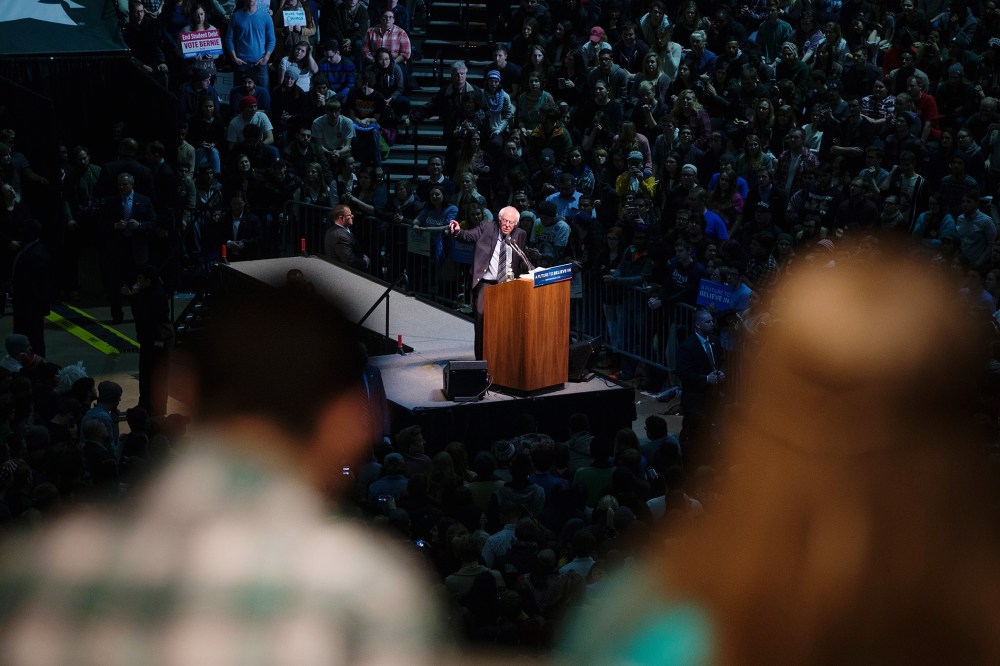
Sanders landed in Michigan this week to campaign ahead of next week’s primary there. After a rounding setback on Super Tuesday, winning just four (largely white) states compared to Clinton’s seven, the prospect of a Sanders nomination has gotten much slimmer. On Wednesday, Sanders made impassioned appeal to black voters, telling an audience of about 10,000 gathered at Michigan State University’s basketball stadium in East Lansing that “the campaign is listening to the African-American community.”
The overture was clear, but it wasn’t one heard in mostly black Detroit or Flint. East Lansing is a college town with a black population of less than 7 percent. The optics of Sanders standing before overwhelmingly white audiences, as popular and exuberant as those events may be, reinforce the notion that the candidate has yet to truly capture the attention or excitement of blacks.
Sanders has been able to siphon off some younger black voters by appealing to their sensibilities around criminal justice reform and racial justice. Many millennial blacks may have a view of President Bill Clinton’s legacy that is colored by his criminal justice failures, including the 1994 Crime Bill, which ushered in an era of mass incarceration that destroyed generations of black families. But many of their parents and grandparents serve as a counterbalance, recalling the era more fondly with its solid economy and higher employment rates. They’ve also put any animosity they had with Hillary Clinton over the hard-fought 2008 primary with Barack Obama behind them.
Cornell Belcher, president of Brilliant Corners Research and a former pollster for the DNC and Obama’s election team in 2008 and 2012, said the sort of conservative, moderate, progressive framing of voter behavior can be somewhat artificial.
“It’s not a real conversation in this sense that if you look at the spectrum of issues and where most people land on them, from wages, etc., it just doesn’t play out that way unless you have a group of people who are far left and far right,” Belcher said. “There’s a lot of intermingling, particularly in the South where your ideology is full of religiosity.”
Conservative, he said for example, becomes “a proxy for religiosity” especially when you look at African-Americans in the South, where you have a broad swath of black folks who go to church twice a week.
“They may identify as conservative, but that’s not necessarily a direct connection to where they are on the minimum wage,” Belcher said. He added that Sanders’ talk about shaking up Wall Street in particular, which he described as a “very progressive liberal base argument” simply doesn’t play well in focus groups of African American women. “That’s not to say that Bernie Sanders doesn’t have a credible message with liberal progressive, but that certainly isn’t the starting point” in addressing the problems facing their community, Belcher explained. Clinton has been dogged by questions over her handling of the Benghazi attacks and of sensitive information sent to her personal email account, consequently drawing scrutiny over her general trustworthiness. Those concerns may very well rest primarily with those privileged enough to be worried about what’s on her email server, rather than the next meal served to their children or how justice is served in their community. According to NBC News Exit Polls, just 29 percent of Democratic primary voters on Super Tuesday said Clinton was honest and trustworthy, compared to 68 percent for Sanders. But 90 percent said that Clinton had the right experience for the presidency compared to just 10 percent for Sanders. RELATED: Bill Clinton’s campaign presence felt on stage and off Among black Democrats in six Super Tuesday states who were surveyed about race relations, about half believe things have gotten worse. And almost as many, 48 percent, said they only trust Hillary Clinton to handle race relations, according to NBC News Exit Polls. Another poll showed fewer than 1-in-10 said they only trust Sanders. Black voters may very well be less concerned about foreign policy, or about whether or not they can trust her handling of classified information, but they trust her to be an ally and to push an agenda that sits with their aspirations and the aspirations of their children. Belcher speculated that if you were to lay out a number of issues of importance to the African-American community, from healthcare to K-12 education, and ask black voters who lines up most with where they are on those issues between Sanders and Clinton, Sanders would lose most of the time. “There’s still a question mark around him,” Belcher said. There are a number of factors that are counting against Sanders in courting black voters, he said, and they go beyond the ideological. “There’s not one silver bullet answer to this. One is that the simple and straight forward truth is that go back five months ago and see what Bernie Sanders’ name recognition was with African-Americans,” Belcher said. “Bernie Sanders was broadly unfamiliar in the African-American electorate. So why, over a couple months, should they leave someone that they’ve known and who has supported them and who has been in line with them on a number of ideals? Why would they move to someone they just got introduce to?”
Trymaine Lee
Trymaine Lee is an NBC News correspondent. Recommended


