









If no presidential candidate wins a majority of delegates and Republicans face a contested convention this summer, a small group of party insiders will have huge sway over who wins — and how to resolve a rift that could fracture the Republican Party.
After all the campaigning, debates and primaries, the GOP’s presidential nomination could hinge on what these insiders decide.
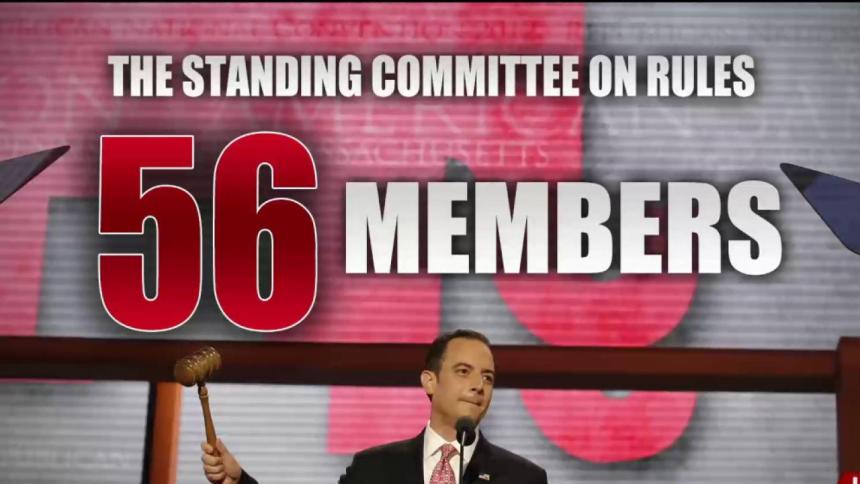
The RNC Rules Committee decides party regulations and writes the first draft of convention rules, which are finalized by a convention rules committee and submitted to a floor vote.
Those rules are crucial. They decide which candidates are on the ballot: They could pass a rule allowing only Donald Trump to run in Cleveland, or a rule enabling new candidates to challenge him. They can decide how delegates vote — and when delegates can switch teams to support rival candidates. These are the kind of restrictions that could make the difference between a coronation or chaos in Cleveland.
According to new interviews with more than a third of the 56 members of the RNC Rules Committee, these party insiders have strong views about how to run a convention.
WATCH: Breaking down the RNC’s rules system
Most say a contested convention is legitimate when no candidate has a delegate majority, but they disagree about whether there is an concerted effort to use this year’s convention to stop Trump. Some say delegates have every right to overrule the preferences of Republican primary voters. Many Rules Committee members say they are comfortable with the prospect of several rounds of balloting to pick a winner this summer — and most rejected one big idea establishment Republicans have put forward for the convention.
While politicos have speculated about a new candidate swooping in to win a contested convention, such as House Speaker Paul Ryan, insiders on the RNC Rules Committee say that idea would be dead on arrival in Cleveland this July.
‘World War III’
“Ridiculous — not happening,” said one Rules Committee member, asked about the prospect of candidates getting on the ballot who did not run this year.
“There’s no way in hell that any of these candidates — who have worked this hard and spent this much money — are going to say, ‘OK, now, for the good of the party, I’ll sit down and let’s bring back Mitt Romney,’” said the insider. “That’s a fantasy world — there’s zero chance of that happening.”
Another committee member said creating a path for a new candidate would lead to a party meltdown.
“Change the rules drastically you will have a problem,” said the insider, who requested anonymity to discuss controversial convention scenarios. “You want to have World War III and destroy the party?”
Related: What Is a Brokered Convention? GOP Rules Favor Trump
Indeed, most of the 19 Rules Committee members reached by MSNBC opposed any rule enabling new candidates to run at the convention. Only three backed a rule allowing new candidates to run.
One of them is Steve Frias, a committee member from Rhode Island, who argues there is nothing wrong with a large number of convention delegates agreeing to offer a new candidate.
“If a majority wants to put forward a candidate, I don’t see what the problem is,” he told MSNBC.
Democracy Is ‘Not the Way We Do It’
Some Rules Committee members worry about an effort to shape the rules in order to stop Trump.
Dianna Orrock, who backs Trump, believes the RNC should intervene to stop any effort to make a contested convention more likely under the rules.
“The fact that Reince Preibus, as chair, has not come out and denounced these high-level Republican operatives who are blatantly trying to sabotage Donald Trump’s campaign speaks volumes,” she said. Any effort to block “the consistent GOP front-runner” at the convention, she argued, would be “shameful.”
Others say it all depends on the size of Trump’s lead.
“If you are fairly close and next person is 300, 400, 500 delegates down — I think you are playing with fire,” said Steve Scheffler, a Rules Committee member.
“If the person is short, but not a lot short — and I don’t know what the magic figure is — I think it’s pretty dangerous to gang up,” he said, “and say he’s not the nominee.”
Other RNC members dispute the idea, however, that a contested convention reflects any orchestrated effort to stop Trump. These Republicans stress that the rules dictate it takes 1,237 delegates to clinch the nomination — so either someone wins those delegates, or there is no official nominee.
“I’ve heard people say, ‘If one candidate — whether it’s Trump or Cruz — goes in with a plurality, your duty is to vote for the one with a plurality,’” said one committee member, incredulously.
“The hell it is! You’ve got to win a majority — if you don’t have a majority, let’s chat,” said this insider, conjuring negotiations with the campaigns.
Another committee member, Zori Fonalledas, said the convention also gives delegates a chance to change their mind.
“Maybe the delegates that voted for Trump can now change their mind — a lot has happened,” she said, “it’s really delegates will elect the candidate.”
Related: Paul Ryan Calls Trump’s ‘Riots’ Comment ‘Unacceptable’
Curly Haugland, a North Dakota committee member, echoed that view, arguing the whole point of the convention is for delegates to pick the nominee. “Do the primaries choose a nominee or do the convention delegates?” he asked. “It can’t be both.”
“Democracy is pretty popular,” he added, “but it’s simply not the way we do it.” Haugland has long advocated for the party to play a bigger role than public primaries in selecting the nominee.
Henry Barbour, a Rules Committee member from Mississippi, stressed there is nothing exceptional, let alone unfair, about following the party’s procedure for a primary that ends without a candidate clinching the nomination.
“The rules are plain: You have to get a majority of the delegates,” he said, noting that if no candidate wins them before the convention, “we have a process in place and the delegates vote.”
“Trump doesn’t get a pass just because he has 100 more delegates than anyone else — if he can’t convince a majority of delegates to vote for him, he’s not going to be the nominee,” said Barbour, who endorsed Marco Rubio.
“That’s the process, the process is fair, it’s been around for decades,” he added, “and we shouldn’t change it for the head of Trump University.”
The nuance in this narrative boils down to whether convention voting is seen as a special ploy to “stop Trump” — or the inevitable, dictated result of a primary season where no candidate clinched a delegate majority.
Several members of the Rules Committee say it is not accurate to suggest this year’s approach is any different in response to Trump’s candidacy.
“Here is where I disagree with Mark Levin and Sean Hannity,” says RNC member Peter Feaman. “I am on the Rules Committee, and there has never been a move to disenfranchise any candidate in any way,” he told MSNBC. “We have never had any discussions about rules to halt Donald Trump.”
New Rules At every convention, the rules are set and finalized by the two rules committees, and rules used in past conventions are typically amended. Whether this year’s convention allows votes for vote leaders like Trump and Cruz, or also John Kasich and others, depends on the rules set for the convention. Sean Spicer, the RNC Communications Director, says the party leadership has no position on who should be on the ballot in a contested convention. “The RNC’s position is the delegates and members of the Rules Committee will decide what the rules of the convention will be,” he told MSNBC. Still, some Rules Committee members worry that in the current climate, even legitimate rule proposals could be seen as unfair “changes” when offered before this convention. Donald Trump has been stoking that concern, darkly predicting “you’d have riots” if he somehow loses the nomination at the convention. “You can’t change the rules three-quarters of the way into game — that’s not fair,” says another Rules Committee member. This insider, who backs Cruz, argued that only he and Trump should be on the convention ballot, since that is the basic choice facing the party. Another member of the committee, Dr. Ada Fisher, disagrees. “I think that anybody who gets one delegate should be on the ballot and counted — that’s democracy,” she told MSNBC. Randy Evans, a Georgia Rules Committee member, is skeptical about establishing any rules that would be seen as last-minute changes. “I’m not a big fan of changing the rules mid-stream,” he said. Evans argues if Trump, or any candidate, has a commanding delegate lead “heading into the convention,” that person should be the nominee. Solomon Yue, an Oregon committee member, says the approach to rulemaking at the convention should demonstrate “fairness” and respect for the “rule of law.” Romney Precedent Apart from the current candidates, some RNC members have a bitter aftertaste from an obscure skirmish over rules at the 2012 convention. Romney backers raised the bar for how candidates could qualify on the convention ballot, in order to avoid any symbolic floor votes for Ron Paul. “I really didn’t like what happened in 2012,” says committee member Peter Feaman. “The Romney folks silenced it with the rule change — we didn’t need to do this, and it alienated the Ron Paul supporters — and for what? It was like taking a fly off someone’s forehead with an ax,” he said. When those rules were brought to a voice vote on the floor, the delegates cries of “no” sounded about as loud as the “yes” votes, according to a review of the footage. Speaker Boehner deemed the voice vote a yes, though, and the rules were adopted. As some delegates would later complain, the official teleprompter even scripted Boehner saying the “ayes have it” before the vote occurred (the moment was caught on tape). The new Speaker, Paul Ryan, will chair this year’s convention, a role he mentioned Thursday while noting there’s a “perception” that an “open convention” is likely. Feaman, a rules committee member from Florida, argued it is especially important for the convention to advance a fair and transparent process this year, when there could be intense wrangling by the campaigns. Asked if any presidential campaigns have already contacted him about the rules process, Feaman paused for a long time, and then declined to comment. Dianna Orrock, the Nevada committee member backing Trump, predicts that rule raising the bar for getting on a convention ballot — Rule 40 — will now be a point of contention if there is a contested convention. “That rules change is coming back to bite them now,” she said, “I have no doubt that in this summer’s Rules Committee meeting, that’s going to be one of the rules changes they’re going to try to change.” If Rule 40 were applied, Trump is the only candidate who would currently qualify for a convention ballot right now — candidates need to have a majority of delegates in eight states. Current and former RNC officials stress, however, that Rule 40 was drafted only for the 2012 convention — when the nominee was known — while this year, a fair rule for getting on the ballot would be written differently. While the rules are made for each convention, some Rules Committee members say changing the ballot threshold now could look like a bid to shape who wins. For a rule listed as “temporary” in the RNC Rulebook, Rule 40 might cast a long shadow. Morton Blackwell, a rules committee member from Virginia who has attended meetings of every Convention Rules Committee since 1972, led an effort to change Rule 40 before this year’s primaries began, which he recounted in a recent post on RedState, a conservative blog. By failing to adjust the rules before the primaries began, he warned, the RNC has now opened itself up to a situation where “every proposed rule change will be evaluated by the effect it would have on the respective candidates” — not its logic or fairness. It is now unlikely, he argued, that the party can advance a process where rules are established “dispassionately based on what is fair and best for our party.” Another Rules Committee member, speaking anonymously, alluded to that emerging political reality. This insider imagined the pressure on the final rules package that will emerge from the Convention Rules Committee, comprised of delegates from every state. “Nobody knows for certain what the rules are going to be coming out of that Rules Committee,” the RNC member said, “that will be ground zero for all of these candidates.” This story originally appeared on NBCNews.com
Ari Melber
Ari Melber, an Emmy Award-winning journalist, writer and attorney, is the host of “The Beat with Ari Melber” airing nightly at 6 p.m. ET on MSNBC. He also serves as MSNBC’s chief legal correspondent and an NBC News legal analyst. Before joining MSNBC, Melber practiced First Amendment law and served as a legislative aide in the U.S. Senate. He received a J.D. from Cornell Law School and is a member of the New York Bar. Recommended


