








Racial profiling is still a major part of life for communities of color across the country, and a new report has found that legal protections from such profiling vary wildly from state to state. The NAACP report came the same day the families of three black men killed by police officers in recent months called for justice for their loved ones.
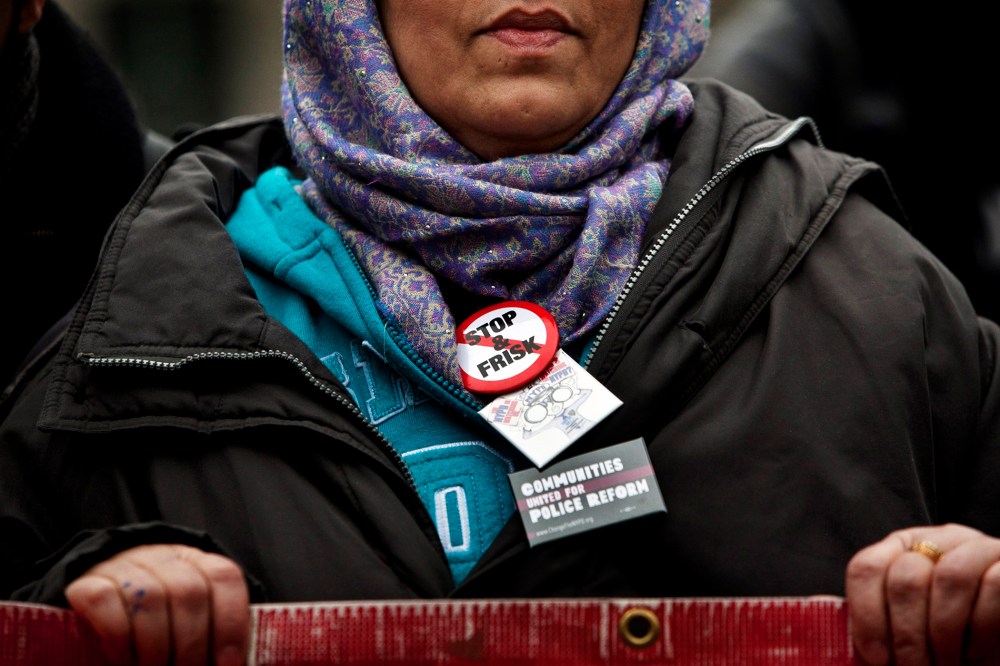
After several noteworthy killings of black men by white police officers, the NAACP on Thursday released Born Suspect: Stop-and-Frisk Abuses and the Continued Fight to End Racial Profiling in America, which looked at racial profile laws in all 50 states. It also examined how activists and civil liberties advocates in New York City successfully fought the NYPD’s discriminatory “stop and frisk” police search policy, which disproportionately targeted black and Hispanic residents.
“In 2014 there is not one state that has a statute that can stand up against this pandemic of police misconduct,” NAACP President Cornell Brooks said of the report. According the NAACP’s review, 20 states don’t have a ban on racial profiling, and only 17 states with anti-profiling laws make violations a crime.
The kind of data collected by law enforcement varies from state to state, the report found, making it difficult to compare communities and strategies effectively.
Connecticut and Rhode Island were both singled out for having the most protections for their citizens against racial profiling, but neither state met every one of the NAACP’s criteria for constitutional safeguards. And Kentucky, “which basically lacks all of the necessary components for a good law,” landed at the bottom of the list.
Besides laying out the details of every state’s policy and calling for greater data collection, Brooks also called on Congress to pass the End Racial Profiling Act, a bill that would ban racial profiling by police at the federal level.
At the National Press Club in Washington on Thursday, the families of Michael Brown and Eric Garner joined civil rights leaders to appeal for justice. The parents of Brown, the unarmed 18-year old Ferguson, Missouri boy whose death at the hands of a white police officer inspired protests and a heavily militarized police response, still have no explanation why Darren Wilson, the officer who shot and killed Brown, has not been charged. A grand jury is examining evidence in the case and the Justice Department is conducting a separate civil rights investigation.
Garner, a 43-year old Staten Island man arrested for selling untaxed cigarettes, died after a New York City police officer placed him in an illegal chokehold. That officer has also not yet been charged.
“These deaths in Ferguson and New York are not isolated incidents. They’re not aberrations of injustice,” Brooks said at the morning press conference. Mark Morial, President of the National Urban League, called for full federal investigations into the deaths of Brown and Garner, and for greater clarity in the process.
“What we need so much, not just in Ferguson, is transparency. If we don’t’ have it, this distrust will only get greater,” Morial said. “We need to be able to trust that our law enforcement officers works equally for everybody.”
Thomas Jackson, head of the Ferguson Police Department, released a video message Thursday apologizing to Brown’s family. “I’m truly sorry for the loss of your son. I’m also sorry that it took so long to remove Michael from the street.” Jackson also said his officers had not done enough “to protect [Ferguson residents’] constitutional right to protest.” Separately on Thursday, the family of John Crawford III spoke out a day after a grand jury declined to indict the police officers that shot Crawford in an Ohio Walmart and after the DOJ announced it would review the facts of the incident. Surveillance video shows police officers shooting Crawford while he held a BB gun sold by the store. The announcement Thursday that Attorney General Eric Holder planned to resign, and with the top position at the DOJ’s office for civil rights vacant, means progress could be slow. The DOJ has still not completed its investigation into the death of Trayvon Martin, a 17-year old boy killed by a neighborhood watch volunteer in February 2012. The relationship between residents and police in St. Louis County, Missouri, where Ferguson is located, show few signs of improving. The family of a young woman who police say committed suicide while in custody for traffic warrants last week is looking for more information. There is reportedly video of the area where Kimberlee Randale-King was being held by the Pagedale, Missouri police, but it has not been released. In another case getting attention, South Carolina state trooper Sean Groubert was fired and charged with aggravated assault and battery after he shot a man at a gas station in Columbia, South Carolina on September 4. After Groubert ordered Levar Edward Jones to show his driver’s licencse, Jones reached into his car, and Groubert shot him. A South Carolina prosecutor has asked the U.S. Attorney’s Office to look at the case.
Meredith Clark
Meredith Clark is a freelance writer and editor. She was previously a senior news producer for "Patriot Act with Hasan Minhaj," a reporter with MSNBC.com, the digital politics and culture editor at Glamour and a senior news and politics editor at Refinery29. She has written for Vulture, Rolling Stone, Self, Marie Claire, Cosmopolitan, The Daily Beast and Bustle. Recommended


