








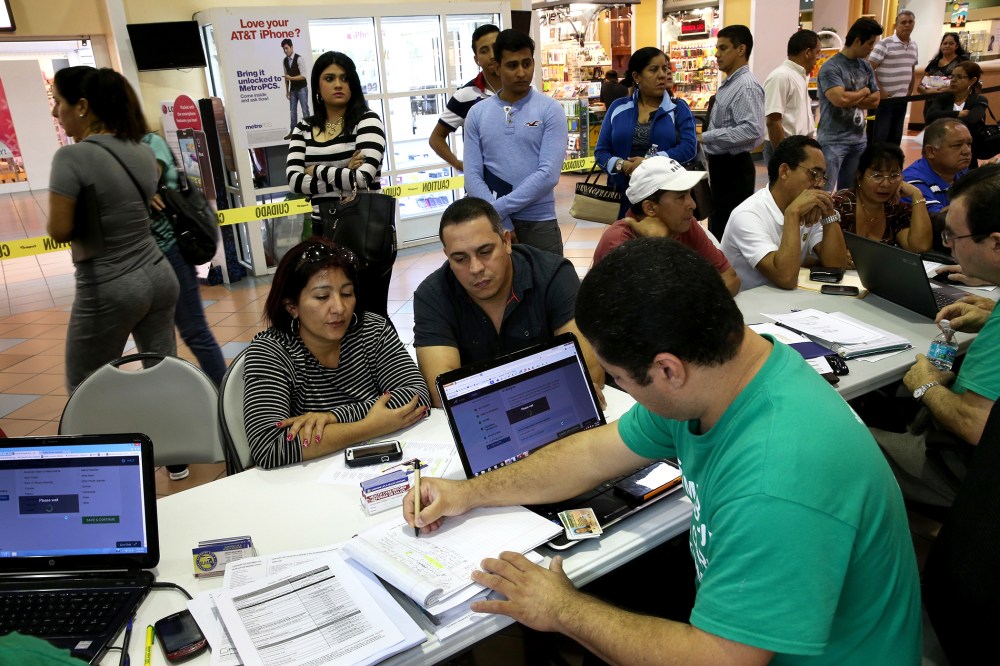
Obamacare has made a big difference for Raghu Raju and his wife. The couple is paying 30% less and receiving more coverage and benefits than before. That’s cut down one of the biggest expenses for their small business in Atlanta, which they quit their jobs to start a few years ago.
But Raju isn’t sure what he needs to do to stay covered in 2015: While many who are covered through the exchanges will be automatically enrolled in the same plans next year, the rules vary from state to state.
“We’re confused as to whether or not we need to enroll—we’ve gotten conflicting messages,” says Raju, a former attorney who now runs Mahamosa Gourmet Teas, Spices & Herbs. In Georgia, where Raju lives, participants are supposed to be auto-enrolled for 2015, but he says he received a letter from his insurer suggesting that was not the case.
In advance of the next open enrollment period, which begins on Saturday, officials and outside groups are urging everyone who’s currently covered through Obamacare to make sure their insurance is in place for 2015. They’re also encouraging everyone to shop around to look at their options again, as many enrollees could face higher premiums unless they change insurance plans.
The Obama administration has tried to take steps to streamline the process. Over the summer, the Obama administration decided that nearly everyone covered through the 34 federally run exchanges would be auto-enrolled in the same plans for 2015, with the same subsidies they received in 2014. The goal is both to ensure that more people would remain covered through Obamacare, to avoid both overwhelming the website during open enrollment and having a repeat of last year’s technical difficulties. Less than 100,000 opted out of auto-renewal when they signed up for 2014 coverage.
Related: The fight against Obamacare continues
However, some of the 17 state-based exchanges will make current enrollees sign up again if they want to stay covered. In Oregon, everyone who bought coverage through the Obamacare exchanges needs to re-enroll to keep their insurance next year, as the state also scrapped its original exchange website and is using healthcare.gov for 2015 coverage. Maryland also scrapped its entire website this spring due to major technical problems. Those currently covered by the exchange will be auto-enrolled in the same plan unless they act by December 15. But Maryland residents who received premium subsidies will have to reapply for them through the new website.
“I’m for affordable health care—human beings should have the right to health, but if you’re going to implement a plan like this, the idea is to make it simple and effective. Auto-enroll should probably have been clear throughout the nation,” says Raju.
Health officials are encouraging everyone who’s currently covered through the exchanges to look at their options again for 2015, even if their coverage is being automatically renewed and they plan to keep their plan. Consumers are also urged to report changes in income, as their subsidies may rise or fall accordingly.
“We want to make sure that people really do shop their plans and their coverage, and look at any rate changes they experience,” says Kate Sullivan Hare, a health-care consultant who’s on the board of directors for D.C.’s insurance exchange.
Like Raju, the majority of those enrolled in Obamacare are happy with their coverage, early surveys indicate. Of those enrolled through the exchanges or newly enrolled in Medicaid, 78% said they were happy with their insurance and 58% said they were better off than before, according to Commonwealth Fund poll conducted from April to June 2014. But not everyone will be happy to hear that their costs could increase in 2015 unless they’re willing to switch insurance plans.
The changes in Obamacare premiums for 2015 will vary dramatically depending on the local market and type of plan: In Jackson, Mississippi, the premium for a benchmark mid-range plan is expected to fall by 25.5%, from $410 to $305 per month, in 2015, according to an analysis from the Kaiser Family Foundation. With 25% more insurers participating in 2015, premiums in Anchorage are expected to rise by 28.4%, from $380 to $488 per month. Overall, new competition in the exchanges will help keep premiums in check: Kaiser’s analysis of major cities in every state shows that the benchmark silver plan will by 0.2% cheaper on average in 2015.
Related: The weird politics of Obamacare
“One of the fears going into the second year is that premiums would skyrocket. That’s largely not the case; For most of the country, for most insurers, premium increases are quite modest,” says Larry Levitt of the Kaiser Family Foundation.
But if those enrolled want to prevent their health care costs from rising in 2015, many will have to be willing to change their insurance plans. About 83% of the 7.1 million enrolled in the exchanges receive subsidies that are designed to insulate them from premium price hikes, as they are calculated according to the cost of the second-lowest cost “silver” plan in an area, as well as an individual’s income. (In 2015, premium subsidies will be available for individuals earning up to $46,680 annually and up to $95,400 for a family of four.) So many enrolled will either have to change to a different plan or face higher health care costs in 2015. “It’s likely to be a confusing situation for consumers,” says Levitt “The onus will be on consumers themselves to go search out their options—a lot is changing.” Exchange officials and insurance companies are notifying Obamacare enrollees about some of the changes and the steps they need to take. Enroll America has raised $20 million for an enrollment campaign that the group expects will reach more than 1.4 million consumers. The campaign is aimed both at enrolling new consumers in Obamacare and encouraging those already enrolled to stay insured and revisit their options for 2015. The overall message is “Get covered, stay covered,” says Enroll America’s president Anne Filipic. The group found last year that consumers responded most strongly to the promise of subsidies for insurance coverage. So advocates plan to deliver a similar message to those currently enrolled, “to check out the financial assistance that’s available to you— they may be eligible for a different subsidy,” says Filipic. Experts and advocates point out that premium hikes were commonplace well before Obamacare, and that the market for individuals and small businesses was particularly vulnerable. “Before the ACA, the individual market was quite volatile—double digit increases were not at all uncommon,” says Levitt. The Obama administration expects that up to 10 million people will be enrolled through the exchanges in 2015. Under the law’s individual mandate, the penalty for not having adequate health care coverage will rise in 2015 to 2% of annual household income or $325 per person, whichever is higher; in 2014, it was 1% of annual income or $95 per person. For Raju, keeping their current Obamacare plan in 2015 would be worth the cost of a premium hike, provided that it’s relatively modest. “We already have physicians to work with and familiar with where the hospitals are and where the clinics are. When you get accustomed to something, it’s an inconvenience to have to change and relearn a new system,” he said. Having to go through the whole shopping process again would be time-consuming as well, he adds. The D.C. exchange expects that premium increases will be lower than they expected. But they’re still anticipating a lot of questions from consumers trying to sort out their options in year two. “We’re bracing ourselves for some phone calls when the notices come out,” says Hare.
Suzy Khimm Recommended


