








In his unusual address about race relations after the George Zimmerman trial, President Obama recounted personal experiences when people thought he was dangerous, or a criminal, because of his skin color. He was describing a social form of racial profiling, of reactions to him based solely–instantaneously–on his race. The official practice, while widely condemned, actually remains legal under federal law and in about 25 states. And in the wake of the president’s remarks, there’s a new push in Washington to ban racial profiling.
Under Supreme Court precedent, race can be used as a factor in policing, providing that the authorities demonstrate it is relevant to specific law enforcement goals. And many states and cities maintain the option of profiling as a police tactic–though few openly admit it.
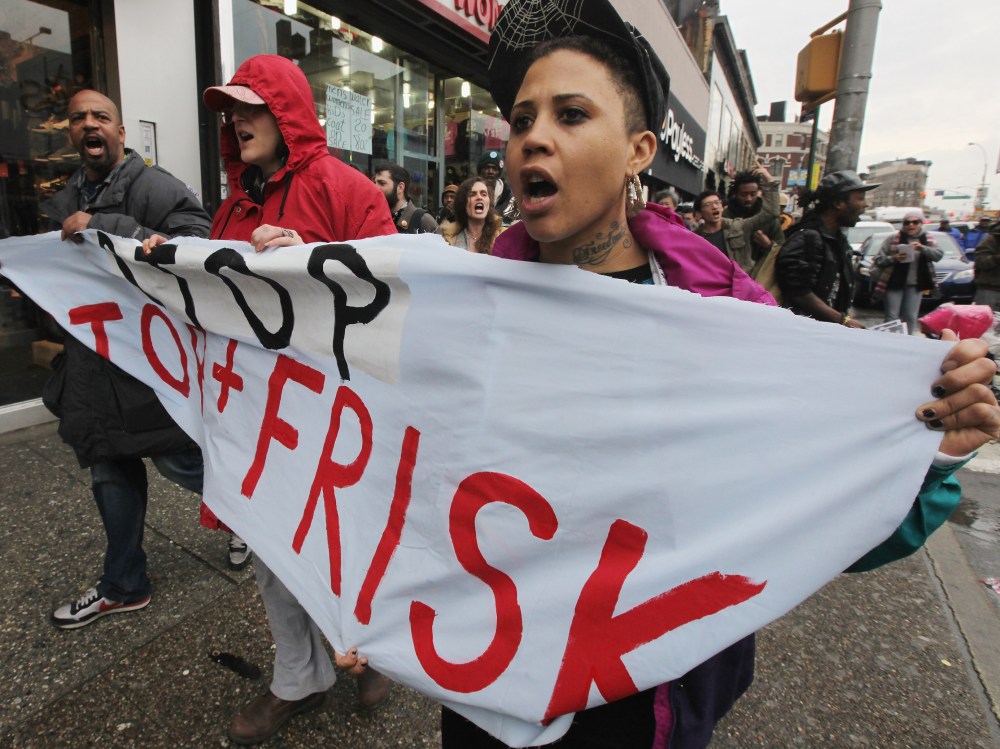
New York City runs a sweeping program that inspects predominantly young minority males. Last year, under that “stop and frisk” policy, the NYPD conducted 532,000 searches of city residents. A striking 85% of the targets were racial minorities–almost double their share of the population. Those hundreds of thousands of black and Latino New Yorkers were presumed suspicious, and forced to stop, in public, and submit to searching and questioning.
The presumption was wrong.
NYPD data indicates that the vast majority of the search targets–89%–were innocent.
“I grew up in New York City and I was subjected to the same stops,” says Marquez Claxton, a former NYPD detective who retired in 2005 after 20 years on the force. Claxton says that while New York’s profiling policy clearly violates people’s rights, it will continue “until there’s a penalty for constitutional violations.”
Civil rights advocates agree. They insist the program is not only humiliating to hundreds of thousands of innocent New Yorkers, straining relations between police and law-abiding citizens, but that it is unconstitutional. A federal court in New York heard a challenge to the policy in May, and its ruling is expected in the coming months.
Mayor Michael Bloomberg continues to tout the program, but even he is careful to argue that it does not use racial profiling.
“Nobody racially profiles,” Bloomberg insisted last month, in response to questions about local legislation that could curb the practice.
It is telling that New York, a city with an unusually diverse and liberal political establishment, is so reliant on racial profiling that the policy has sparked federal lawsuits, city council battles and rancorous debate in the contest to replace a centrist and fairly popular mayor. (Most of the Democratic candidates oppose the policy.) In many other parts of the country, profiling continues with far less outcry.
While 25 states have, technically, passed legislation to discourage racial profiling, only 12 of those states actually ban it. Even then, if you’re looking for laws that penalize police found guilty of profiling, the number of states drops to five, as the ACLU documented in a 2009 report.
The outlook is similar at the federal level, where racial profiling is widely condemned, but rarely punished.
Policing the Police
Few national politicians embrace the prioritization of race in policing. President Bush even singled out the practice in his first State of the Union address, saying he planned “to end racial profiling” with input from the Justice Department.
“By stopping the abuses of a few,” the new Republican president argued in 2001, “we will add to the public confidence our police officers earn and deserve.”
The Justice Department followed up with new guidelines in 2003. While the policy was historic in some sense, it proved to be toothless.
The new rules marked the first time the U.S. federal government ever limited racial profiling across all law enforcement agencies. Some civil rights groups cheered that step, especially given incendiary debates about profiling Muslim Americans at the time (just two years after the 9/11 terror attacks). But the actual policy was ineffective.
The rules created key exceptions, such as national security cases and a loophole technique called an “assessment” inquiry. More critically, in a familiar dodge from state legislatures, the rules failed to provide any real enforcement mechanism, or punishment, for federal officials who engage in profiling.
While law enforcement officials constantly emphasize “tough” punishment as a deterrent for would-be criminals, the logic did not extend to policing their own. Reform Today, with the nation vigorously debating race and criminal justice, the Justice Department could re-open those rules. Attorney General Holder launched an internal review of the profiling guidelines in 2009, but several Democratic members of Congress protest it hasn’t led to any action. Now Congress is starting to push harder, advocating federal legislation to write a racial profiling ban into the criminal code. Sen. Ben Cardin introduced the “End Racial Profiling Act of 2013” as a more permanent approach than executive rule-making, and the bill now has 16 cosponsors including Majority Leader Harry Reid, who added his name last month. “Unfortunately we don’t have a law against it,” Cardin told me in a recent interview, “and as we saw in the Zimmerman case, the jury spoke as to the criminal responsibility, but clearly, Trayvon Martin was a victim of racial profiling. That needs to stop.” (George Zimmerman’s lawyers insist that race played no role in the killing, and the judge largely limited references to “profiling” in the trial.) On the House side, the current climate has also drawn more attention to the issue. John Conyers, the top Democrat on the House Judiciary Committee, reintroduced a House version of the bill on July 30. “Though the death of Trayvon Martin was not the result of a law enforcement encounter,” said Conyers, “the issues of race and reasonable suspicion of criminal conduct are so closely linked in the minds of the public that his death cannot be separated from the law enforcement profiling debate.” For his part, President Obama has long supported legislative remedies to racial profiling. He even cited that policy record in a section of his remarks on Zimmerman that drew less attention. “When I was in Illinois, I passed racial profiling legislation,” the president recalled. “Initially, the police departments across the state were resistant,” he said, “but actually they came to recognize that if it was done in a fair, straightforward way, that it would allow them to do their jobs better and communities would have more confidence in them and in turn be more helpful in applying the law.” That politically palatable rationale–a profiling ban benefits cops, not just suspects–echoed the previous president’s pitch in the State of the Union. But not all police groups agree. The National Fraternal Order of Police, the largest law enforcement organization, opposes the End Racial Profiling Act as “unnecessary” and based on the “faulty premise” that racial profiling is a systemic practice. As the nation takes a renewed look at race relations, however, casting racial profiling as merely an imaginary problem may prove untenable.
Ari Melber
Ari Melber, an Emmy Award-winning journalist, writer and attorney, is the host of “The Beat with Ari Melber” airing nightly at 6 p.m. ET on MSNBC. He also serves as MSNBC’s chief legal correspondent and an NBC News legal analyst. Before joining MSNBC, Melber practiced First Amendment law and served as a legislative aide in the U.S. Senate. He received a J.D. from Cornell Law School and is a member of the New York Bar. Recommended


