








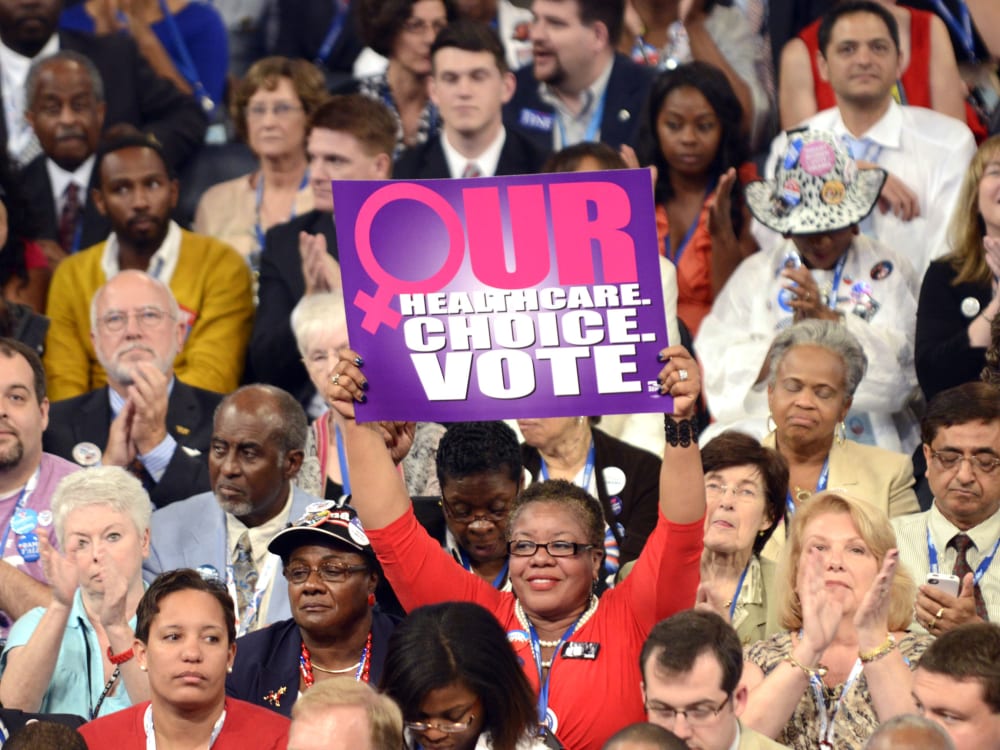
President Obama has been a stalwart supporter of women’s health, and women have rewarded him richly for it. He won the last election by 18 points among female voters―the widest margin ever recorded by Gallup―by standing firm on birth control access, abortion rights and funding for Planned Parenthood. But in December 2011, he made a tactical call that left advocates and health experts reeling. In a move reminiscent of Bush-era meddling, his Health and Human Services secretary overturned an FDA approval of the morning-after pill for non-prescription sale to people of all ages. Instead of admitting the obvious―that he didn’t want a teen-sex brouhaha dominating the early days of the campaign―the president claimed that he and his cabinet secretary had found flaws in the FDA’s technical review.
On Friday, a federal judge called him out for it. In a spirited 59-page legal decision, Federal District Court Judge Edward Korman said the administration’s meddling with FDA had been arbitrary, capricious and unreasonable. The government’s restrictions on emergency contraception are inconsistent with federal law, he declared, and the administration’s professed concern for the safety of young teens is “an excuse to deprive the overwhelming majority of women of their right to obtain contraceptives without unjustified and burdensome restrictions.” The ruling gives the FDA 30 days to reinstate the ruling it tried to issue two years ago.
The administration isn’t yet saying whether it will contest the court’s ruling. If it stands, it may finally resolve a 14-year political battle. The FDA first approved prescription sales of the “Plan B” morning-after pill in 1999. Seven years later, after a prolonged battle that prompted high-level resignations within FDA, the agency approved non-prescription sales to women 18 and older. Advocates then sued over the age restriction, which lacked a sound medical rationale, and in 2009, Judge Korman took their side. The lawsuit sought to kill the age restriction entirely, but Korman ordered the FDA to lower it from 18 to 17 and left the agency to fairly assess whether younger teens could understand the package instructions for swallowing a pill to prevent pregnancy within 24 hours of unprotected sex.
“The Commissioner of the FDA had resigned and his replacement. . . had been nominated by the newly elected President,” Korman recalls in the new ruling. “This change in leadership suggested that the FDA could be trusted to conduct a fair assessment of the scientific evidence.”
The new commissioner was Dr. Margaret Hamburg, a seasoned public health official who took the charge seriously. In early 2001, Teva Pharmaceuticals submitted a formal application to eliminate the age restriction, and Hamburg reconvened a panel of pediatricians and ob-gyns to review it. After an exhaustive review, the experts recommended expanding over-the-counter access to “all females of child-bearing potential,” and Hamburg accepted their guidance. As she explained at the time, the review “determined that the product was safe and effective in adolescent females, that adolescent females understood the product was not for routine use, and that the product would not protect them against sexually transmitted diseases. Additionally, the data supported a finding that adolescent females could use Plan B One-Step properly without the intervention of a healthcare provider.”
The events that followed were unprecedented in FDA history. After the FDA announced the approval, HHS Secretary Kathleen Sebelius stepped in publicly to announce she was overruling the agency. “Because I do not believe enough data were presented to support the application to make Plan B One-Step available over the counter for all girls of reproductive age,” she said in a statement, “I have directed FDA to issue a complete response letter denying the supplemental new drug application.” During the uproar that followed, the president claimed he hadn’t ordered the veto but fully supported it. “The reason [Secretary Sebelius] made this decision was she could not be confident that a 10-year-old or an 11-year-old go into a drugstore, should be able—alongside bubble gum or batteries—be able to buy a medication that potentially, if not used properly, could end up having an adverse effect.” That may sound like common sense. But as Korman notes in his new ruling, it’s medically unfounded and wholly inconsistent with federal standards for drug approval. Levonorgestrel, the synthetic hormone in emergency contraceptives, has been used safely worldwide for two decades. Its most serious side effects are transient headache, nausea and fatigue. “These emergency contraceptives would be among the safest drugs sold over the counter,” Korman writes. “[T]he number of 11-year-olds using these drugs is likely to be miniscule, [and] the FDA permits drugs that it has found to be unsafe for the pediatric population to be sold over the counter subject only to labeling restrictions.” Women’s health advocates are cheering the ruling, and FDA officials must surely be savoring the moment. Unless the administration contests the decision, emergency contraception could show up on convenience store shelves this year, where women facing emergencies will have direct access to them. Under the Sebelius standard, a scared teenager can’t prevent an unwanted pregnancy without visiting a doctor and finding an open pharmacy―all within 24 hours. And no woman of any age can buy Plan B when her pharmacy is closed or the pharmacist is off duty―a common predicament at night and on weekends. The new ruling gives the president a graceful way to clean up an otherwise stellar record on women’s reproductive health and rights.
Geoffrey Cowley Recommended


