








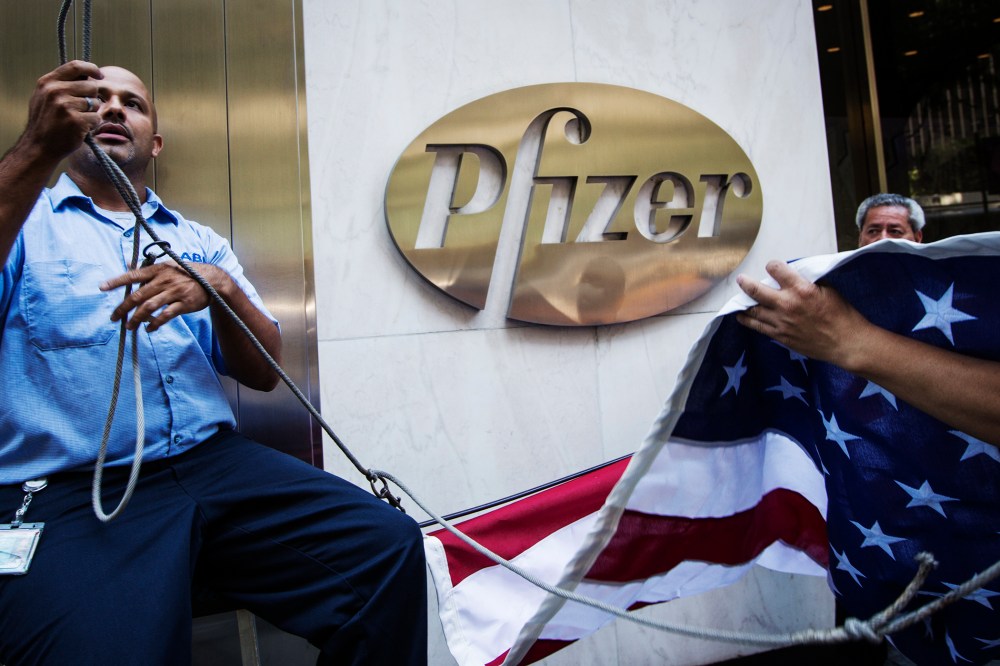
“Great corporations,” President Theodore Roosevelt said more than a century ago, “exist only because they are created and safe-guarded by our [government] institutions.” One way corporations are safeguarded is that they pay less in taxes than people do. But not enough less, by the lights of Pfizer, to remain a U.S. company, as it’s been since 1849. So the “world’s largest research-based pharmaceutical company” wants to reincorporate with AstraZeneca in Britain, where it would pay less corporate tax. Under current rules, it can do that—and still maintain its headquarters inside the U.S.
%22Dismiss%20from%20your%20mind%20any%20thought%20that%20Uncle%20Sam%20has%20been%20squeezing%20poor%20Pfizer.%22′
Teddy Roosevelt would not be pleased, and neither is Barack Obama. His administration has proposed making it more difficult for U.S. companies to dodge U.S. taxes by merging into an offshore shell company. Under current rules, such “inversions” are permissible only if shareholders end up owning no more than 80% of the merged entity. The Obama proposal would lower that threshold to 50%. “If we ever had a legislature, we could do something about this,” H. David Rosenbloom, director of New York University’s international tax program, told Bloomberg. “But I don’t expect to live that long.”
Conservative commentators have suggested that Pfizer’s bid to relocate shows how intolerably high U.S. corporate taxes are relative to other nations. And it’s true, the nominal U.S. rate of 35% is high by international standards. Obama has proposed lowering it to 28% in exchange for eliminating various loopholes. The Obama administration’s proposal to lower the inversion shareholder threshold to 50% is part of the same package.
But don’t kid yourself that U.S. corporate taxes, as experienced in the real world, are particularly high. A February report by Citizens For Tax Justice, a left-leaning nonprofit, examined U.S. federal taxes paid by the 288 Fortune 500 companies that were “consistently profitable” between 2008 and 2012. It found that the effective U.S. rate paid by these companies—i.e., how much they paid after loopholes were taken into account—was, for those companies with significant offshore profits, lower than what they paid abroad. The U.S. average effective tax rate for all 288 companies was about 19%, compared to a foreign average of about 22%.
And Pfizer? What has Pfizer been paying? The company claimed in its filings with the Securities and Exchange Commission that in 2010-2012 its effective U.S. tax averaged 21.7%, or just a whisker below the foreign average. But the nonprofit Tax Analysts calculates Pfizer’s effective U.S. tax rate during those years to be closer to 15%—well below the foreign average. So dismiss from your mind any thought that Uncle Sam has been squeezing poor Pfizer.
(The U.K.’s corporate tax rate is 21%; presumably the effective rate there will be much lower for Pfizer, which claims to have paid an effective U.S. tax rate last year of 27.4%. By one estimate, cited in The Wall Street Journal, the company would save as much as $1 billion per year—a disparity that reflects not confiscatory tax policy in the U.S., but rather a tax-slashing policy in Britain these days that’s prompted some to compare England’s green and pleasant land to the Cayman Islands.) If Teddy Roosevelt were alive today, how else might he perceive Pfizer to be “safe-guarded” by the U.S. government? Well, there’s pharmaceutical coverage under Medicaid and Medicare—with the latter prohibited by Congress from using its market leverage to negotiate a price discount. The amount Pfizer reaps from these two government health insurance programs is difficult to quantify, but for a sense of scale, consider that in 2009 Pfizer paid the government $2.3 billion just to settle charges that it defrauded the U.S. government—the fourth such settlement over the previous decade. Between 2010 and 2013 Pfizer also received $4.4 billion in government contracts, according to Citizens for Tax Justice. But perhaps it’s unfair to pick on Pfizer. Walgreen’s is looking to play the inversion game too, which means an American buying a bottle of Lipitor may soon find himself benefitting not one tax-exiled corporation, but two. Corporate inversions are a trend; at least 31 publicly-traded corporations headquartered in the U.S. are currently incorporated abroad, according to Bloomberg, and about half of them took the plunge during the past two years. There is no reason the U.S. has to tolerate such shenanigans. Our government has cracked down on tax dodges in the past, not by lowering taxes but by making it more difficult for U.S. companies to shelter profits offshore. Time to do it again, walking softly and carrying a big stick.
Timothy Noah Recommended


