








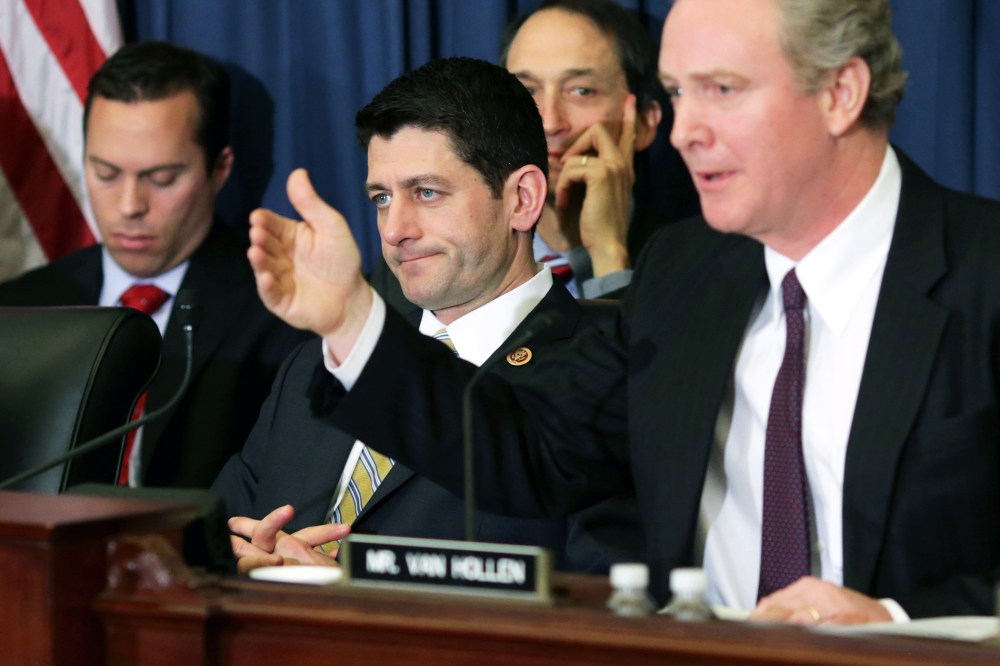
After a day of rampant misinformation, dishonest political attacks, and misleading media reports, Congressional Budget Office director Doug Elmendorf took the stand before a House committee to explain what, exactly, his report says about Obamacare.
The president’s health care law does create a new incentive for people to work fewer hours to qualify for subsidized insurance, Elmendorf told the House Budget Committee on Wednesday. But that means they are consciously deciding to forgo a higher salary because it’s worth more to them to have cheaper health-care and more time for other things, he stressed.
“There is a critical difference between people who want to work and can’t find a job…and people who choose not to work because because [they’ve] decided to retire, or spend more time with their family, or spend time on a hobby,” Elmendorf said. “They don’t feel bad about it, they feel good about it. We don’t feel bad about it, we say, ‘Congratulations.’”

For the most part, it will be lower-income Americans making these decisions: The maximum income to qualify for the Medicaid expansion is $15,282 for a single individual and $31,322 for a family of four. Exchange subsidies phase out altogether for single people earning $45,960, and families of four earning $94,200. Since the Medicaid eligibility and exchange subsidies are scaled according to income—i.e., means-tested—earning less income would make it easier to get cheaper insurance.
That’s prompted criticism from Republicans who argue that the new government program is a new “poverty trap” that will discourage lower-income Americans from working more, as Rep. Paul Ryan declared at Wednesday’s hearing.
“I guess I understand ‘better off’ in the context of healthcare. But ‘better off’ in inducing a person not to work who is on the low-income scale, not to get on the ladder of life, to begin working, getting the dignity of work, getting more opportunities, rising their income, joining the middle class, this means fewer people will do that,” Ryan told Elmendorf. In other words, Obamacare will create more “takers” not “makers,” in Ryan’s worldview.
The CBO report finds that some will work fewer hours and others will drop out of the labor force altogether to retire early or go on disability, though it does not specify how many would fit into either group.
Democrats, for their part, are trying to argue that the CBO’s findings are cause to celebrate. “At the beginning of this year, we noted that as part of this new day in health care, Americans would no longer be trapped in a job just to provide coverage for their families, and would have the opportunity to pursue their dreams,” White House Press Secretary Jay Carney said.

But Democrats didn’t do themselves any favors by continuing to misconstrue the CBO’s findings as well, albeit in an attempt to defend the law. Obamacare “will enable more than 2 million workers to escape ‘job-lock,’” House Minority Leader Nancy Pelosi said in a statement.
The CBO’s report, however, never said that it was “2 million workers” who were reducing their work hours or leaving their jobs altogether. Rather, the total number of reduced hours is the equivalent of 2 million full-time workers. And contrary to the Democratic spin, not all of those taking advantage of the new subsidies are trying to escape “job-lock”: Some aren’t receiving health care at all through their current employer and will simply be working fewer hours to get a bigger subsidy.
Such distinctions may seem like hair-splitting, but the widespread confusion over the CBO’s report has made it even more difficult to debate the actual substance of the findings—and made the report even easier to exploit politically. To the House Budget Committee’s credit, Elmendorf’s hearing made it clear that both Ryan and his Democratic counterpart, Rep. Chris Van Hollen, had read the CBO’s report and were willing to debate its actual findings. But the most politically explosive part of the report is hardly unique to Obamacare. “There is a tension between trying to assure people some minimum level of security—income security, health insurance security—by providing it to people who otherwise can’t attain through their own earned income,” says Gary Burtless, senior fellow at the Brookings Institute. “Social Security, Medicare, food stamps—any program that provides a substitute source of income from your own market earnings can discourage some people as working as much as they possibly can.” What’s more, Burtless adds, it’s worth remembering exactly what people are getting when they give up greater income for more subsidized care: Health insurance, and only health insurance. “You can’t pay your rent with your subsidy,” he says. It’s also worth taking the CBO’s findings with a grain of salt. The office had previously forecast that Obamacare would reduce the total hours worked by the equivalent of 800,000 workers, then updated its forecast based on more recent research. But one new study that CBO cited in its report actually “found no significant effect of Medicaid on employment or earnings” when Oregon expanded the program in 2008. Austin Nichols, a researcher at the Urban Institute, says such evidence makes him skeptical that Obamacare’s effect on the labor market will be as large as the CBO predicts. “I don’t think we’re going to see the kinds of reductions in labor supply that Elmendorf is talking bout today,” says Nichols. “We have also evidence from Massachusetts that doesn’t show a large impact.”
Suzy Khimm Recommended


