








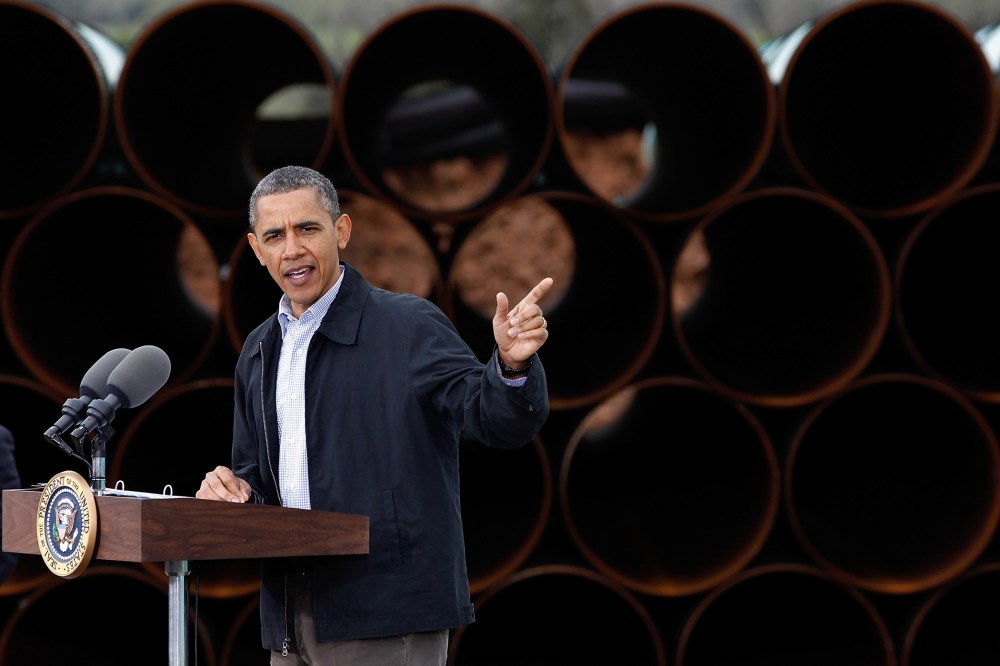
Our Constitution authorizes the president of the United States to reject legislation that’s not in the national interest. The reason: the president is the only public official elected to represent all of the American people.
That confers upon the president the singular responsibility to make decisions based on what best serves the country as a whole, not any collection of districts or states and not, for that matter, any single political party.
In carrying out that responsibility, presidents dating to George Washington have found it necessary to exercise their veto authority 2,563 times to date.
That includes Ronald Reagan’s 78 vetoes, the most of any president in modern time, and Barack Obama’s two vetoes, the fewest of any president since the Civil War.
Obama, though, is about to make it three.
As early as Monday, the Republican-controlled Congress will send him a bill meant to force approval of the Keystone XL tar sands pipeline.
Obama has said he’ll veto the bill, and well he should. This bill is exactly what our Constitution had in mind when it authorized our chief magistrates to provide a check against congressional overreach.
Under a policy put in place in 1968 and updated by President George W. Bush, it is the president’s job to review cross-border infrastructure projects like the Keystone XL pipeline, which would link Gulf Coast refineries to Canadian tar sands.
In determining whether to green-light the project, the president is guided by a single question: is it in the national interest?
To answer that question, Obama has put the project before the U.S. State Department, which oversees our foreign policy. State is being aided by additional advice and counsel from a host of additional agencies: the Department of Energy, the Commerce Department and the Environmental Protection Agency, among others.
Only within the past two weeks have these agencies weighed in with views as to whether this is in the national interest. Those perspectives are receiving thorough consideration and undergoing assessment within the administration as part of a deliberative process aimed at reaching the best possible decision.
The GOP leaders in Congress would bypass that process, set aside the judgment it renders and assert upon the nation their political calculus that the pipeline must be built at all costs.
That’s exactly the kind of congressional overreach the authors of our Constitution called on the president to keep in check.
Congress wasn’t designed to be a permitting agency, to usurp executive authority or to short-circuit the process of informed evaluation already well underway.
RELATED VIDEO: Keystone cash-whipping exposed
Those are good reasons for the president to reject this bill. Then he can take the next step and kill the tar sands pipeline outright.
It’s a fair question as to why the GOP leadership picked the pipeline bill as the first order of business for the 114th Congress. Republican leaders say they want to make progress, and yet they opened the new Congress with a bill they knew the president would veto. Why would they deliberately overlook the opportunities to make progress when there is broad bipartisan agreement on energy measures like expanding renewable power on public lands and extending tax incentives to encourage energy efficiency and promote wind and solar power? Is it because the fossil fuel industry spent more than $720 million over just the past two years to advance its allies and agenda in Congress? That’s a legitimate point of inquiry as well. Strip out the politics, though, and this much is clear: the dirty tar sands pipeline is not in our national interest. It’s a plan to pipe some of the dirtiest oil on the planet through the breadbasket of America so it can be refined on our Gulf coast into fuels that will mostly be shipped overseas. That’s not a plan to help our country. It’s about big profits for big oil – and big pollution for the rest of us. Instead of piping dirty oil across our heartland waterways, ranches and farms; instead of staking our future on a project that would drive up the carbon pollution that’s driving climate change; and instead of enabling the expansion of one of the most destructive industrial processes ever devised in the wild boreal forest of Canada, let’s do something else. Let’s invest in energy efficiency, so we can do more with less waste. Let’s get more of our power from the wind and sun. And let’s build, in this county, the best hybrid and all-electric cars anywhere one the planet. And, while we’re at it, let’s keep three things straight. It’s the president’s job to advance and defend our national interests. The tar sands pipeline would anchor our future to the dirty fuels of the past. It’s in our interest, as a nation, to invest in the clean energy future. Rhea Suh is president of the Natural Resources Defense Council, an environmental advocacy organization with more than 1.4 million supporters and activists nationwide.
Rhea Suh Recommended


