








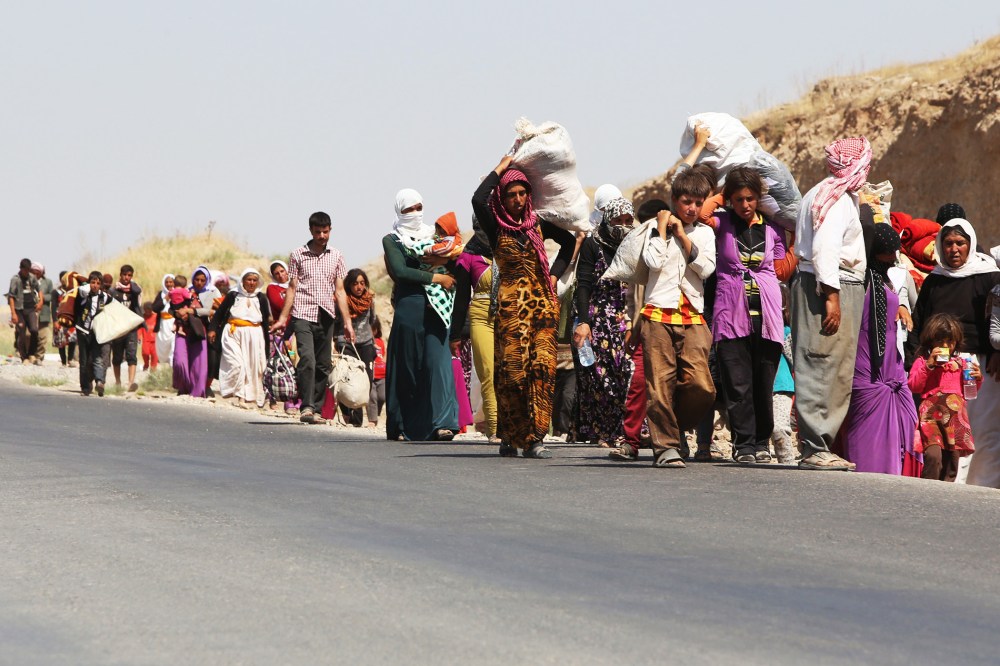
The U.S. is “far less likely” to conduct an evacuation mission on Mt. Sinjar, the Pentagon said in a statement issued late Wednesday, after concluding that “there are far fewer Yazidis on Mt. Sinjar than previously feared” and that “[t]he Yazidis who remain are in better condition than previously believed.”
“We will continue to provide humanitarian assistance as needed and will protect U.S. personnel and facilities,” the statement concludes.
U.S. military forces continued to engage ISIL terrorists in Iraq Wednesday, successfully conducting an airstrike on an ISIL armed truck west of the village of Sinjar. At approximately 12:20 p.m. EST, the U.S. remotely piloted an aircraft that struck and destroyed an ISIL armed vehicle west of Sinjar. All aircraft exited the strike area safely.
The White House continues to assert that U.S. forces won’t engage in combat in Iraq, despite the decision Wednesday to send an additional 129 armed military advisers to help minority groups threatened by Islamic militants in the northern part of the country.
“At the recommendation of the secretary of defense, the president has authorized temporarily sending approximately 130 additional U.S. military personnel to northern Iraq to assess the scope of the humanitarian mission and develop additional humanitarian assistance options,” a senior defense official told NBC News on Tuesday, adding that the forces would only be in the country briefly and won’t be involved in combat.
Militants from the Islamic State of Iraq and Syria (ISIS) have claimed territory and terrorized various religious sects, including Christians, Kurds and Yazidis, in their attempt to seize control of the region. Tens of thousands of Yazidis, a small religious minority group in northern Iraq, have been trapped for days atop Mount Sinjar as they hide from ISIS forces.
Although President Obama may not approve a direct rescue mission, news of the proposal suggests a potential escalation of U.S. involvement in the region.
Pentagon spokesperson Col. Steve Warren on Wednesday justified arming the additional troops by saying the advisers need weapons for self-protection, even if they are not taking steps to engage ISIS directly. The president has said repeatedly that only a new, more inclusive Iraqi government can end the current crisis, a position reiterated by Secretary of Defense Chuck Hagel and Deputy National Security Adviser Ben Rhodes.
“Again, these 130 personnel are not going to be in a combat role in Iraq. They’re there on a temporary basis to make assessments about how to get the population off that mountain. This would be a humanitarian effort, again, to get them to a safe space,” Rhodes said Wednesday during a news briefing. He added that government officials don’t think it’s “sustainable” to rely solely on airdrops to the stranded people in the mountains.
The United States would, however, consider using American ground troops to rescue refugees atop the mountain, Rhodes said.
“As a bottom line, force protection is always a mission for U.S. personnel in any country in the world,” he added.
Obama has said his decision to launch airstrikes and dispatch additional troops is aimed at preventing a genocide in northern Iraq, where ISIS has threatened religious minorities with execution if they do not convert to their strict interpretation of Islam. The operation is also designed to repel ISIS advances on the Kurdish city of Erbil, where the U.S. has a consulate with dozens of State Department and military personnel. There are now more than 900 members of the U.S. military stationed in the country. A helicopter carrying aid to Yazidis stranded in the mountains crashed Tuesday, killing the pilot and injuring passengers, including a journalist from The New York Times. Earlier this week, the CIA began providing weapons directly to Kurdish forces to assist them in regaining territory lost to ISIS. France has pledged to join the United States in sending arms beginning early Wednesday. The re-escalation of U.S. military operations in Iraq, the first since troops withdrew in 2011, began last week when Obama authorized airstrikes to protect American assets and Iraqi minority groups in the region. The United States has also been dropping food, water and humanitarian supplies to trapped civilians. Iraqi President Fouad Massoum on Monday nominated Hayder al-Abadi to take over the role of prime minister from Nouri al-Maliki after the country missed a deadline over the weekend to name a new leader for the role. Maliki addressed the country on Iraqi state television on Tuesday, calling the president’s choice “a breach of democracy” and seeming to cling to power. But recent reports indicate Maliki has lost support among Iraqi politicians and military officials. Other leaders around the world have voiced their support of Abadi. Additional reporting by Rachel Kleinman
Michele Richinick Recommended


