








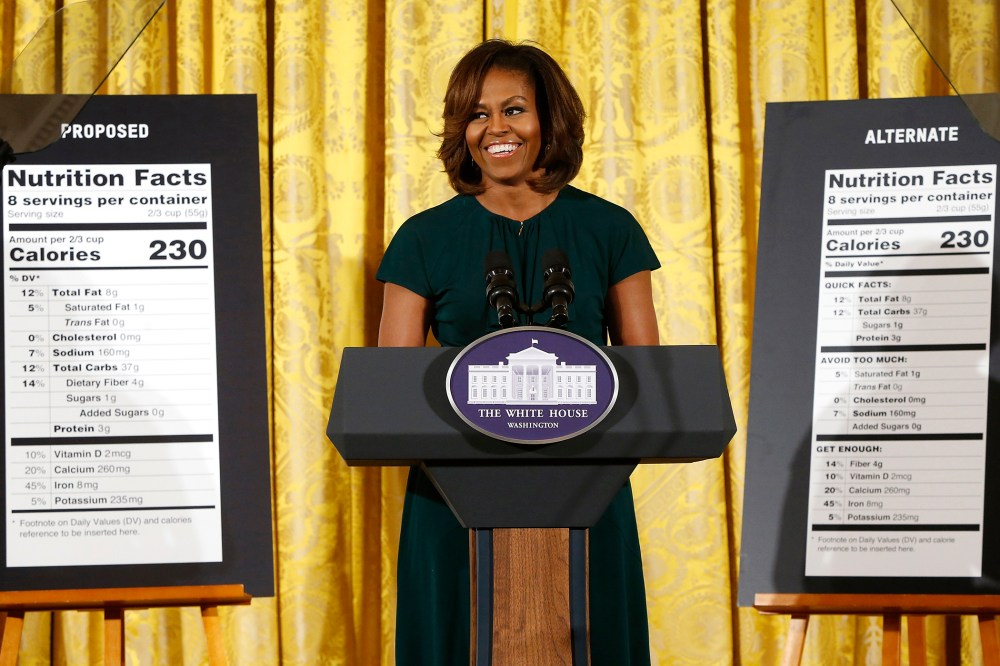
Tweaking nutrition guidelines is a rough political game that the food industry plays to win, but the Obama administration is jumping into the fray today.
More than two decades after the “Nutrition Facts” panel first appeared on packaged foods and beverages, the FDA is proposing some important changes to make it more relevant and more accessible.
In a move the White House is linking to first lady Michelle Obama’s “Let’s Move” anti-obesity campaign, the FDA released a proposal to display calorie counts more prominently, reveal the amount of added sugar in processed foods, and get real about serving sizes.
“Our guiding principle here is very simple,” the first lady said in a statement. “You as a parent and a consumer should be able to walk into your local grocery store, pick up an item off the shelf, and be able to tell whether it’s good for your family. So this is a big deal, and it’s going to make a big difference for families all across this country.”

Dietary fat was the nutritional villain du jour when the FDA introduced the first nutrition labels in the early 1990s. The current label gives “calories from fat” almost equal billing with total calories per serving. But science has since shown that the type of fat we eat is far more important than the amount. Dietary fat can be perfectly healthful if it comes from seeds, nuts and fish rather than cheeseburgers. The new label still lists fats by type, to separate saturated fat from the healthier unsaturated varieties. But the FDA wants to drop the “calories from fat” listing and highlight a far more pernicious ingredient.
That would be sugar. Obesity and diabetes have exploded since the early ’90s, as sugary snacks and beverages have boosted our daily calorie consumption. The nutrition panel has always listed the total sugar content of a packaged product, but the new one breaks out “added sugars” to highlight the astonishing amounts that many products contain. The American Heart Association suggests that women consume only 6 teaspoons of added sugar each day and that men limit their intake to 9 teaspoons. Yet the average American downs nearly three times that amount (23 teaspoons a day)—no surprise when you consider that a single 20-ounce soda delivers about 17 teaspoons.
That kind of sugar density wouldn’t be so dangerous if we were still sipping the 8-ounce colas of yesteryear. But serving sizes have ballooned in recent decades, making a mockery of the portions that many nutrition labels still treat as the norm. In a nod to America’s new food environment, the FDA’s proposed labels list an 8-ounce container of ice cream as one serving, not two. It would also force manufacturers to acknowledge that a 20-ounce soda is now the standard for a person rather than a family. If the agency gets its way, portion sizes will change in about 26 of the 150 categories of packaged food. The proposed changes fall far short of a measure the Institute of Medicine recommended in a 2011 report on food labeling. In a report commissioned by the government, the IOM’s outside experts devised a simple nutrition symbol that would appear on the front of the package as an at-a-glance summary of the more detailed Nutrition Facts panel. The IOM’s front-of-package label would reflect three “nutrients of concern”—salt, sugar and unhealthy added fats. And instead of detailing grams, milligrams and percentages of daily values, it would simply indicate whether the three ingredients were held below reasonable thresholds. A three-star product would be instantly recognizable as harmless, and a no-star product would give almost anyone a moment’s pause. The FDA could still adopt a front-of-pack rating system in the future. Meanwhile, the proposed Nutrition Facts panel could give conscientious shoppers a clearer sense of what they’re buying. The Grocery Manufacturers’ Association isn’t rejecting the current proposal outright. “We look forward to working with the FDA and other stakeholders,” the group said in a statement. “It is critical that any changes are based on the most current and reliable science.” What counts as “current and reliable” will be hot topics during the government’s 90-day comment period. But the tweaks will be hard to argue with. “For 20 years consumers have come to rely on the iconic nutrition label to help them make healthier food choices,” said FDA commissioner Margaret Hamburg. “To remain relevant, the FDA’s newly proposed Nutrition Facts label incorporates the latest in nutrition science as more has been learned about the connection between what we eat and the development of serious chronic diseases impacting millions of Americans.”
Geoffrey Cowley Recommended


