








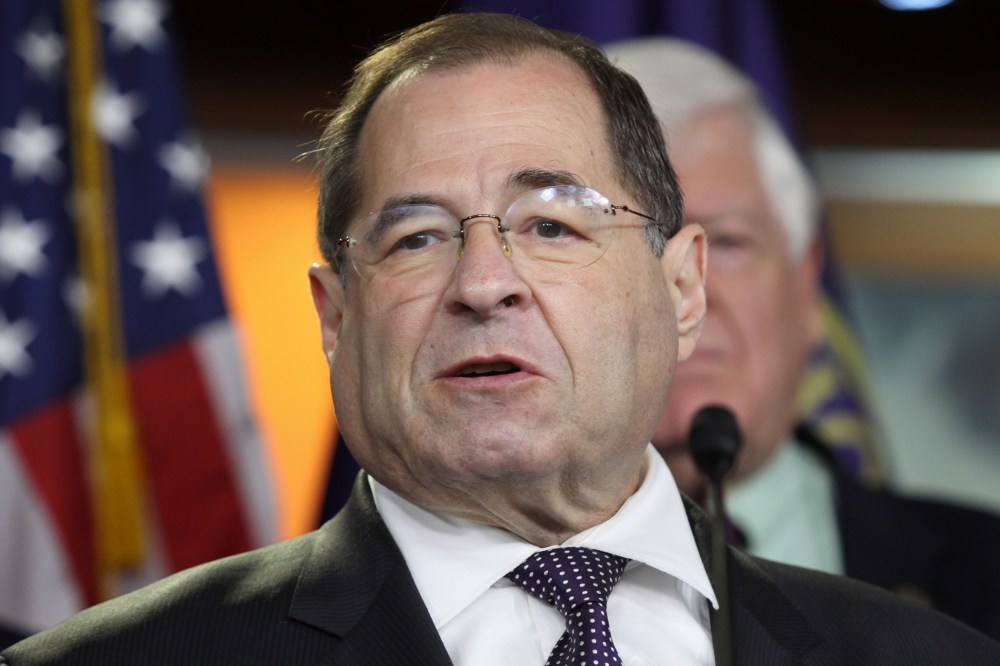
President Barack Obama’s controversial nuclear deal with Iran received an important boost on Friday from Democratic Rep. Jerrold Nadler of New York, who announced he would support the agreement.
The endorsement makes Nadler the only Jewish New Yorker in Congress to approve of the deal, which is being seen as a win for Obama even as other Democratic lawmakers in the Empire State — including Sen. Charles Schumer and Reps. Eliot L. Engel and Steve Israel — have refused to back the accord.
%20%E2%80%9CI%20have%20sought%20to%20ignore%20the%20political%20pressures%2C%20as%20well%20as%20the%20demagoguery%20and%20hateful%20rhetoric%20on%20both%20sides%20…%22′
“I bring to my analysis the full weight of my responsibilities as a member of Congress, and my perspective as an American Jew who is both a Democrat and a strong supporter of Israel,” Nadler said in a statement after receiving a personal letter from Obama addressing some of his concerns. “I have sought to ignore the political pressures, as well as the demagoguery and hateful rhetoric on both sides that I think has been harmful to the overall political discourse.”
Nadler, whose district is believed to have the country’s largest Jewish population, added that while the deal isn’t perfect, rejecting it “would almost certainly result in a far greater likelihood of Iran developing a nuclear bomb in relatively short order.”
RELATED: The Iran deal whip: Where does your senator stand?
The commander-in-chief has been trying to drum up congressional support ahead of a looming vote on the agreement in September. Under the deal, which the U.S. and other world powers hammered out with Iran, the Islamic Republic would curb its nuclear program in exchange for billions of dollars in relief from economic sanctions.
Most Republicans and a handful of Democrats are against the accord. They argue that the deal doesn’t do enough to force Iran to halt its nuclear program, that sanctions relief would allow the regime to increase its funding of anti-Israel terrorist organizations like Hamas and Hezbollah, and they question whether International Atomic Energy Agency inspections will be effective.
The big question is if there will be enough votes to override a presidential veto. There would have to be at least 13 Democrats in the Senate and 44 Democrats in the House willing to side with Republicans, assuming all of them vote against the deal.
As things stand, Congress is unlikely to override the veto, according to a Washington Post analysis. Only 12 House Democrats have said they are against it while two Democratic senators — Schumer and Bob Menendez of New Jersey — have said they will oppose the deal. Obama continued his push for the deal this week with an op-ed in Mendendez’s hometown newspaper. “The idea that we can get a better deal by talking tough or squeezing Iran into submission with more sanctions is simply not realistic,” Obama wrote in the Star-Ledger, pushing back at an argument made by critics including Schumer and Menendez. “The international unity we spent years building—the unity that brought Iran to the negotiating table—would be destroyed if this deal is rejected.” Meanwhile, a new poll by CNN/ORC suggests Obama may have to do more to convince the American public — not just lawmakers — that he’s doing a good job dealing with Iran. More than half — 60% — said they disapproved of the president’s management style when it comes to the country’s relationship with Iran.Recommended


