








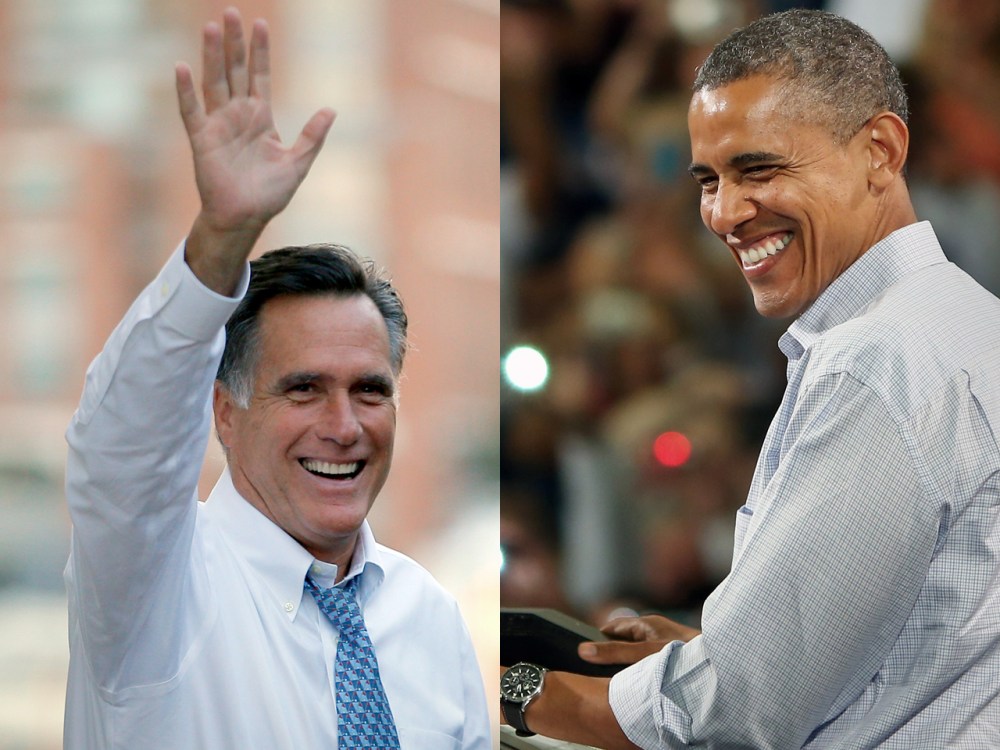
A week after President Barack Obama’s lackluster debate performance, Republican challenger Mitt Romney has made some gains in three key swing states among those most likely to vote, according to the latest round of NBC News/Wall Street Journal/Marist polls.
Romney and Obama remain in a virtual tie in Virginia and Florida, and the Democratic incumbent maintains a slight advantage in Ohio.
Romney saw his largest gain in Virginia, where he now edges the president 48 percent to 47 percent, a 3-point reversal from last week’s poll, released the day of the first presidential debate. The spread is within the poll’s margin of error.
In Florida, before the debate, it was a 1-point race with Obama leading 47 percent to 46 percent. Now, it is still a 1-point race with Obama leading 48 percent to 47 percent.
In Ohio, where there has been a renewed focus by the Romney campaign after the former Massachusetts governor’s strong debate performance, Obama leads 51 percent to 45 percent. That’s a 2-point uptick for Romney.
But the Ohio poll also included an 11-point advantage for self-described Democrats — 40 percent to 29 percent for Republicans. Last week’s poll had a narrower 5-point advantage for Democrats. . (In 2008, the party identification split was 39 percent Democrat and 31 percent Republican, according to exit polls.)
One factor that may have pulled the party ID more heavily toward Democrats in this poll was early voting. One-in-five respondents (18 percent) said they have already voted, and, of those, almost two-thirds (63 percent) said they voted for Obama.
The ideological makeup in this poll was 22 percent liberal, 32 percent moderate, 46 percent conservative, which is actually less moderate and more conservative than four years ago when it was 20 percent liberal, 45 percent moderate, and just 35 percent conservative, according to the exit poll.
When early voters are taken out of the equation, Obama’s lead shrinks to 48 percent vs. Romney’s 46 percent.
“Perhaps the poll is picking up the Obama absentee push,” said Barbara Carvalho, director of the Marist poll.
“By way of methodology, last week there was no question about absentee voting in the Ohio survey. It had not yet started. … Those who said they voted absentee in the past week, since absentee voting started in Ohio, are overwhelmingly Democratic and they voted for the president by a wide margin. This can account for a difference in party identification among likely voters because last week they would have been ‘likely voters’ and this week because absentee voting had started, they are ‘definite voters.’”
There are signs that Romney’s debate performance had an impact with the narrow slice of persuadable voters.
In all three states, the overwhelming majority of voters said they made up their minds before the debate — 92 percent in Florida and Ohio, and 91 percent in Virginia. Just 7 percent in Virginia, 6 percent in Florida, and 5 percent in Ohio said they decided after the debate. But in all three states, Romney won them.
“The debate helped Romney but most voters had already picked sides,” Carvalho added.
Romney also made significant gains with independents in Virginia and Ohio. In Virginia, Romney jumped 7 points with the group — from a 45 percent to 44 percent statistical tie to a 50 percent to 42 percent lead.
In Ohio, he got an even wider 12-point boost. He was down 47 percent to 43 percent with them. But now, Romney is up 49 percent to 41 percent. In Florida, there was little change. Romney also improved his image post-debate in all three states, but he’s still viewed more negatively than positively in Ohio. Romney’s favorable score has jumped to 49 percent in Florida and Virginia, up from 46 percent in Florida and 45 percent in Virginia. In fact, before the debate in Virginia, Romney was viewed more negatively than positively. Now, that’s reversed. Neither score is as good as the president’s, who continues to enjoy favorable ratings above 50 percent in all three states. Obama’s approval rating also held steady — 48 percent in both Florida and Virginia and 47 percent in Ohio. Obama continues to be bolstered by women. There’s a 13-point gender gap in Florida, and 12-point gaps in Ohio and Virginia. In the key Senate races, Democrats lead, but the race in Virginia has narrowed back to a tie. Many observers believe as goes the presidential race in Virginia, so goes the competitive Senate race. And that very well may be the case, as Democrat Tim Kaine and Republican George Allen are once again deadlocked. Kaine holds the narrowest of advantages, 47 percent to 46 percent. Last week, Kaine led by 5 points, 49 percent to 44 percent. In Florida, incumbent Democratic Sen. Bill Nelson continues to hold a sizable lead over Republican Rep. Connie Mack, 52 percent to 39 percent, about where it was last week. In Ohio, incumbent Democratic Sen. Sherrod Brown continues to hold a significant advantage, 52 percent to 41 percent, over Republican challenger Josh Mandel. Last week, Brown led 50 percent to 41 percent. The polls were conducted from Oct. 7-9 and have a margin of error with likely voters of +/- 3.1 percent.
Domenico Montanaro Recommended


