








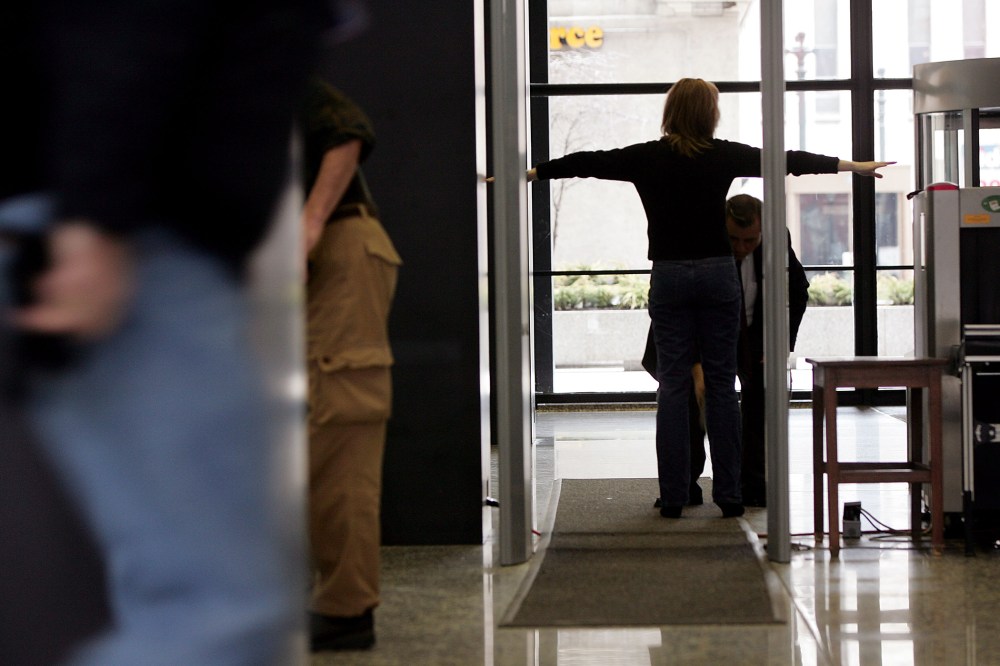
Coming soon to a theater near you: metal detectors and pat-downs.
Or at least that’s what nearly one-third of moviegoers in America would be willing to endure in the wake of deadly theater violence, according to a study conducted last week by research firm C4.
Debate over increasing security measures — and whether they would be effective in stopping such rampage — remains in the spotlight following yet another random attack Wednesday in Tennessee.
RELATED: Cousins Amy & Chuck Schumer take on gun control
Vincente David Montano, 29, was armed with an airsoft pellet gun, pepper spray and ax when he ambushed patrons during an afternoon screening of “Mad Max: Fury Road,” Nashville police said. No one suffered serious injuries before Montano was killed by police.
The incident comes almost two weeks after a gunman shot 11 people, including two fatally, at a Lafayette, Louisiana, theater before turning the weapon on himself.
Other high-profile cases include the fatal shooting of a Florida man who was texting during a movie, and of course Colorado theater gunman James Holmes, who faces the death penalty for killing 12 people in 2012.
A witness to the Lafayette rampage, Jacob Broussard, said Thursday that he would support heightened security measures if they mean possibly saving lives.
“With the events that happened yesterday (in Tennessee), we really need something to make it safe,” Broussard told NBC News. “Metal detectors or some sort of screening would help make the movies safe.”
He added that the perceived hassle of extra security wouldn’t take away from his personal movie theater experience.
“Some people will be against it for sure. But I’m for it — and anyone else who was in Lafayette would be for it,” Broussard said. “If it’s safer for everyone then it’s worth it.”
But security expert Michael Dorn estimated that it would cost $250,000 to $1 million for a multiplex theater to install equipment and have armed officers each year, making the additions cost prohibitive.
“I fear that we may use the facade of metal detection to make people feel safer,” said Dorn, executive director of Safe Havens International, a Georgia nonprofit that consults with schools and other facilities about security.
Dorn also said that in a situation like a movie theater, security enhancements could result in longer wait times to get in. Long lines outside the theater could also present a new target for anyone wanting to stage an attack.
A more feasible security solution, he said, would be hiring law enforcement and armed security personnel to guard the lobby and parking lot areas. “Having a police officer in the lobby or a parking lot, that can prevent much more common attacks,” he said. “The last movie I went to there was an officer in front. We may start to see that more and more.” He added that the larger issue at hand remains mental health. Sen. Charles Schumer, D-N.Y., and his cousin, actress Amy Schumer, addressed that issue when they announced a bill Monday to reward states that submit records on felons, spousal abusers and the mentally ill to the federal background check system. The National Association of Theater Owners declined to address the issue of increased security. But one independent theater owner in Michigan told NBC News that the incidents are still rare enough that they don’t warrant an overhaul of the industry’s practices. “Where do you draw the line? Things happen in malls — do we put metal detectors there?” owner Dan Taylor asked. “I think the answer is simple: vigilance and people reporting suspicious activity.” This article originally appeared on NBC News.com
Erik Ortiz
Jacquellena Carrero Recommended


