








A move by the prosecutor presiding over the grand jury in the police shooting death of Michael Brown to continue the jury proceedings until January has angered many of Brown’s supporters who see the extension as a political maneuver and a slap in the face.
St. Louis County Prosecutor Bob McCulloch announced this week that the jury now has until Jan. 7 to determine whether or not Ferguson police officer Darren Wilson should be indicted on criminal charges in the Aug. 9 shooting death of Brown.
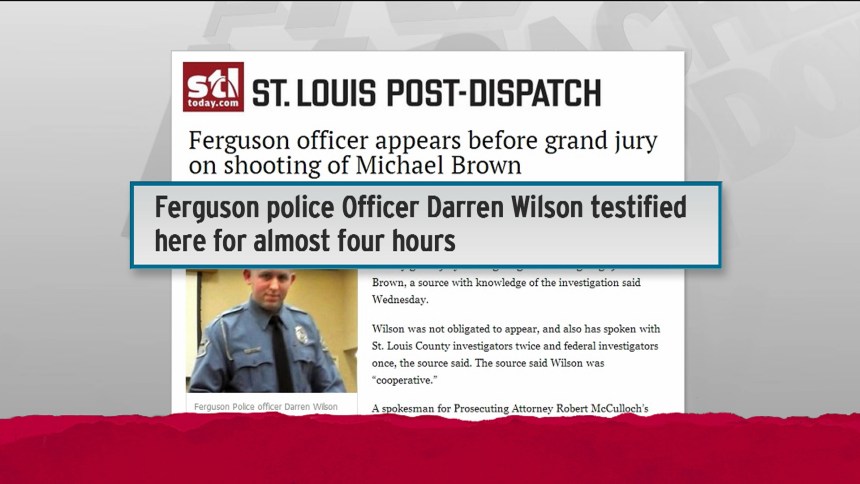
Wilson, after more than a month in hiding, emerged publicly for the first time on Tuesday to testify before the grand jury, according to the St. Louis Dispatch. Wilson has been on paid administrative leave since the shooting. He delivered nearly four hours of testimony before the grand jury, according to a source close to the investigation who spoke with the Dispatch.
Wilson was not legally bound to testify, but according to the Dispatch’s source, the officer was “cooperative.”
In the wake of protests and violence following Brown’s killing in Ferguson, Missouri, McCulloch said the jury would likely issue a decision by October.
%22Moving%20the%20grand%20jury%20back%20to%20January%20was%20like%20throwing%20gasoline%20on%20a%204-alarm%20fire.%22′
“Moving the grand jury back to January was like throwing gasoline on a 4-alarm fire,” said Patricia Bynes, a Democratic committeewoman for Ferguson. “People are angry and they see this as political manipulation. To think that it’s going to take this long, 5 to 6 months, to look at the evidence and say we may need a trial, is pissing people off.”
“This has energized the people even more,” Bynes said.
Many supporters of Brown and his family have called for McCulloch to step down and be replaced with a special prosecutor. Critics say his close ties to law enforcement, his past inability to successfully bring charges against cops who kill blacks and a well-known family history that includes his police officer father being killed on duty by a black assailant, make him unable to objectively prosecute the Brown case.
PHOTO ESSAY: How the crisis in Ferguson unfolded, in photographs
McCulloch has said publicly that he has no plans to step down. He has promised fairness and transparency and said this week that if the grand jury opts to not indict Wilson, he would release all transcripts and audio of the grand jury’s proceedings.
In a move that some found surprising, McCulloch said that he will be presenting all the evidence in the case to grand jurors to allow them to determine whether or not to indict Wilson. Typically a prosecutor will offer jurors a set of recommended charges. In this case, McCulloch, has declined to do so. Instead, the grand jury is being fed every shred of evidence in pieces as the prosecutor’s office receives it, rather than waiting for the county and federal probes to be completed, as is common practice.
%22The%20prosecutor%20may%20want%20cover%2C%20which%20they%20can%20get%20by%20sharing%20the%20responsibility%20with%20the%20grand%20jury.%22′
“The prosecutor may want cover, which they can get by sharing the responsibility with the grand jury,” Susan W. McGraugh, a criminal-defense lawyer and professor at the Saint Louis University School of Law, told The Washington Post. “So when the public reacts to what does or does not happen, they can go back to the fact that the grand jury played a large role in the decision. They can say, ‘We let these jurors, who are your peers, hear what witnesses had to say. This was their decision.’ ”
She said it’s legal and is sometimes used in high-profile cases.
Benjamin Crump, an attorney for Brown’s family, told MSNBC last week that the grand jury is being used as a “smoke screen.”
“There’s enough probable cause that exists to indict the officer now,” Crump said. “We don’t need this grand jury.”
Police say Wilson shot and killed Brown during a struggle over Wilson’s gun. Brown was struck six times, according to an independent autopsy released by the 18-year-old’s family. More than a half-dozen witnesses say Wilson shot Brown as he attempted to flee and that the final gunshots came as Brown turned around with his hands up in surrender.
Wilson has since been placed on paid administrative leave and his whereabouts have been kept secret.
Protesters have ramped up their calls for McCulloch, a Democrat, to step down and have even threatened to support Republicans in upcoming elections to hurt his political allies.
On Tuesday night, protesters packed a St. Louis County Council meeting and disrupted the meeting with chants including “Arrest Darren Wilson!”
Much of the anger from protesters was directed at Steve Stenger, a Democratic councilman and McCulloch friend facing Republican state representative Rick Stream in the November general election for county executive.
Several speakers demanded that Stenger call for McCulloch’s resignation and gave him until noon on Wednesday to get it done.
Protesters chanted, “Twelve noon, Stenger! Twelve noon, Stenger!” “We will do everything in our power on election day because we see you sitting there with a smug look on your face,” one speaker told Stenger, according to the St. Louis Dispatch. “We will have our say in November when we go to vote.” Patricia Bynes, the Democratic Committeewoman, said the disruption of Tuesday’s county council meeting was a clear sign that the energy behind the Michael Brown movement is far from waning and that supporters are becoming more politically engaged in the process. “The meeting last night was actually one of the more impressive political statements that people have made,” said Bynes, who said the crowd grew so thick at the meeting that attendees filled overflow rooms. “Stenger is running for county executive in November and people were very honest in saying we are not voting for you and letting him know that. This is the most political I’ve ever seen of one these meetings.” %22I%20think%20basically%20it%E2%80%99s%20a%20prequel%20to%20a%20non-indictment.%20I%20think%20they%E2%80%99re%20waiting%20to%20January%20because%20they%20want%20people%20to%20fade%20and%20for%20the%20movement%20to%20fizzle%20out%20in%20the%20cold%20weather.%22′ Umar Lee, a St. Louis cab driver and supporter of Brown’s who has been involved in protests since shortly after his death, called the decision by the prosecutor to extend the grand jury a “tactical decision.” “I think basically it’s a prequel to a non-indictment,” said Lee, who was among hundreds of protesters arrested during the first month of street actions in Ferguson. “I think they’re waiting to January because they want people to fade and for the movement to fizzle out in the cold weather.” Lee said the move may have had the opposite affect. “We were at the county council meeting last night and it was packed, very energetic,” said Lee. “You saw a new phase of the campaign. It’s moving not just from a protest phase and street phase to a political and judicial phase … because a vote for Steven Stenger is a vote for Bob McCulloch, because Bob McCulloch made Steven Stenger.” McCulloch was a chief ally in Stenger’s recent primary win over County Executive Charlie Dooley just days before Brown’s killing. Lee is among a growing number of protesters calling for supporters to add Michael Brown’s name to the November election as a write-in candidate challenging Stenger. Protesters promised to ramp up actions if McCulloch doesn’t step down and if they don’t get justice. One speaker, according to reports, likened officials to terror groups, saying “You are ISIS to black people.” Others threatened to shut down upcoming sporting events in St. Louis, including Sunday’s St. Louis Cardinals and Rams games. Filing out of the meeting, demonstrators gathered in the lobby and held four and a half minutes of silence, representing the four and a half hours that Brown’s body was left uncovered in the street after the shooting. Then, they marched from the building and into the night, headed for prosecutor McCulloch’s office.
Trymaine Lee
Trymaine Lee is an NBC News correspondent. Recommended


