








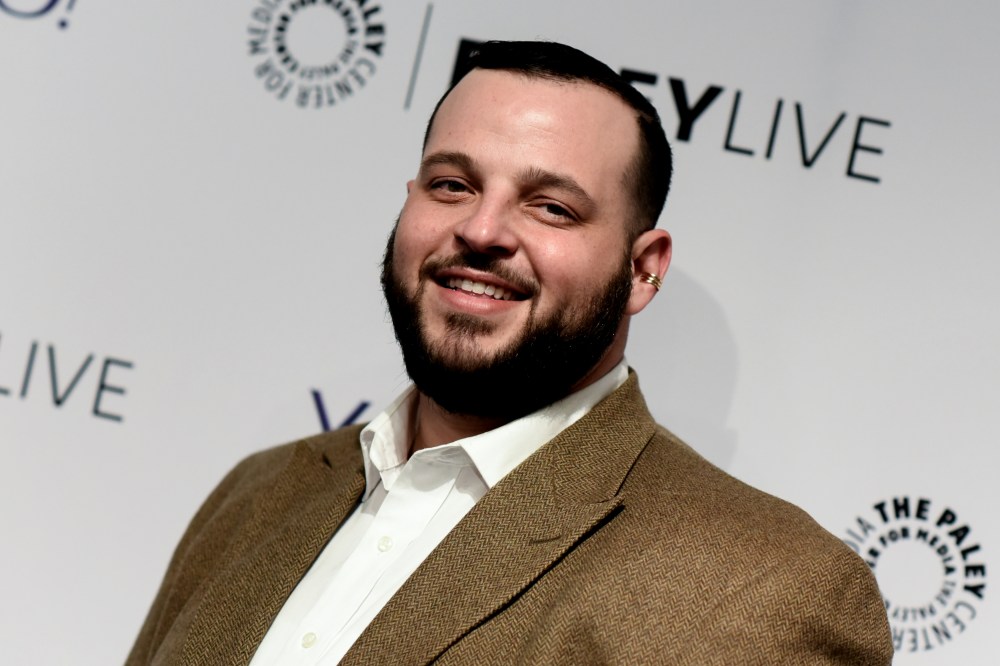
The central love story on HBO’s “Looking” is portrayed by two actors, Jonathan Groff and Russell Tovey, who flaunt an incalculable amount of body fat and abs galore — but it is self-described “big dude” Daniel Franzese who’s enjoying the limelight.
When “Looking” first aired, Franzese wasn’t watching it for the same reasons he had not watched similar shows: There wasn’t a character who looked like him. He joined the cast in the show’s second season, which concludes Sunday evening.
After realizing that the casting director was Carmen Cuba, the woman who had cast him in his first film, Bully, in 2001, Franzese sent her some photos with a note along the lines of, “‘Well if you ever need a sexy bear …’” he told msnbc.
The shows’ creators were indeed looking to add a character with his body type and Franzese, who at the time was making waves in the press as he reunited with the “Mean Girls” cast, was their top choice.
“I met with Andrew Haigh for breakfast, and he offered me the role. And essentially he told me during the role that I would be portrayed in a sexy light as a big bear, and I thought that that was something really progressive and groundbreaking,” Franzese said of his meeting with the show’s executive producer.
%22No%20matter%20what%20your%20size%20or%20your%20age%20or%20your%20color%20or%20your%20status%20or%20anything%2C%20you%20too%20are%20worthy%20of%20being%20loved%22′
But those with a different body type weren’t the only ones who were about to see themselves portrayed on screen in Franzese’s character, Eddie, who is also a happy and healthy man living with HIV.
For Franzese, this unsought HIV twist hit home on a personal level. When one of his best friends was diagnosed HIV-positive, Franzese helped connect him to care through his friend Quinn Tivey, the grandson of the late Academy Award-winning actress and fierce HIV/AIDS activist Elizabeth Taylor. He in turn became a leading supporter of the foundation in her name.
More than 30 years have passed since the HIV/AIDS outbreak, and while infections continue to rise, until this month, Franzese played the only openly regularly appearing HIV-positive character on television.
“That evoked some odd feeling inside me, feeling like it shouldn’t be that way if 1.2 million people are living with HIV,” he said. “It didn’t seem enough that I was the only person representing that.”
With the Elizabeth Taylor AIDS Foundation and GLAAD, Franzese is partnering on an initiative to reach out and have Hollywood recommit to telling more stories about people with HIV and AIDS. The night before msnbc exclusively broke the news about this new initiative, a character was diagnosed as HIV-positive on the season finale of “How to Get Away with Murder.”
“We live in a very interesting and diverse world, and the more that we can see interesting and diverse characters, of all sizes, statuses, and everything else appear on screen, and the more that people can see themselves represented, I think the more we’re really being true to the art form of filmmaking,” Franzese said.
Both characters in these shows have love interests that are HIV-negative, and in “Looking,” this has allowed creators to start perhaps the first story arc about a revolutionary new HIV prevention medication known as PrEP, a one-pill a day regiment that studies have shown to reduce HIV infections in men by up to 92%.
“I think that it alleviates a lot of the stress that Agustin is having in starting a relationship with my character Eddie, and I feel that this might create examples of how it could become a possibility in the near future of the story,” he said.
%22There%E2%80%99s%20nothing%20more%20life%20affirming%20than%20coming%20to%20a%20show%20where%20not%20only%20is%20it%20OK%20to%20be%20gay%2C%20but%20it%E2%80%99s%20cool%20to%20be%20gay%22′
These story lines are starting conversations that will spread information over stigma, a valuable tool in stopping the spread of HIV/AIDS, Franzsese said.
“I wasn’t aware that we were that far along in AIDS research, and so if we have those tools right now people need to be aware of them,” he said. “And they need to be educated about them, because we could finally eradicate this disease once and for all.” “Looking” isn’t the first time that Franzese played a gay man of above average weight. As “too gay to function” Damian on Tina Fey’s “Mean Girls,” Franzese may have played the gay friend sidekick, but to him, the role meant something much larger. “’Mean Girls’ was the first time that I was able to see a chubby gay teen, and for him to have a story arc, and for him to be a part of the movie instead of him just being a laughing matter, and even in a comedy, I think Damian was cool,” Franzese said. “People liked Damian, and I think that that freed a lot of people.” But while Franzese was playing an openly gay teen, he was a 26-year-old who wouldn’t come out of the closet for a decade, in part because of fears that it would hurt his career in Hollywood. “I was filming ‘Mean Girls’ and still pretending to be straight off set to everyone that I worked with,” he said. “So I felt really a lot of pressure, and there was pressure from the industry, from my reps, that it wasn’t necessarily like you better not say you’re gay. It was more like well you don’t have to, which sort of fueled the fire in me keeping my life a secret.” But now Franzese is more than happy in his own shoes, and he’s found a home with one of the most inclusive shows ever of gay men on television. “I’ve never felt more comfortable in my life,” he said of working with the cast of “Looking,” where the show’s main characters are all openly gay, as well as some of the actors. “As a gay man who just came out last year, there’s nothing more life affirming than coming to a show where not only is it OK to be gay, but it’s cool to be gay,” he said. With “Mean Girls” and “Looking” now under his belt, Daniel Franzese may have started a movement. “No matter what your size or your age or your color or your status or anything, you too are worthy of being loved,” he said.
Joseph Neese Recommended


