








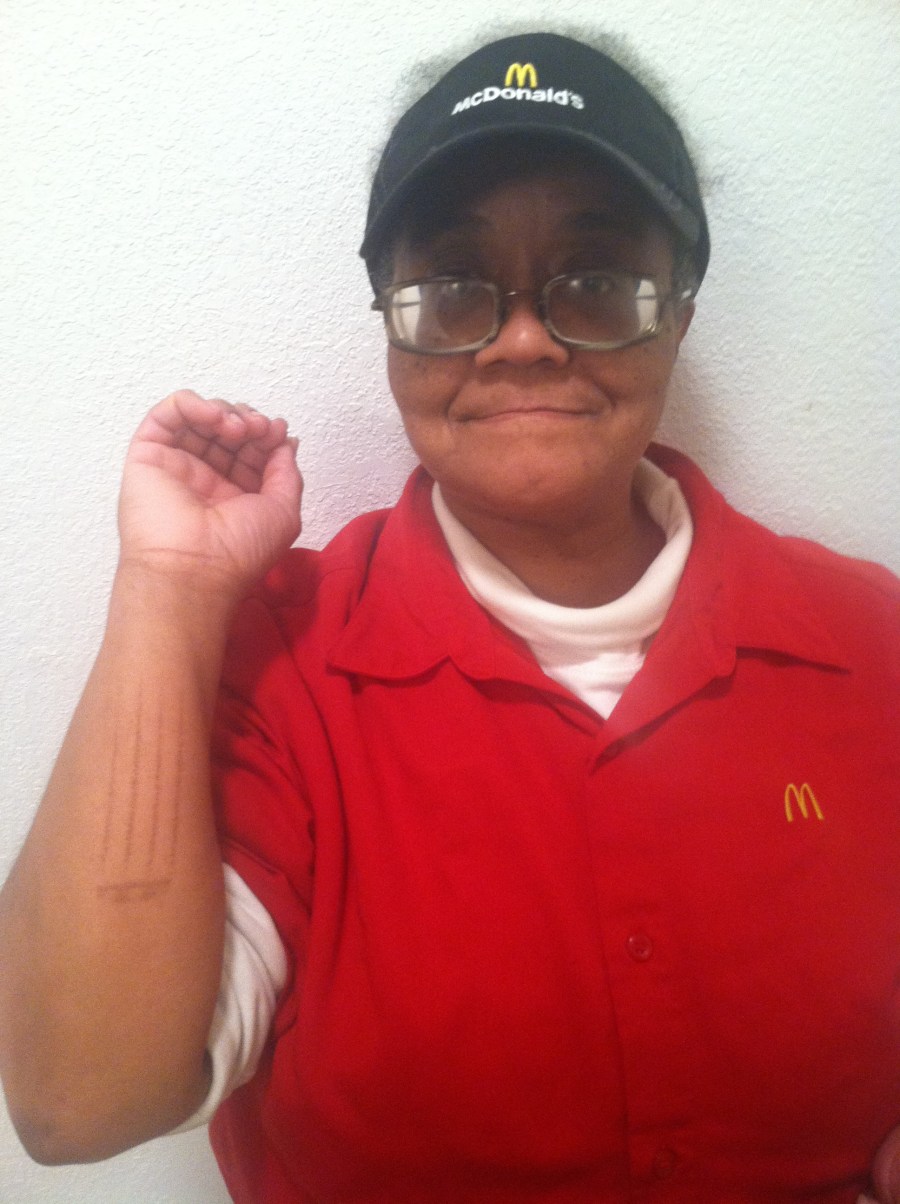
“Put some mustard on it.” That’s the advice that Chicago McDonald’s worker Brittney Berry allegedly received from her manager after suffering a scalding burn on her arm from the grill used to make eggs. And this was no minor burn — she was eventually taken to the hospital in an ambulance, and had to miss work for six months.
This McDonald’s worker’s story is shocking, but not unique — McDonald’s workers who have suffered severe burns on the job recently filed 28 health and safety complaints against the company in 19 cities. Many workers reported nearly identical stories of managers dismissively telling them to treat burns with condiments like mustard, mayo, or ketchup.
%22Put%20some%20mustard%20on%20it.%22′
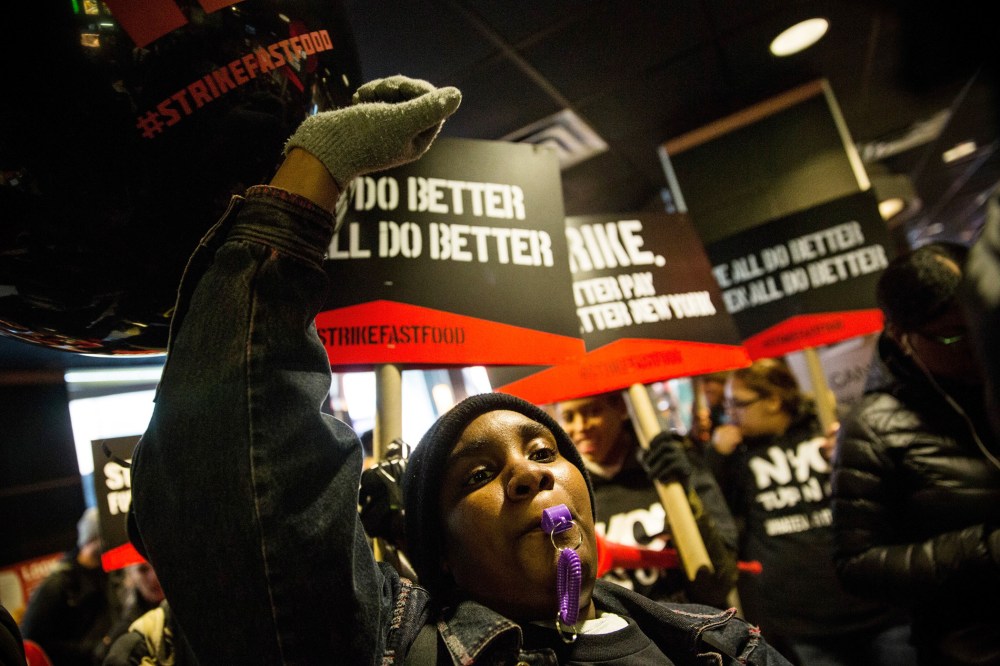
These horror stories of McDonald’s managers showing blatant disregard for workers’ health and safety are certainly eye-opening, but they also point to a bigger underlying problem: without a real voice on the job, workers have nowhere to turn to demand accountability for egregious conditions faced at the workplace.
A worker-led organization at a company like McDonald’s could address this problem, by empowering workers to demand precisely the accountability that is sorely lacking at the company today. This type of organization could take many forms, but regardless, it’s clear that an organization or union of some kind that gives workers a collective voice on the job remains an urgent priority, and would be for the better of workers and the company as well.
RELATED: Fast food workers’ strike fueled by other low-wage employees
To understand the importance of this kind of worker organization, consider that the McDonald’s workers who filed these health and safety complaints cite factors like understaffing and pressure to work too fast as the top reasons for the their burn injuries. These hazardous conditions are created by the fact that the company dictates the pace of work and staffing levels according to a bottom line that does not incorporate the resulting dangers posed to workers. If workers at McDonald’s had any collective input over these conditions, they could stand together to ensure that their safety is taken into consideration as well.
Consider another example: Last year, more than a dozen African-American workers at three McDonald’s restaurants in Virginia were reportedly fired simultaneously by the store’s highest-ranking managers, who offered no explanation aside from wanting to “get the ghetto out of the store.” Many of these workers informed McDonald’s that they had been fired because of their race, but the company simply ignored their call, and actually referred them back to the same store owner that had just fired them.
These workers have now filed a major federal civil rights lawsuit against the company, alleging a pattern of racial discrimination, harassment, and wrongful termination. But if there were a worker organization or union at McDonald’s, then these workers would have been able to stand together to demand fair treatment and respect – and protection from an abusive manager – without having to go to court.
RELATED: Workers file civil rights suit against McDonald’s And only at a company where workers truly have no voice on the job could managers get away with flagrantly stealing from workers’ paychecks. In March of last year, McDonald’s workers in three states filed class action lawsuits against the company, alleging systemic wage theft – workers reported that managers would erase hours from their timecards, refuse to pay overtime, and simply force workers to go off the clock. %22Without%20a%20real%20voice%20on%20the%20job%2C%20workers%20have%20nowhere%20to%20turn%20to%20demand%20accountability.%22′ Against the odds, fast-food workers striking for $15 an hour and union rights have managed to capture the nation’s attention, and have drawn praise from the likes of President Obama and Hillary Clinton. But even with the support of powerful leaders, as long as workers at McDonald’s lack a means for standing together on the job, it’s still the case that managers can get away with telling workers to treat serious burns by putting some mustard on it. It’s encouraging to see Democrats increasingly pointing to unions as a way to address inequality — but it’s important to remember that collective bargaining can also play an important role in addressing a range of hazardous working conditions facing low-wage workers today. And with problems over health and safety, racial harassment, and wage theft continuing to mount at McDonald’s, a worker organization at the Golden Arches could be the right place to start. Catherine Ruetschlin is senior policy analyst at Demos and a national thought leader on issues facing low-wage workers.
Catherine Ruetschlin Recommended


