








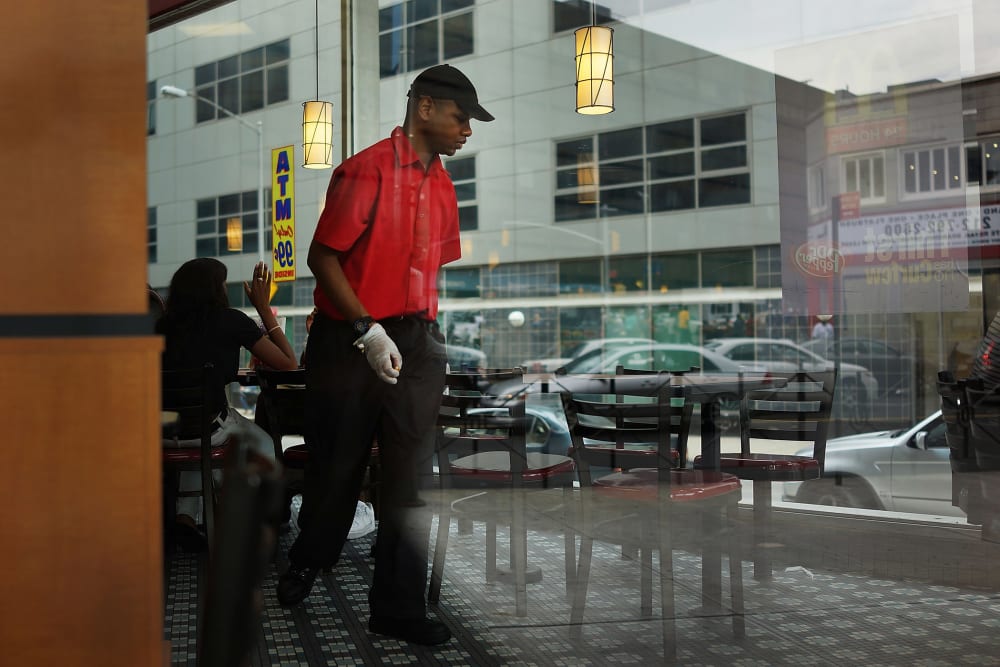
McDonald’s made a bit of a splash this week when it announced it will soon raise starting pay for employees by $1.00 over local minimum wage rates. According to the company, this will bring average hourly wages of covered employees to $9.90 by July 1 of this year, and to more than $10 by the end of 2016.
While any wage increase is good news, the devil is in the details — and the details here show how far short the company’s gesture falls in ensuring that the hundreds of thousands of people working for a living at McDonald’s can actually make a living from their work.

The planned increases extend only to individuals working at restaurants directly owned by McDonald’s, benefiting roughly 90,000 employees but excluding more than 700,000 others who perform the same jobs in the company’s franchised operations. And, at an average wage of only $9.90 this year, even the typical employee getting a raise will still have earnings that barely top the poverty level for a family of three—assuming she works full-time, year-round, a rarity for most workers in fast food.
The company’s announcement came one day after plans became public for the biggest-ever strikes by fast-food workers — walkouts in 200 cities set for April 15. Indeed, McDonald’s announcement is a tribute to several years of courageous advocacy by fast-food employees who overcame fears of retaliation to join the Fight for $15 campaign, putting the issue of living wages and freedom to join a union front and center. And as with other recently-announced wage hikes by major national corporations, the increases promised by McDonald’s are progress in the Fight for $15.
But this modest step falls well short of what’s needed to convert McJobs into good jobs that can support the hundreds of thousands of workers around the country who sell McDonald’s goods and burnish the company’s brand. McDonald’s can and should do more to raise workers’ pay and to sit down at the bargaining table with its employees to discuss other workplace issues, like the burns detailed in a series of complaints filed with the Occupational Safety and Health Administration last month.
RELATED: McDonald’s workers need a voice
Seventy percent of McDonald’s employees are adults, many of them supporting families. They’re not looking to work a few hours a week to earn a little extra spending money, nor is a fast food job merely a temporary stopping place on their road to high-end careers in other fields.
This%20modest%20step%20falls%20well%20short%20of%20what%E2%80%99s%20needed%20to%20convert%20McJobs%20into%20good%20jobs%20that%20can%20support%20the%20hundreds%20of%20thousands%20of%20workers%20around%20the%20country%20who%20sell%20McDonald%E2%80%99s%20goods.’
Instead, as low-wage sectors like fast food, home care, retail, janitorial, and food services account for ever-larger shares of employment, growing numbers of workers are finding that they are spending years, if not entire careers, laboring under the Golden Arches. The only way to make these high-growth jobs the kind we need to rebuild the middle class and sustain a healthy economy is through higher wages, better working conditions, and a voice on the job for the men and women who spend their lives earning their livelihoods from them.
That’s why workers and their allies around the country aren’t swayed by piecemeal gestures and are doubling down in their Fight for $15. That means taking to the streets to show how hard it is to work for a living, and yet not be able to make a living from work. It means pushing for policy change to ensure accountability by profitable mega-corporations that make the rules and reap the rewards from the labor of workers who do the companies’ bidding and generate its profits, regardless of the label—like the McDonald’s franchise model—the company attaches to its employment arrangement with those workers. It means going to court to enforce hard-won worker rights against all the businesses responsible for violations. And it means continuing to take risks, even putting jobs on the line, in order to build better workplaces and a fairer economy that will enable workers to provide for today and prepare for tomorrow. The Fight for $15 is the most urgent battle for economic justice in America today—and for a future in which work delivers on the promise of economic opportunity and security for all of America’s workers. Christine Owens is the executive director of the National Employment Law Project.
Christine Owens Recommended


