FLINT, MI — By now you’ve probably heard that this proud American factory town is facing a state of emergency, subsisting on rationed water after its own supply was spiked by lead. But on Wednesday night — in a special edition of “The Rachel Maddow Show” — the leaders of Flint spotlighted something you probably haven’t heard: the problem here isn’t actually being fixed.
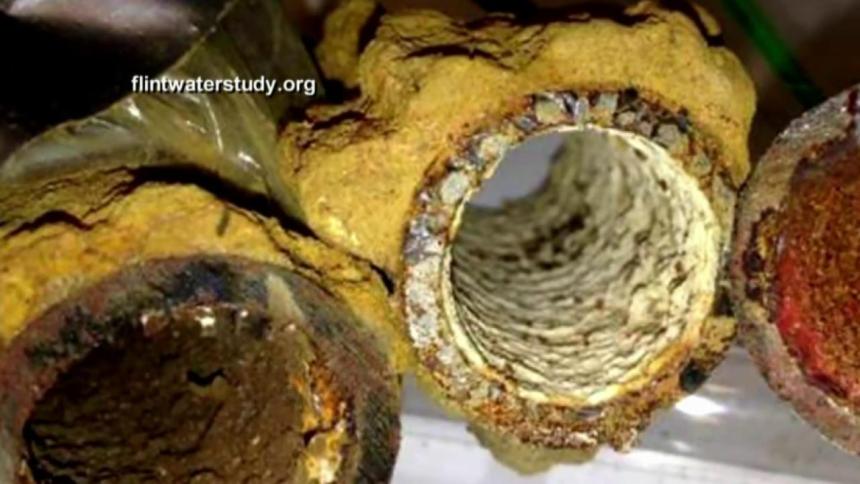
In “American Disaster: The Crisis in Flint,” host Rachel Maddow brandished a long bar of lead pipe to explain the delay and kick-start a freewheeling town hall aimed at solutions. The pipe is part of hundreds, if not thousands, of miles of lead-corroded plumbing and service lines. They vein the city, unseen and actually safe if the water flowing through them is properly treated.
Flint’s water was not, the state now acknowledges.
RELATED: An American Disaster: The Crisis in Flint
As a result, when the city — under the undemocratic direction of a state-appointed manager — switched its water supply to the more corrosive Flint River, the pipes started to bleed metal. Lead leached into the city’s drinking supply, exposing 100,000 people to the toxin, including about 9,000 children under the age of six.
Months after this problem was first acknowledged, and weeks after the state declared a disaster, the damaged pipes of Flint are still in the ground, Maddow reported. The water is still undrinkable, and there’s no timetable for when the pipes will be replaced and the issue rectified.
“Our trust has been broken in the city of Flint,” said Flint’s mayor Karen Weaver, “and until we get safe pipes people are not going to trust the water.”
The MSNBC special was shot before a live audience of Flint families and school officials inside the Brownwell/Holmes STEM Academy, a telling location given its troubled status as one of three Flint schools where the water inside was tainted by a dangerous level of lead. No lead is safe, according to health experts, but Brownwell/Holmes was polluted well beyond the federal limit.
Lead is an “irreversible neurotoxin,” Dr. Mona Hanna-Attisha told the audience on Wednesday. As a pediatrician at Hurley Medical Center, she was the first to confirm the elevated levels in Flint’s children. In some areas, she founded that the percentage of kids affected had doubled or tripled.
In her opinion, educators and health officials have to respond to Flint as a community-wide problem, because every person in the has been unknowingly exposed to months of poisonous water, which researchers have attributed to lower IQs, behavioral problems, and a cascading list of poor health outcomes, especially in children.
But Dr. Hanna-Attisha brought a redemptive message, too: “Every kid in Flint is at risk,” she said, “but there are things that we can do” to mitigate the impact of lead, especially in children. As cheers filled the room, she outlined the basics of a healthy childhood, including wholesome food and top notch education. She called it a “whole child approach,” one strong enough to “take these lemons and make lemonade.” That’s easier said than done in Flint, a city where 40 percent of the population is below the poverty line.
But there is hope here now like there wasn’t before, according to Mayor Weaver.
This long-struggling city is slowly gaining back some powers of self-governance. It’s also coming to grips with what it will take to actually fix those pipes. Marc Edwards, a professor of engineering at Virginia Tech University, detailed the issue alongside University of Michigan professor Martin Kaufman.
RELATED: Who’s really at fault for the Flint water crisis
The first thing is to find out exactly where the decades-old pipes are located. Kaufman is working on that painstaking task, gathering input from residents and cross referencing it against hundreds of hand-written index cards on file with the city.
After that, the pipes will have to be addressed in stages. In the short term, they’ll need to be re-coated with a film to hold in the lead. In the long term, the only fix is ripping them out — every mile of them. No American city has ever done it.
“What we’re struggling with here is that there is really no precedent for this kind of man-made disaster,” Edwards told the audience. State officials have in recent days said that tests suggest that the amount of lead in Flint’s water is falling. Maybe so, said Edwards, but the crisis hasn’t passed. He puts Flint’s odds of passing a federal water quality test at about 50/50 — far too long to risk it.
Michigan Governor Rick Snyder has apologized for the crisis, blaming it on the errors of experts in his department of environmental quality. He says the state is developing long-term solutions. That’s supposed to mean help for Flint’s kids, whose symptoms — delayed speech, difficulty learning, stunted motor skills — could lay dormant for years.
It also means investigating the human source of this problem and holding that person to account. The governor or members of his administration may even face criminal charges, the Michigan attorney general said this week. But that process will take months and many Flint residents — including seemingly most in the audience Wednesday — want repercussions now. Some of the biggest cheers of the night followed remarks from the Reverend Charles William III, a member of the National Action Network, a civil rights organization founded by MSNBC host Al Sharpton. RELATED: A timeline of the Flint water crisis “All I got to say, is Governor Snyder got to go,” said Williams. “I would have been fired a long time ago.” Williams backtracked a moment later. He still thought the governor should resign, but he had an idea for how he might stay in office: “move to Flint, and take a shower right now.” The room erupted in applause. Michigan Senator Debbie Stabenow got the next applause line, not for her own words but for a message from President Obama. “He loves you,” she told the people of Flint. “He has your back and we’re going to do everything possible at the federal level to help you.” For now, the people of Flint will wake up tomorrow with the same question: Do we have enough water? If not, it’s off to the fire station or the community center, where a mix of state and private funds have paid for daily bottled water drops. They still use it to drink, cook and often to bath, warming it in the microwave and then rubbing themselves down. Help is here and more is on the way, but it’s taking time. “I’m sorry,” Rachel Maddow told the crowd, just a few minutes before going on air. She was one of the first national figures to address the crisis, and her coverage has been peerless and passionate. The show ended with the crowd chanting her name. But she wished she’d done more. “My greatest regret,” she told the crowd, “is that we were not on this sooner.”
Tony Dokoupil Recommended