








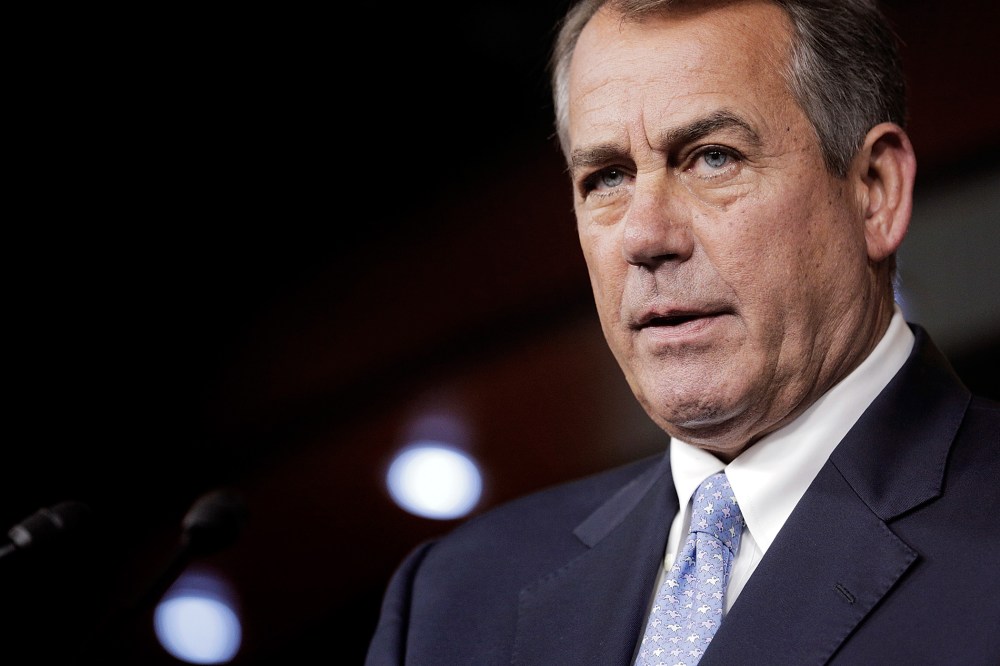
The speaker of the house plans to sue the president over his use of executive actions. And legal experts have a message for John Boehner: Good luck — You’re gonna need it.
Over the weekend, the Ohio Republican penned an op-ed for CNN, writing that “the Constitution makes it clear the president’s job is to faithfully execute the laws. And, in my view, the president has not faithfully executed the laws when it comes to a range of issues, including his health care law, energy regulations, foreign policy and education.”
Boehner said he plans to bring legislation to the GOP-majority House floor this month greenlighting the Bipartisan Legal Advisory Group to file a lawsuit against Obama. The group (made up of three Republicans and two Democrats) was created in 2011 after the White House said it would no longer defend the Defense of Marriage Act.
Democrats have dismissed the potential lawsuit as a GOP political ploy months before the midterm elections. Last week, Obama brushed off his critics, insisting Republican obstructionism has left him little choice but to act alone on matters like delaying parts of his health care law, fighting climate change, raising the minimum wage for federal contract workers and deferring deportations for some young undocumented immigrants. “So sue me,” Obama said last week. “As long as they’re doing nothing, I’m not going to apologize for trying to do something.”
%22Courts%20don%E2%80%99t%20like%20to%20referee%20political%20disputes.%20They%E2%80%99re%20not%20going%20to%20start%20ordering%20the%20president%20to%20do%20this%20or%20do%20that.%22′
While there is no law prohibiting the lower chamber of Congress from suing the president for alleged abuse of executive power, there’s certainly no precedent for it. When individual lawmakers have tried to bring cases against former presidents in the past, courts have typically thrown out suits and have been reluctant to get involved in what they see as political matters. For example, when 26 members of Congress tried to sue President Clinton over the U.S. participation in airstrikes against Yugoslavia, a federal judge dismissed the case and said the group lacked legal standing to act on behalf of the entire Congress.
“There are a lot of reasons why you can think this will fail. There are not many reasons why you think this would ever succeed,” said John Hudak, a fellow in governance studies at the Brookings Institution. Hudak said while the measure would likely pass in the House, there’d be many roadblocks from there on out, including “issues of standing, finding specific issues on where Obama has overstepped … and courts may simply defer to the president.”
“A great deal of what Boehner is objecting to is the discretion of the president,” said Erwin Chemerinsky, the dean of the University of California-Irvine’s law school. He pointed to Raines v. Byrd, a United States Supreme Court case in which the court held that individual members of Congress do not automatically have standing to litigate the constitutionality of laws affecting Congress.
Stan Brand, who served as the House’s general counsel under former Democratic House Speaker Tip O’Neill, said the main hurdle is “what we lawyers call standing, the right of someone to get a federal court to take a case. Essentially, the courts have said that you can’t sue the executive branch as a member of Congress unless you’ve exhausted all your other remedies and you’ve been injured in a way that the institution as a whole has been injured.” That hasn’t happened in this case, he said.
“Courts don’t like to referee political disputes. They’re not going to start ordering the president to do this or do that. It’s not something suitable or practical for courts to do and they have resisted doing that,” Brand added, citing courts throwing out lawsuits brought by lawmakers challenging the Vietnam War.
Tara Grove, a William and Mary law professor, also said the lawsuit would have no standing, arguing the House has other ways to encourage the executive branch to do what it would like it to do. That includes holding oversight hearings, cutting off appropriations, not extending appropriations, and at the extreme end of the spectrum, impeaching the president. “I don’t think our judiciary was designed to decide every constitutional controversy. There are some things that are supposed to be left to politics,” she said. While Obama has used executive actions on matters like delaying parts of the Affordable Care Act, the federal minimum wage and new environmental regulations, Obama has actually issued fewer executive orders than his predecessors. The president issues such orders an average of every 11 days, according to the Brookings Institution. In comparison, President George W. Bush issued an executive order every 10 days. President Ronald Reagan issued them about once every seven days, and President Jimmy Carter issued more than one every five days, according to the think tank. In fact, Obama’s rate is the slowest since President Grover Cleveland’s administration. Hudak said even if the GOP does forge ahead with its lawsuit, Obama has time on his side, as it could take years for the suit to make its way through the federal courts. The president’s short-term agenda is unlikely to be touched. “This is likely something that will move quite slowly through the courts. Federal courts, in general, are not a quick process but also when you’re in an area where everything is new, judges are going to want additional time and be willing to grant additional time to parties in the case,” he said. “… It will make an already slow process even slower.”Recommended


