








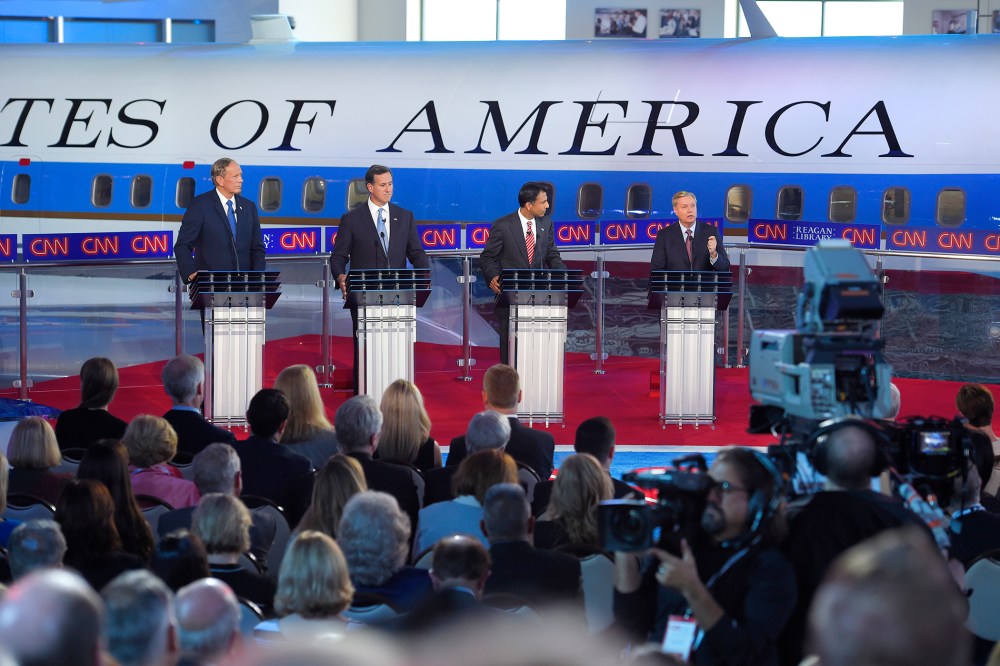
It didn’t take long for low-polling Republican presidential candidates participating in Wednesday night’s undercard debate to pivot toward Kim Davis, the Kentucky clerk jailed for defying a federal judge’s order that she issue marriage licenses to same-sex couples.
Davis’ case has captivated the nation, becoming a lightning rod for the so-called “religious freedom” movement and divided the crowded Republican presidential field. Louisiana Gov. Bobby Jindal and former Pennsylvania Sen. Rick Santorum — two hopefuls jockeying for support among evangelical voters and social conservatives — delivered a strong showing of support for Davis and religious freedom protections more broadly, while former New York Gov. George Pataki and South Carolina Sen. Lindsey Graham advocated for the rule of law.
RELATED: ‘Kids table’ GOP debaters can’t decide how to handle Trump
“I wasn’t the best law student — by the end of this debate will be the most time I spent in any library,” joked Graham, who delivered a strong performance Wednesday at the Reagan Library in Simi Valley, California. But, Graham continued, the Supreme Court’s June decision that found state same-sex marriage bans unconstitutional is “the law of the land.”
Eager to appear the most muscular on ISIS, Graham quickly turned the conversation to national security threats.
“Were you the wedding cake baker, or the gay couple or the baptist preacher, radical Islam would kill you if they could,” Graham said. “Let’s not lose sight of the big picture.”
Jindal was the first candidate to bring up Davis, prompting CNN’s moderator Jake Tapper to note that the candidates were clearly “chomping at the bit” to discuss her case. When asked how Jindal would balance his pledge to root out Islamic terrorists with making sure Muslims aren’t subjected to discrimination, Jindal said that “right now, the biggest discrimination going on is against Christian business owners and individuals who believe in traditional forms of marriage.”
“Let’s talk about the Christian florist, the caterer, the musician,” Jindal said, referring to high-profile lawsuits in which religious business owners refused to provide wedding services to same-sex couples in states with laws barring discrimination on the basis of sexual orientation. Most states have no such protections, but Democratic lawmakers at the federal level are trying to essentially expand the Civil Rights Act to cover LGBT Americans.
That bill, known as the Equality Act, stands little chance of clearing the GOP-controlled Congress. Surprisingly, neither does its legislative opponent — the First Amendment Defense Act — which would prohibit the federal government from taking “discriminatory action” against people or companies that believe marriage is between one man and one woman. Though the bill has a tremendous number of Republican co-sponsors in both the House and Senate, GOP leaders seem reluctant to move it forward.
Santorum said he would pass the First Amendment Defense Act as president, and invoked Dr. Martin Luther King Jr.’s letter from a Birmingham jail as justification to defy the Supreme Court’s marriage equality ruling.
RELATED: Donald Trump goes after rivals early in GOP debate
“[Dr. King] said there are just laws and there are unjust laws, and we have no obligation to follow unjust laws,” Santorum said. “I would argue that what the Supreme Court did is against natural law, God’s law, and we have every obligation to stand in opposition to it.”
Pataki appeared horrified by Santorum’s reading of history and the Constitution. The former New York governor said Davis had an obligation as an elected official to follow the rule of law and that if she were working for him, he would have fired her. As an elected official, Davis actually can’t be fired. But the line earned big applause from the crowd — indicating where many Republican voters stand. “Wow,” Pataki said in response to Santorum’s call to stand up to the justices. “We’re going to have a president who defies the Supreme Court when they don’t agree?” “I hope so,” Santorum said. Tapper tried to recreate the rift over Davis during the prime time debate, but he found former Govs. Mike Huckabee of Arkansas and Jeb Bush of Florida more united on the topic than their lower-polling competitors. Huckabee, a former Baptist pastor who escorted Davis out of jail last week to much fanfare, said the Supreme Court had crossed into the realm of “judicial tyranny” with its marriage ruling. “I thought everybody here passed 9th grade civics,” Huckabee said. “The courts cannot legislate.” Though Bush said in a statement earlier this month that Davis was “sworn to uphold the law,” he backed away from that position during Wednesday’s debate, saying he agreed with Huckabee that Davis deserved an accommodation to allow for other people in the clerk’s office to issue the licenses without her authority. Kentucky law states that marriage licenses be issued by the clerk of court, but Davis has taken her name and title off of the form — perhaps jeopardizing the validity of marriage licenses issued since her incarceration. “If she, based on conscience, can’t sign that marriage license, there should be someone in her office able to do it,” Bush said. “If the law needs to be changed in the state of Kentucky, which is what she’s advocating, it should be changed.”
Emma Margolin
Emma Margolin is a reporter at MSNBC.com. Recommended


