








Coming just two months before the midterm election, President Obama’s decision to escalate the U.S. campaign against the Islamic State of Iraq and Syria puts some Democrats in a tricky political position.
Polls show American people overwhelmingly support action, but the consequences are unforeseeable, the memory of the Bush Iraq War remains fresh in Democrats’ minds, and the president making the request is deeply unpopular in the red and purple states that will determine control of the upper chamber.
While the timing of Obama’s decision may have been driven by events on the ground, it’s inconvenient for threatened incumbents who don’t need another difficult needle to thread.
Complicating matters, the CIA on Friday told NBC News the terror group has more fighters in the field than previously believed, at least in part due to increased recruitment after battlefield successes in Iraq.
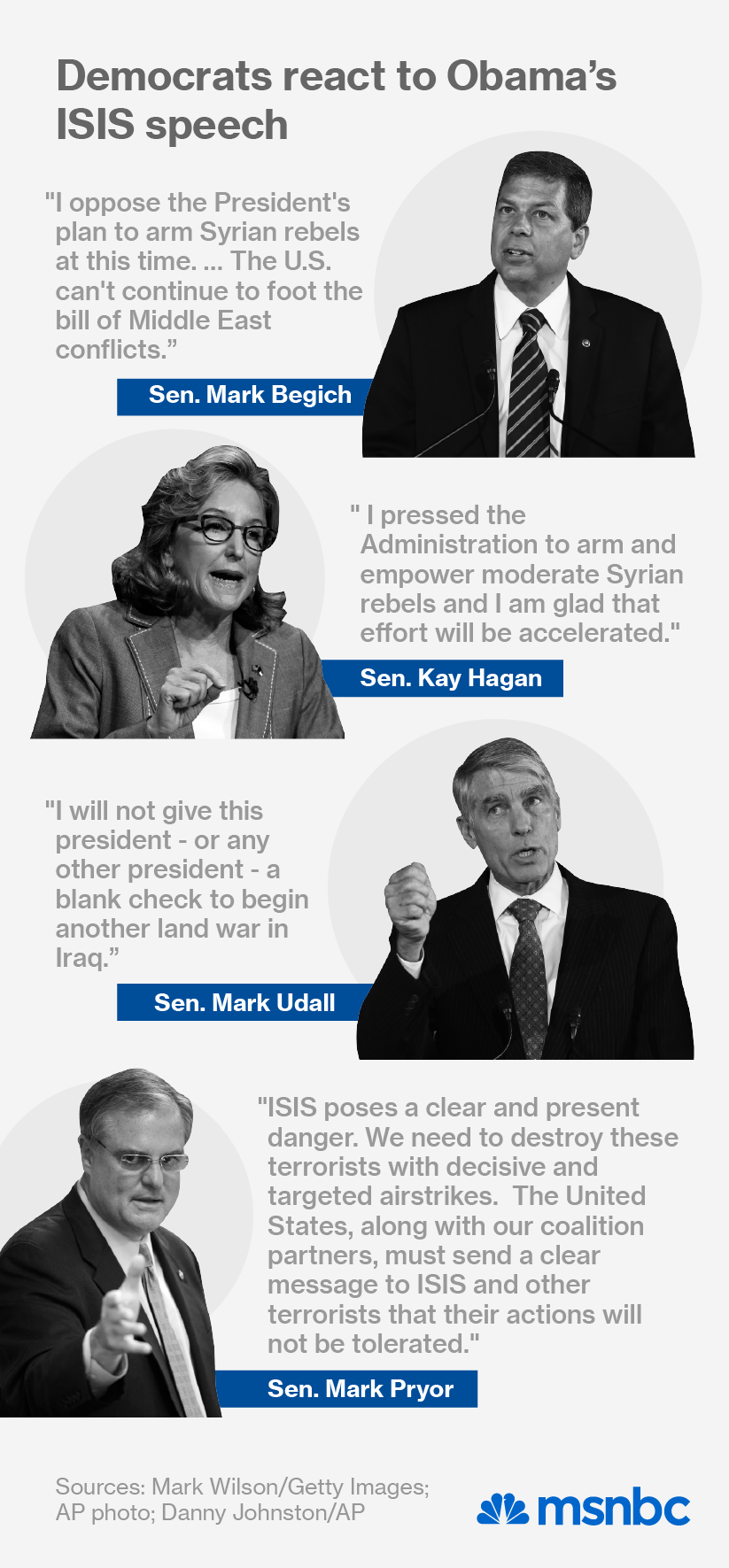
Democrats locked in tough re-election battles have taken different approaches in reacting to Obama’s speech Wednesday night, but the common thread is an attempt to put some distance between themselves and an unpopular White House.
Alaska Sen. Mark Begich took the most strident position, in keeping with his campaign’s theme of independence from the White House. “I oppose the President’s plan to arm Syrian rebels at this time,” he said in a statement. “The U.S. can’t continue to foot the bill of Middle East conflicts.”
Sen. Mark Udall, a Democrat who is also facing a tough reelection battle in more purple Colorado, said he “will not give this president — or any other president — a blank check to begin another land war in Iraq.”
On the other ideological side, North Carolina Sen. Kay Hagan suggested the president acted too slowly against ISIS. “As long ago as the spring of last year, I pressed the administration to arm and empower moderate Syrian rebels and I am glad that effort will be accelerated,” she said.
In very brief statements, Sens. Mark Pryor of Arkansas and Mary Landrieu of Louisiana both expressed support for the stepped up campaign against ISIS — but neither mentioned the president. Landrieu said she supports “the call for strong military force against ISIS,” without specifying who issued that call. Pryor, meanwhile, said only that “we need to destroy these terrorists with decisive and targeted airstrikes.”
Given Obama’s weak poll numbers, this is not particularly surprising. “They’re looking for any chance they can to put some distance between themselves and the president,” said Jim Manley, a Democratic strategist who worked in the Senate for two decades. “Some are attacking from the left, while others are attacking from a more traditional conservative position, depending on the political dynamics of their race.”
New Hampshire Sen. Jeanne Shaheen, whose Republican opponent Scott Brown has accused her of going too easy on Obama, stressed that she intends to “question administration officials” and “will continue to press the president” on ISIS.
If the plan to arm the Syrian rebels comes to a standalone vote, instead of being included in a larger government funding plan, Obama will not have a unified Democratic Caucus behind him.
Already, activists on the progressive left, many of whom cut their teeth during the 2003 Iraq war, are working to undermine a potential vote.
Stephen Miles, the advocacy director of the Win Without War Coalition, which believes that military action against ISIS is counterproductive, said the strong public support for bombing at the moment is an “illusion,” since no costs have been introduced into the conversation yet.
“Policymakers would be wise to remember where the polling on Iraq and Afghanistan ended up,” he said. “We’ve seen this movie before, we know how it ends: It ends with more extremists, more instability, and a larger threat.” The progressive advocacy group CREDO is already urging its members to tell lawmakers to vote against any resolution to bomb targets in Syria. Others are demanding a vote. But liberal pressure, even in an election year where Democrats are working hard to mobilize their base, is unlikely to influence the Democratic incumbents in red states, said Bill Galston, a former Clinton White House aide. While anti-war sentiment may be “the liberal equivalent of gun control” — a single issue some will vote on above all else — there likely aren’t enough of those voters in Alaska, say, to make a difference. “This is not a bind in 2014 in the same way that immigration clearly was.” he added. Just last week, the White House delayed a planned executive action on immigration because it put Democrats up for reelection in a tough spot. Privately, some Democratic aides say some senators facing tough re-election battles would just as soon avoid having to go on the record on the issue. The same maybe true for some Republicans. “A lot of people would like to stay on the sideline,” Georgia Republican Rep. Jack Kingston told The New York Times in a remarkable moment of candor. “It’s an election year. A lot of Democrats don’t know how it would play in their party, and Republicans don’t want to change anything. We like the path we’re on now. We can denounce it if it goes bad, and praise it if it goes well and ask what took him so long.” Ken Gude, a senior fellow at the liberal Center for American Progress pointed to Kingston’s comment as further reason the White House should seek a clear vote on military action, even if it inconveniences some in Obama’s party. Gude is critical of the White House’s legal justification for the war, and wants a new congressional authorization for the use of force against ISIS, which would force politicians to further clarify their positions. “I can understand how members of Congress of both parties would feel some anxiety about supporting another war right now,” he said. “If they believe that the threat from ISIS is so great that it requires an American military response, they should be on the record supporting it.”
Alex Seitz-Wald Recommended


