








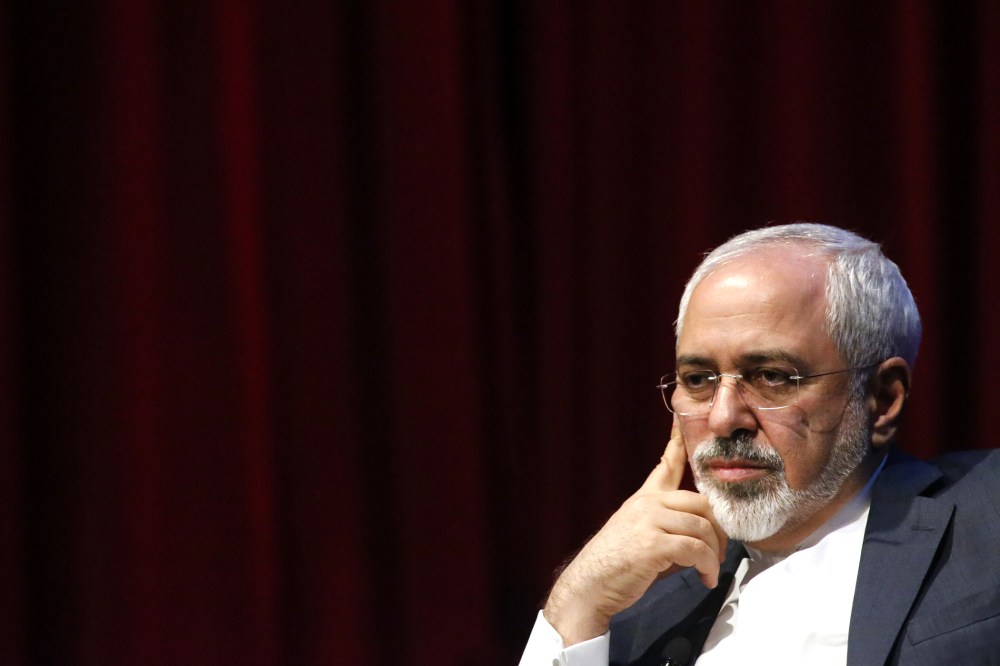
Iranian Foreign Minister Javad Zarif sought to turn the tables Wednesday as negotiations for a nuclear accord were set to resume, saying Congress should be more concerned about what could happen if the United States failed to implement its obligations rather than focusing on a possible Iranian failure.
Speaking at New York University, on the margins of a United Nations conference, Zarif said a new round of intensive nuclear negotiations would start Thursday in New York and would move to Europe on Monday.
A major sticking point has been how crippling U.S. and international sanctions on Iran will be lifted once a deal is in place and Tehran has complied with initial obligations. To assuage concerns that Iran could “cheat” and conduct nuclear work in secret, U.S. officials have promised that any final accord would include a “snap back” clause allowing the immediate return of the kinds of sanctions that have prevented Iran from modernizing its economy.
Earlier this month, Iran and the United States, joined five world powers in reaching an outline for a deal on the nuclear program. Although a final accord would focus only on nuclear issues, it would mark a historic turning point in U.S.-Iranian relations all but severed after the 1979 Islamic Revolution and the hostage crisis at the U.S. Embassy in Tehran which ended in 1981 after 66 Americans were held for more than a year in captivity.
RELATED: Iran seizes cargo ship, US officials say
Suspicions over Iran’s nuclear program have persisted for more than a decade as intelligence agencies and international inspectors have uncovered nuclear facilities and work that have weapons applications. The Iranian government has consistently maintained that its work is in pursuit of peaceful nuclear energy. Still, it has agreed to significantly downgrade its capabilities in exchange for the lifting of sanctions.
#photooftheday An activist shows a poster Zarif talks during a public event at New York University, Apr. 29, 2015. pic.twitter.com/Jzaiz4GoAJ
— Iran Pulse (@TheIranPulse) April 29, 2015On Wednesday, Zarif said the “snap back” clause was reciprocal and that if Iran concluded the United States was failing to carry out obligations under the deal, the accord would provide a mechanism for withdrawal.
Zarif said Iran had entered into the negotiations in good faith and wants the agreement to work. But, he said, “if people are worried about snap back, they should be worried about the U.S. violating its obligation and us snapping back, not Iran violating its obligation. That is the point the U.S. should be seriously worried about,” he said.
Addressing comments by some Republican members of Congress that a bilateral deal signed by the president, also known as an executive deal, could be reversed by a successor, Zarif said, “This is not a game. We expect the other side to be as committed to implementing this deal, this is not a voluntary stroke of a pen agreement that can be changed in another stroke of a pen.”
Last month, Republican Sen. Tom Cotton of Arkansas sent a letter to the government of Iran, signed by 47 Republican colleagues, suggesting that an agreement would not be considered binding.
Asked whether he was concerned, at the beginning of a presidential election cycle here, that a new U.S. president could reverse course, Zarif added, “I believe the U.S. will risk isolating itself in the world if there is an agreement and it decides to break it. I think the united states, whether you have a Democratic president or whether you have a Republican president, is bound by international law, whether some senators like it or not.”
WATCH: Washington Post journalist still held in Iran
Chiding Cotton directly, Zarif said perhaps the Arkansas senator was unaware that the vast majority of bilateral agreements were executive agreements that “have stood the test of decades. If the U.S. Senate wants to send a message to the rest of the world that all of these agreements that the United States has signed are invalid, then you will have chaos in your bilateral relations with the rest of the world. I don’t think that would be something even the most radical elements in congress want to see.”
Zarif said he hoped negotiators could conclude a deal before the June 30th deadline. Then, he said, “within a few days after that, there will be a resolution before the U.N. Security Council,” to lift sanctions, “which will be mandatory for all member states whether Sen. Cotton likes it or not.”
Cotton later issued a statement in response. “Sanctions relief isn’t about what I like, but what will keep America safe from a nuclear-armed Iran. The repeated provocative statements made by members of the Iranian leadership demonstrate why Iran cannot be trusted and why the President’s decision to pursue this deal and grant dangerous concessions to Iran was ill-advised from the beginning,” Cotton wrote. Cotton then took to Twitter to challenge Zarif to a debate in Washington on “Iran’s record of tyrant, treachery and terror.” The American-educated Zarif also shed new light on the case of a Washington Post reporter held in a Tehran prison on espionage charges. Zarif called Jason Rezaian, who holds U.S. and Iranian citizenship, “my friend,” and said he “is accused of a very serious offense and I hope he is cleared in a court.” Zarif went on to say that it was “unfortunate that some overzealous, low level operative tried to take advantage of him,” the reporter. He did not name the nationality of the operative. Zarif paused, saying he didn’t want to “go into more detail because it was a pending case before the court,” but then added, “The fact is that there are people who take advantage of the needs of some people who tried to get a visa to come to the United States or get a visa for their wives to come to the United States and make demands that are illegal, and dangerous and damaging to the professionalism of a journalist.” Rezaian’s wife is Iranian and Zarif appeared to be suggesting the Washington Post reporter was trying to secure a visa for her to visit the United States. He did not provide further details expect to reiterate that he continues “to hope that Jason will be able to clear his name before a court.” RELATED: Deal or no deal, America’s problems with Iran are just beginning Rezaian has been held in Tehran’s Evin prison for nine months and is facing espionage charges that his family, The Washington Post and President Obama have said are baseless. “For nine months, Jason has been in prison for nothing more than writing about the hopes and fears of the Iranian people,” Obama said Saturday night during the White House Correspondents Dinner “We will not rest until we bring him home to his family, safe and sound,” Obama said. The Post has launched a campaign to raise awareness of Rezaian’s imprisonment and press for his release. At the dinner in Washington Saturday, hundreds of guests including some members of Congress, wore #FreeJason pins. Secretary of State John Kerry, who is negotiating a nuclear deal with Iran, also wore a pin. During a one-hour talk led by Washington Post columnist David Ignatius, Zarif also spoke about conflict in Yemen, Syria Iraq and the Islamic Republic’s relationship with Saudi Arabia. He said a ship recently stopped in Iranian waters was ordered to port because it is in a legal dispute in Iran, and not because of security or political concerns. Zarif also elicited laughter from a friendly audience when he said that Israeli Prime Minister Benjamin Netanyahu had become a “nonproliferation guru,” despite the country’s well known but undeclared nuclear weapons stockpile. Netanyahu has been the most vocal opponent to any U.S.-Iranian accord, claiming that it would be nothing more than a sham perpetrated by an Iranian leadership bent on building weapons of mass destruction. Netanyahu’s position has held sway with congressional Republicans but it has eroded his relationship with the White House and cost him support among some Democrats. Although Zarif said most regional conflicts needed to be resolved “without preconditions,” he responded with a resounding “no” when asked if the same principle would apply to talks with Israel, saying Israel must end its occupation of the West Bank and Gaza and allow the Palestinians to achieve independent statehood.
Dafna Linzer Recommended


