








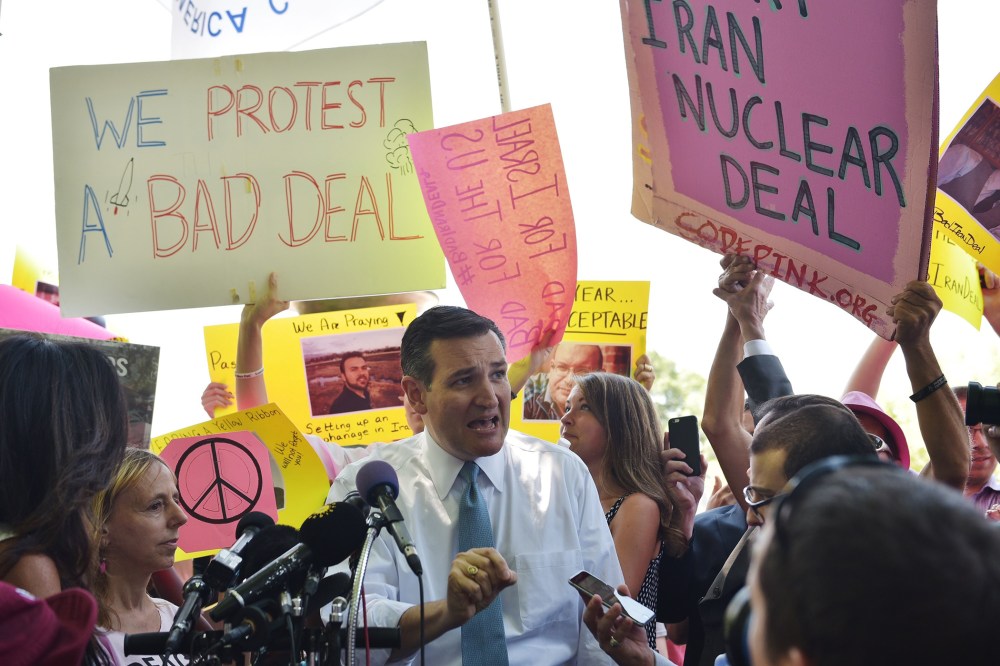
Wisconsin Gov. Scott Walker has said he would kill it on his first day in office.
Florida’s former Gov. Jeb Bush said it isn’t diplomacy, it’s appeasement.
Florida Sen. Marco Rubio has said the next president should re-impose sanctions.
And that is only what a handful of the Republican party’s field of 17 candidates for president are saying about the Obama administration’s deal with Iran.
Since President Obama announced his historic deal to curb Iran’s nuclear capabilities, Republican candidates have piled on, seeking unique ways to express their shared opposition to the deal.
Related: Obama administration continues Iran deal push
Candidates have cut television ads, engaged in sharp exchanges during congressional hearings, spoken out in conservative media and bashed the deal on the campaign trail.
Yet aside from vowing to undo the deal, candidates have so far not said much about what they would do to contain Iran’s nuclear program or contend with its position as a powerful force within the Middle East.
Thursday’s first debate for Republican presidential candidates in Cleveland will provide the largest forum for the 17 hopefuls to differentiate their views from one another, and not just from Obama.
But the mechanics of the debate are threatening to prevent voters from hearing a broad discussion on the issue.
According to rules set by Fox News, which is hosting the event, the debate stage will be limited to candidates finishing in the Top 10 of an average of national polls. Those lucky 10 will be announced Tuesday and could include Sens. Rand Paul and Marco Rubio – two members of the Senate Foreign Relations committee who have been outspoken on Iran.
Paul came out against the deal, even though in April, he said he backed negotiations with Iran.
Fox will broadcast a separate forum for second-tier candidates earlier Thursday. That group is likely to include former Pennsylvania Sen. Rick Santorum, who was a member of the Senate Foreign Relations committee; Santorum has also been vocal on the issue and would be eager to differentiate himself on foreign policy from others in the crowded field.
Candidates without the power to shape foreign policy votes in Congress have been just as outspoken.
Donald Trump, speaking after an event in Charlottesville, VA, called the deal “terrible.”
“I don’t understand the president. He dealt from desperation,” Trump told NBC News, before offering a prediction. “You know the Iranians are going to cheat,” he said. “They’re great negotiators.”
Trump said that inspectors should have immediate and 24-hour-a-day access to all nuclear sites in Iran.
A new NBC News/Wall Street Journal poll finds Trump leading the field, with 19% of GOP primary voters. Walker, the Wisconsin governor, and Jeb Bush follow, with 15 and 14% respectively.
Candidates with smaller numbers appear to be even more aggressive in their messaging.
New Jersey Gov. Chris Christie’s campaign released an-issue specific ad focusing on the deal, which political advertising experts called an unusual step this early in the race.
“President Obama gave away the store to the Iranians, to a group of people who since 1979 have been chanting ‘death to America,’” Christie says in narration, over images of a street rally and American flags burning.
The super-PAC group supporting Christie has also published a separate ad about the deal, and the super-PAC backing Rubio has run two ads about it. The same NBC News/Wall Street Journal Poll found that Christie’s support is at 3%, and Rubio’s at 5%.
Last month, when Secretary of State John Kerry returned to Capitol Hill for the first time since closing the deal during marathon meetings in Vienna, Rubio welcomed him with a barrage of criticism, telling Kerry the agreement “makes the world a more dangerous place.”
Observers were stunned by the way Republicans on the committee treated Kerry, who once ran Senate Foreign Relations as the senator from Massachusetts.
Under the terms of the deal Kerry negotiated in Vienna, Iran would dramatically limit its enrichment capacity during the next 10 years, giving up most of its centrifuges. Critics of the deal — from both parties — have questioned what would happen afterward.
By law, Congress has a 60-day period to review the deal before taking a vote. The review clock began on July 20.
Most observers doubt that there will be enough votes in Congress to override the president’s veto, something that may be fueling a sense among the opposition that this is a fight on principle.
Jeb Bush, who is a critic of the deal, nonetheless sparked the only major disagreement among the GOP field on the issue after he urged candidates to be “thoughtful” about vows to dismantle the deal immediately.
“That sounds great, but maybe you ought to check in with your allies first. Maybe you ought to appoint a secretary of state, maybe a secretary of defense,” Bush told reporters during a campaign stop in Nevada last month. Related: ‘Crazy talk’ over the Iran nuclear deal The remark seemed aimed at Wisconsin Gov. Scott Walker who had said during his announcement for president earlier that week “we need to terminate the bad deal with Iran on day one.” The Walker campaign mobilized quickly against Bush. Robert O’Brien, a delegate to the UN under the George W. Bush administration and a senior adviser to Walker, said in a statement “we don’t need more information, we don’t need to confirm the next secretary of state, we need decisive leadership.” Walker also appeared to shoot back at Bush, telling reporters at an event in Iowa that a president “shouldn’t wait to act.” Former Texas Gov. Rick Perry has also vowed to take action on his first day in office, saying he would return sanctions against Iran. Carly Fiorina, the former Hewlett-Packard CEO, said over the radio on the day the deal was announced that she would personally call Iran’s supreme leader and announce a new deal giving broader access to inspectors. The rhetoric appears only to have grown hotter in recent weeks. Former Arkansas Gov. Mike Huckabee recently invoked the Holocaust, telling a radio interviewer that the Iran deal “will take the Israelis and march them to the door of the oven.” The remark drew criticism from Jewish groups, but Huckabee did not back down. “All in all in fact the response from Jewish people has been overwhelmingly positive,” Huckabee said on “TODAY.” Texas Sen. Ted Cruz has said that by lifting sanctions on Iran, the Obama administration would become “the leading financier of terrorism against America in the world.” Obama called the remarks by Huckabee and Cruz “sad,” but the president is also keenly aware that his deal is unpopular across much of the Republican Party. During the 2008 race, the GOP’s deep suspicions about Iran were thrown into relief when Sen. John McCain, the eventual Republican nominee, parodied the Beach Boys’ song “Barbara Ann” during a campaign stop in South Carolina. “We have known for quite a long time now what the real problem is in the Middle East,” a voter said. “When do we send them an air mail message to Tehran?” “That old, eh, old Beach Boys song, ‘Bomb Iran?’” McCain replied. At the time, Obama was locked in his own primary battle against Hillary Clinton — who is now running for the Democratic nomination for a second time, and who has cautiously backed the deal. But, when it comes to the general public, the president still has some selling to do. The NBC News/Wall Street Journal poll found that the American public is divided, with 35% of Americans saying they support the deal and 33% saying they oppose it. Another 32% said they don’t know enough about it. Opposition to the deal has grown, according to the poll. In June, 36% said they supported it and 17% opposed it.
Jamie Novogrod Recommended


