








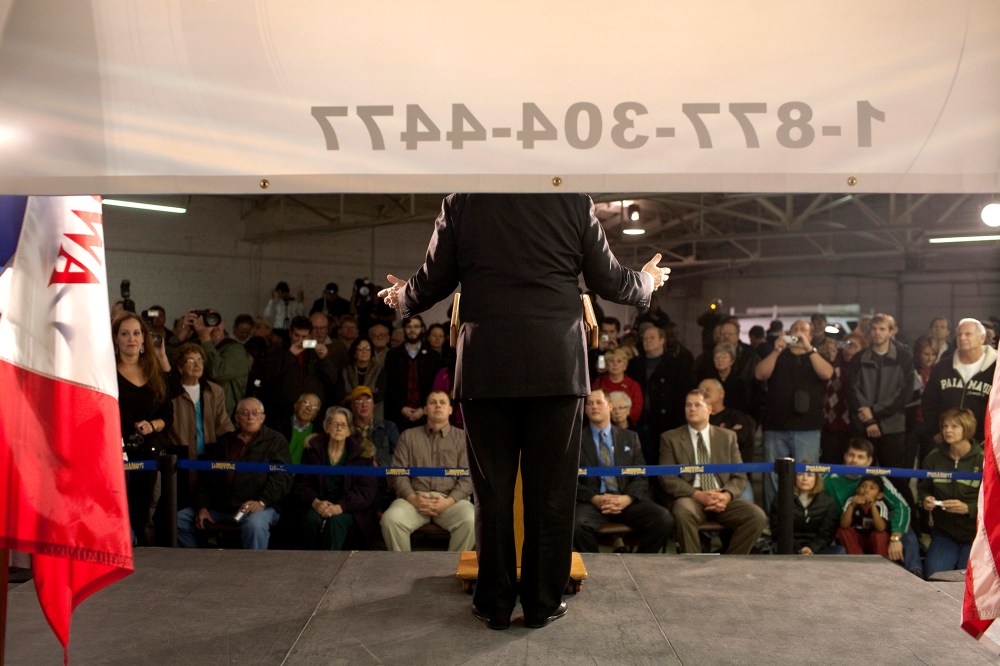
DES MOINES — In Iowa, democracy is visceral. And not only on the night of the first-in-the-nation presidential caucuses, but in the months leading up to them, when the men and women vying to one day control America’s nuclear arsenal seem determined to hug and handshake and look in the eye of every last Iowan.
While munching on fried snacks at the State Fair or greeting residents on a quaint town’s main drag, presidential wannabes perform the kind of one-to-one politics that has long given underdog candidates who can’t afford a massive television advertising campaign a chance to compete with their better-funded foes.
The state’s endless rolling cornfields, wide open roads, big blue skies, and picturesque barns make a perfect backdrop for American political theater, while Iowa’s famously nice and informed residents are capable extras who enjoy prize the attention.
On Caucus night itself, voters gather together to elect a candidate, instead of trickling in throughout the day to a polling place. While Republicans cast a ballot and move on, the Democratic process is different and more kinetic.
They gather in a large room and form clumps of supporters for each of the candidates. As the night goes on, candidates are eliminated (you need 15% of attendees to be remain “viable” and make it to the final count) and the larger clumps fight to absorb the smaller clubs.
The process feels like a throwback to a more primitive form of American or even Athenian Democracy, but the system is actually a thoroughly modern creation. A product of TV and George McGovern more than George Washington, as former Drake University professor Hugh Winebrenner documents in his comprehensive study of the caucuses, “The Making of a Media Event.”
The Caucuses existed long before they mattered, and only became what we know them as today in 1972, after a rule change in the party. It’s not the number of delegates that makes Iowa important, it’s its ability to set the tone for the rest of the contest by going first.
And Iowans take going first very seriously. It’s the law, in fact. “The date shall be at least eight days earlier than the scheduled date for any meeting, caucus, or primary which constitutes the first determining stage of the presidential nominating process in any other state,” reads Title II Chapter 43.4 of the Iowa Code.
Iowans of both parties guard the spot jealousy. “There are numerous states, mostly ones with a greater population and thus more electoral votes, that would love to steal the spotlight,” warned Craig Robinson, a former state Republican Party operative who now runs the blog The Iowa Republican. It’s often challenged, especially after problems. In 2012, Republicans announced that Mitt Romney had won the caucus, only to reverse themselves 16 days later to declare Rick Santorum the winner after finding an error. Snafus like that might stir jealousy in New Hampshire, which comes after Iowa. But the two states long ago came to an understanding. At meetings of National Democratic Committee group that decides which states go first, the chairmen of the Iowa and New Hampshire parties sit next to each other and defend each other’s primacy. Besides, Iowa has a Caucus, New Hampshire has a primary, so they can both claim to be first. In 2016, the Iowa Caucus will most likely be held on February 1, a month later than in 2012. Party loyalists will file in on what is sure to be a bitter cold evening. Around 7 p.m., precinct captains and chairs will count heads, and the race for president of the united states will officially kick off. This is part of msnbc.com’s “Road Trip ” series, which has msnbc.com reporters traveling across the country to profile movements that sparked change in America. For more, click here.
Alex Seitz-Wald Recommended


