








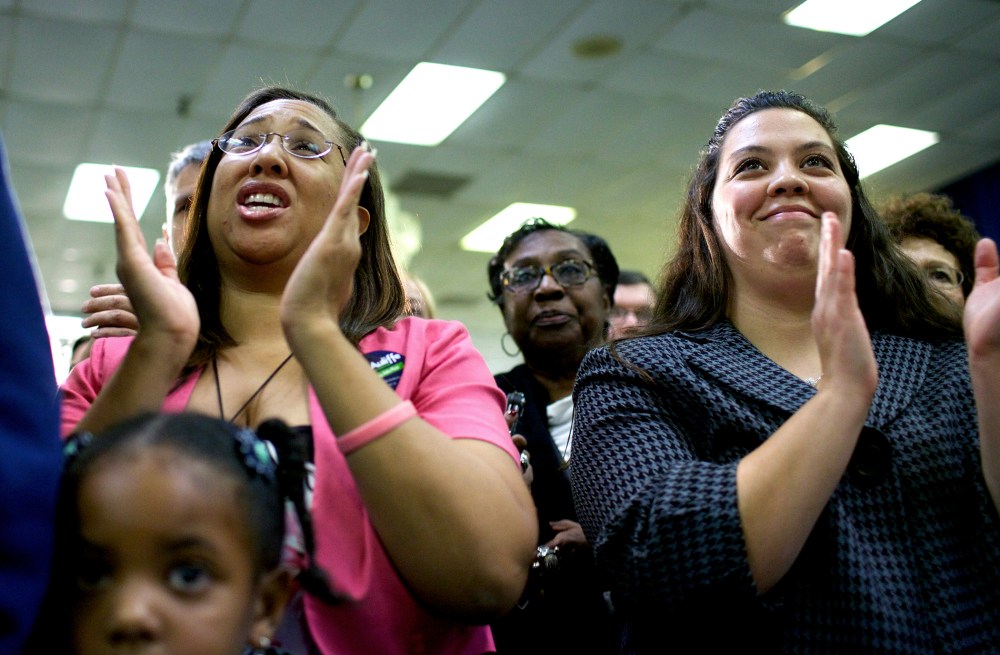
Democrat Terry McAuliffe won the Virginia’s governor’s race narrowly on the strength of women’s votes, by an eight-point margin–slimmer than several polls had predicted. That was partly because white women broke heavily for Republican Ken Cuccinelli, 54-38, according to NBC News exit polls. Cuccinelli also won married women’s votes by eleven points.
But because African-American, Latina, and unmarried women turned out in numbers close to Barack Obama’s 2012 election, McAuliffe won women overall–and with them, the election. He also won 59% of the votes of people who said abortion was the most important issue to them, who made up 20% of the electorate.
The McAuliffe camp had pinned its hopes on at least narrowing the gap with white female voters, who made up 36% of the electorate this year. Over the summer, some polls showed Cuccinelli and McAuliffe even on white female voters.
Geoff Garin, McAuliffe’s pollster, hoped his candidate would gain from women’s rejection of Cuccinelli’s hard-line position on abortion. “Our data was very clear that what people most remembered about Cuccinelli was his abortion position,” said Garin before the votes were in. “That was what was more sticky with voters, especially female voters.”
And from the start, the McAuliffe campaign, along with allies Planned Parenthood and NARAL Pro-Choice Virginia, made sure women were repeatedly reminded of that position.
“The whole country is watching to see if the rights of women and girls will be respected, especially over our own bodies and health care,” Hillary Clinton said when she campaigned for McAuliffe in October, adding, “You will not have to worry about that with Terry McAuliffe in the governor’s office.”
Planned Parenthood’s political action groups, both nationally and in Virginia, poured millions of dollars into the race to “Keep Ken Out,” with TV, radio, and Internet presences. The organization’s president, Cecile Richards, argued that “so-called ‘women’s issues’ have flipped a switch for voters,” calling it “the new normal.” The organization hopes to replicate its strategy in Virginia in a race widely anticipated to be much tougher: Wendy Davis’ 2014 gubernatorial bid in Texas.
If the less than sweeping results in Virginia are any indication, winning white suburban women by highlighting the assault on reproductive rights won’t be a cakewalk. Still, Cuccinelli’s 16-point margin with white women was paltry compared to the last GOP governor, Bob McDonnell, who won white women by nearly 30 points in 2009. In 2012, Barack Obama lost white women in Virginia by 19 points, three points more than McAuliffe did. Both Obama and McAuliffe won around two-thirds of unmarried women’s votes, with that demographic making up 18% of the electorate this year.
In addition to Cuccinelli’s opposition to abortion in every circumstance, Democrats pointed to his opposition to funding for Planned Parenthood and to mandated insurance coverage for contraception, as well as his support for a personhood bill.
The McAuliffe campaign also hammered voters with Cuccinelli’s refusal to state his position on the Violence Against Women Act (with an assist from Bill Clinton, who signed the legislation into law) and his support for a law that would make it harder for women to get out of abusive marriages.
Democrats already generally enjoy an advantage with female and non-white voters, and particularly with voters who fall in both of those categories. But the 2009 race in Virginia was dominated by concerns about the economy and anger at Obama, which in the tradition of Virginia off-year elections, wound up being predictive of the 2010 midterms.
In 2012, the focus on a broad range of women’s issues, including an unapologetic position in favor of abortion rights, helped Barack Obama. The gift to the McAuliffe campaign was that the McDonnell administration, with Attorney General Ken Cuccinelli as a faithful warrior, went on to put restricting reproductive rights front and center on the legislative agenda.
Virginia’s abortion restrictions seized the national debate in early 2012, with forced transvaginal ultrasounds becoming both a rallying cry for newly minted activists and a punchline for comedians like Amy Poehler on Saturday Night Live. McDonnell was forced to back off, at least partially, making sure only external ultrasounds would be required. Cuccinelli himself was even more prominent in the ongoing struggle to keep Virginia’s abortion clinics open in the face of a law requiring that they convert to ambulatory surgical centers, a medically unnecessary and expensive process. When the Board of Health said existing clinics could be grandfathered in, Cuccinelli forced through changes to ensure that they wouldn’t be. (One affected clinic is suing to overturn the rules.) Cuccinelli also said that the requirement under the Affordable Care Act that insurance plans cover contraception was so outrageous that he encouraged opponents to “go to jail” rather than comply with it. In 2007, as a state senator, he co-sponsored a personhood bill that declared that life began at fertilization, which, if enforced, would have banned common forms of birth control. At no point did Cuccinelli stray from his roots, in contrast to McDonnell’s centrist messaging in 2009 and Romney’s attempt to project moderation in 2012. In the closing days of the race, he pursued a strategy to fire up his base, campaigning with fellow Fetal Personhood supporters Mike Huckabee and Rand Paul, among others. But the state’s Tea Party base wasn’t big enough to elect Cuccinelli. “I’m not even sure there are enough voters in Utah for Cuccinelli’s message to resonate,” said Garin. Some social conservative groups, like the Susan B. Anthony List, tried to flip the “extremist” mantle back on McAuliffe by attempting to change the subject to later abortions. Indeed, the conventional wisdom for decades has been that Democrats’ support for abortion rights was a liability in all but the most liberal states. But in Virginia, the opposite proved true. McAuliffe defining himself in opposition to Cuccinelli’s position on the issue made all the difference. Attempts by the Cuccinelli campaign to reframe the “war on women” trope — including by trying to associate McAuliffe with Anthony Weiner and Bob Filner, and by highlighting Cuccinelli’s activism against sexual assault as a college student over 20 years ago–never quite took off. Gay rights, which has seen the most dramatic change in public support, particularly among young people, didn’t even come up as a major issue, despite Cuccinelli’s well-known desire to enforce Virginia’s unconstitutional sodomy ban. “We never really got around to doing that as a campaign issue,” said Garin. “Although we had lots of polling evidence that it was another thing that made him seem weird.”
Irin Carmon Recommended


