









A new study released Tuesday by the nonpartisan Urban Institute found that Obamacare will reduce the coverage gap between minorities and whites. But blacks won’t benefit as dramatically unless more states embrace the health care law’s Medicaid expansion, the study, billed as providing the first state-level projections of Obamacare’s impact by race and ethnicity, found.
Health coverage for all racial and ethnic groups is growing as a result of the Affordable Care Act through the new insurance exchanges and additional public funds for health care. But the study found Obamacare’s expansion of Medicaid is particularly effective at reducing the coverage gap between whites and racial minorities, as minorities are more likely to be uninsured and qualify for the program, which covers lower-income Americans up to 138% of the poverty line.
That will ultimately help close racial gaps in health-care coverage, researchers found. By 2016, the difference between the white and Latino uninsured rate is projected to fall from 18.1 to 12.7 percentage points, under the current state of Medicaid and Obamacare. The gap between uninsured whites and Native Americans is expected fall from 12.6 to 6.7 percentage points.
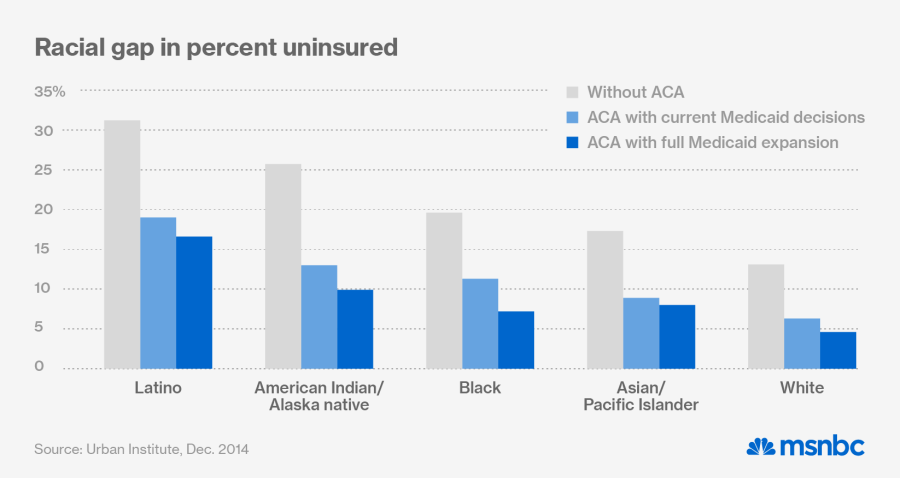
But the gains for black Americans will be less dramatic unless more states embrace the Medicaid expansion, because they disproportionately live in the states that have refused it. Under Supreme Court’s 2012 decision, states can chose to opt out of the Medicaid expansion, which many Republicans argue is an undue burden to states that ultimately must help foot the bill for coverage. To date, 27 states and the District of Columbia have decided to expand Medicaid.
While blacks were slightly more likely to sign up for exchange coverage in 2014, over half of them live in states that did not expand Medicaid in 2014, making up 23% of uninsured blacks in the U.S, according to the study. Unless more states expand Medicaid, the coverage gap between black and whites will fall just 1.5 percentage points by 2016.
Without Obamacare, the uninsured rate for blacks would be 19.6%. That’s projected to fall to 11.3% under the current state of Medicaid, but it would fall even further to 7.2% if all states expanded Medicaid, the study estimates. Obamacare’s impact on the racial health gap comes at a time when other kinds of racial disparities are increasing: The wealth gap between blacks and whites is at its highest level since 1989, according to a new Pew study.
Latinos would also stand to benefit if more states expanded Medicaid, with 38% currently living in non-expansion states. If Texas alone decided to expand Medicaid, Latino health coverage would increase by 11.3% by 2016, according to the study.
But the uninsured rate for Latinos is still expected to remain relatively high given the prevalence of undocumented immigrants who are excluded by law from the program. Even under a full expansion of Medicaid, the percentage of uninsured Latino will be 16.6% in 2016, according to the study, compared to 19.0% under the current state of Medicaid and 31.2% without Obamacare. Undoucmented residents are also excluded from enrolling in coverage through Obamacare’s exchanges.
Overall, an estimated 4 million Americans are in the Medicaid coverage gap because of states’ opting out of Obamacare’s expansion, according to the Kaiser Family Foundation; the group estimates that 44% are white, 24% are Hispanic, and 26% are black. There are signs that more red states will be getting on board with the Medicaid expansion soon. In recent weeks, Republican governors in Tennessee, Utah, and Wyoming have all unveiled expansion plans; GOP governors in Alabama and Florida have also expressed some willingness to back an expansion. While most of the proposed programs would not expand traditional Medicaid, they would target the same population through state-designed pilot programs that have to be approved by the federal government. The goal is “to provide health care coverage to Tennesseans who currently don’t have access to health insurance or have limited options,” Gov. Bill Haslam’s office said in a statement. Some Republicans have touted the moral urgency of the Medicaid expansion; Ohio Gov. John Kasich cited “the Good Book” to explain his decision in 2013. But there are growing financial incentives for states to take action as well. The federal government will cover 100% of the costs of the expansion through 2016, when it will scale back support to 90%. There’s also growing evidence that the Medicaid expansion can significantly reduce the cost of uncompensated care, which state and local governments also have to shoulder.
Suzy Khimm Recommended


