








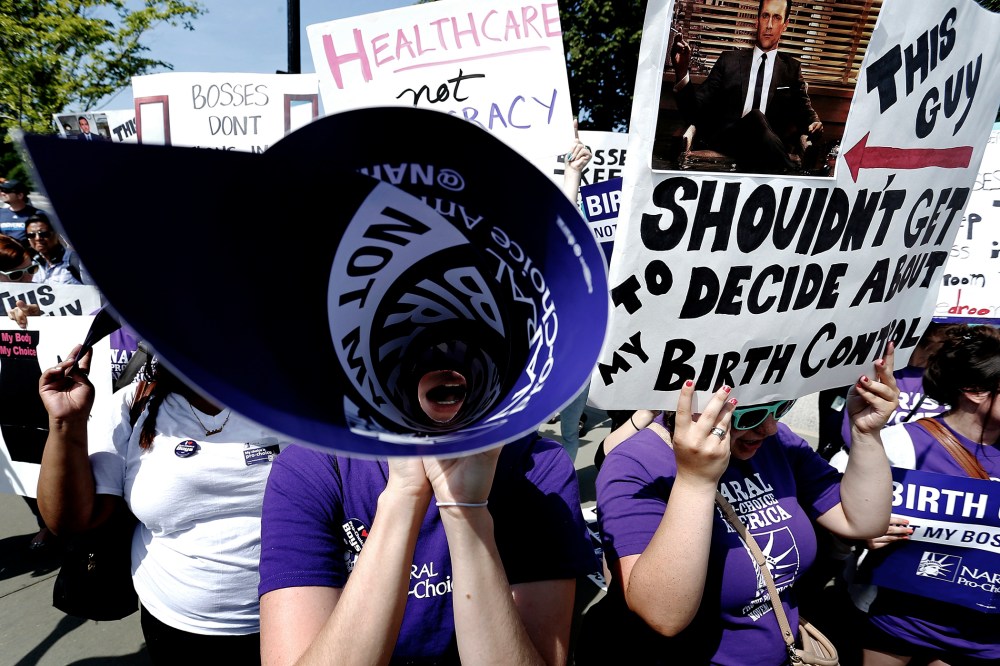
In the wake of the Supreme Court’s decision in Burwell v. Hobby Lobby, which said for-profit businesses can get religious exemptions to insurance coverage of contraception, you’re probably hearing a lot of dubious assertions about contraceptive access. Here are some facts.
1. “What’s the big deal? Contraceptives are cheap.” Not many of the most effective ones, which save money over time but have high up-front costs. For example, the IUD, to which Hobby Lobby objects, can cost between $500 and $1,000, including the care surrounding its insertion. The monthly cost of the hormonal pill can be low, but doesn’t make sense for all kinds of women, including those who experience side effects. Under the regulations Hobby Lobby objects to, the out-of-pocket cost for any FDA-approved contraceptive should be zero.
According to the brief from the American College of Obstetricians and Gynecologists, “Lack of insurance coverage deters many women from choosing a high-cost contraceptive, even if that method is best for her health and lifestyle, and may result in her resorting to a method that places her more at risk for medical complications or improper or inconsistent use.”
Women are already saving money under the contraceptive coverage requirement, which began going into effect in August 2012; an average of $269 per woman, according to a recent report by the IMS Institute for Healthcare Informatics, or $483 million total in 2013.
2. “But Hobby Lobby and Conestoga Wood only object to four forms of contraception.” That is true. (As the Guttmacher Institute’s Adam Sonfield points out, in their formal complaints, they also object to counseling for those forms for contraception. No one knows what that will mean in practice.) But there are dozens of other plaintiffs in cases pending before federal courts who object to all birth control. For example, the owners of Freshway Foods object to all forms of birth control coverage. They already got a preliminary injunction at the D.C. Circuit, where Judge Janice Rogers Brown described the coverage requirement as “the compelled subsidization of a woman’s procreative practices.”
Here’s a list of the 149 for-profit companies whose cases are already pending, including several that object to all forms of contraception. Now that the Supreme Court has sanctioned their standing to make those claims and classified the coverage requirement as a substantial burden, they only have to show the sincerity of their beliefs to win.
3. “Anyway, those forms of contraception are actually abortifacient.” The baseline question here is whether potentially and intentionally preventing the implantation of a fertilized egg constitutes abortion. That’s not the medical definition of abortion, which is ending a pregnancy. But let’s say your sincerely held belief is that interfering with the implantation of a fertilized egg is tantamount to abortion, as it is for the Hobby Lobby and Conestoga Wood owners. There is very little evidence showing that the objected-to methods — two forms of intrauterine devices and two forms of emergency contraception — even work that way, with the exception of the copper IUD.
There are two kinds of emergency contraception on the market: an over-the-counter one generally known as Plan B and a prescription-only one known as Ella. According to the amicus brief filed by the American College of Obstetricians and Gynecologists and several other medical associations, “there is no scientific evidence that emergency contraceptives available in the United States and approved by the FDA affect an existing pregnancy.” Instead, they prevent ovulation, so there is no egg to fertilize. That includes the longer-acting Ella: “There is no evidence that [Ella] affects implantation.”
One form of the IUD, known on the market at the Mirena, includes hormones that prevent ovulation. The other, preferred by women who experience side effects from artificial hormones, doesn’t. “When used as emergency contraception” — i.e., after unprotected sexual activity — “the [non-hormonal IUD] could also act to prevent implantation,” according to the amicus.
If you’re keeping count, that’s one out of four that maybe does what the plaintiffs say it does, in the rare instances it’s inserted after unprotected sex — and that’s still not the medical definition of abortion.
4. “But the government can just pay.” This one comes right from the majority, which said the Obama administration had failed the test of finding the least restrictive means to accomplish its goal. Justice Samuel Alito, writing the majority opinion, suggested “the most straightforward way” of filling the gaps would be for “the government to assume the cost.” He doesn’t have to care that this is, under current political realities, laughable. Senate Democrats have said they’ll introduce a legislative fix to the gaps left by the Hobby Lobby decision, but no one seriously thinks such a bill would become law.
There is an existing family-planning funding program for low-income women, Title X, and nearly all House Republicans have already voted to gut it. In the 2012 campaign, Mitt Romney promised he would kill the program altogether.
Title X funding has gone down more than two-thirds since 1980, after adjusting for inflation,” said the Guttmacher Institute’s Adam Sonfield. “It is far less funded than it needs to be to fully meet the needs of low-income, uninsured people in this county,” he added. “Adding all of these privately insured people would overload it even more and make it even more vulnerable to political attacks.” Some commentators have argued that contraception is cheaply available at Planned Parenthood. That would be largely due to the same federal funding that’s under attack, or state administration of it. In numerous states, most notoriously Texas, access to contraception has been sharply curtailed by politicians looking to punish Planned Parenthood for separately provided abortion. Alito also says the government can just add female employees of religious objectors to the same accommodation the objecting non-profits got, where coverage comes directly from the insurer. He is aware, of course, that 122 religiously-affiliated non-profits are already suing over that accommodation, with one of their attorneys calling the opt-out form a “permission slip for abortion.” Mark Rienzi, the same attorney (who also represented Eleanor McCullen in her successful challenge to Massachusetts’ buffer zone law), wrote yesterday that he believes the court’s reasoning in Hobby Lobby paves the way for the nonprofits to win the same full exemption churches got — in other words, the employee gets no insurance coverage at all. Even if private employers do agree to the nonprofit accommodation, it’s based on an administrative regulation that can change when the occupant of the White House does. 5. “It’s just contraception. It’s not vital health care.” This also comes straight from the majority opinion, though more implicitly. Alito holds at arms’ length the government’s claims that “public health” and “gender equality” are compelling interests, because, he says, they’re too broad. Whether the law serves a “compelling government interest” is part of the test under the Religious Freedom Restoration Act, which was the crucial law in the case. But it’s sufficiently unclear that Alito believes contraceptive access matters at all that Justice Anthony Kennedy felt the need to write separately to “confirm” it. Believing women’s equality matters is a value — one that, clearly, not everyone holds. But contraceptives’ public health benefits are inarguable. Just ask the leading group for obstetricians and gynecologists, who wrote in their brief, “Pregnancies that are too frequent and too closely spaced, which are more likely when those pregnancies are unintended, put women at significantly greater risk for permanent physical health damage … The Centers for Disease Control and Prevention identified family planning as one of the greatest public health achievements of the twentieth century, finding that smaller families and longer birth intervals contribute to the better health of infants, children, and women, as well as improving the social and economic roles of women.” They added, “Contraception also helps to protect the health of those women for whom pregnancy can be hazardous, or even life-threatening,” which Justice Kennedy does note in his concurrence. There are also benefits unrelated to pregnancy, the ACOG amicus points out: Hormonal birth control “helps address several menstrual disorders, helps prevent menstrual migraines, treats pelvic pain from endometriosis, and treats bleeding from uterine fibroids.” Is all of that “compelling”? Justice Alito declined to explicitly say.
Irin Carmon Recommended


