








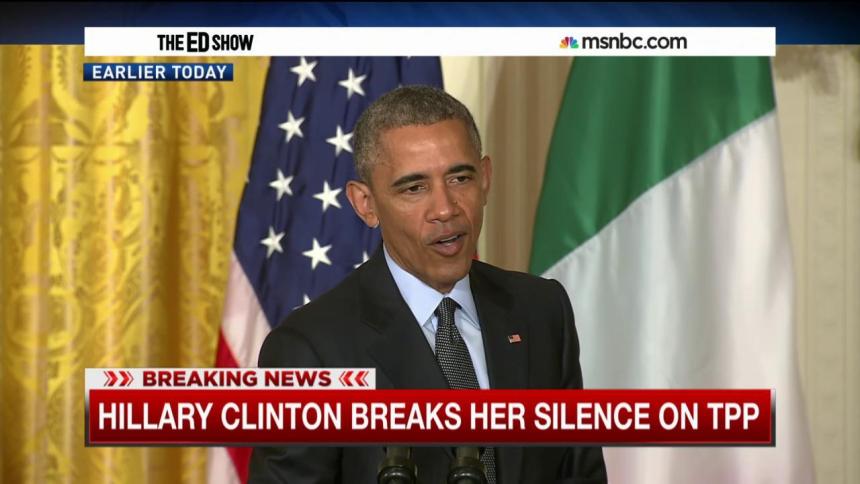
The fight between the White House and many liberal Democrats over trade policy will put 2016 Democratic front-runner Hillary Clinton in an awkward position — one her potential rivals are already exploiting.
Negotiators on Capitol Hill Thursday reached a deal on a bill that will make it easier for President Obama to get congressional authority for a massive new trade deal with 12 Pacific Rim countries. But the treaty and the Trade Promotion Authority bill are hugely controversial on the left, where organized labor and other progressive groups are preparing to wage an all-out war with the White House to stop the trade agenda.
The rare intra-Democratic party skirmish forces Clinton, whose husband signed the controversial North American Free Trade Agreement (NAFTA) in 1990s, to choose sides between her former boss and a progressive base already wary about her candidacy, whom Clinton is eager to appease.
A statement from her spokesperson, Nick Merrill, Friday afternoon struck a delicate balance. “Hillary Clinton believes that any new trade measure has to pass two tests: First, it should put us in a position to protect American workers, raise wages and create more good jobs at home. Second, it must also strengthen our national security. We should be willing to walk away from any outcome that falls short of these tests,” Merrill said.
RELATED: The fast-track trade war has begun
“The goal is greater prosperity and security for American families, not trade for trade’s sake. She will be watching closely to see what is being done to crack down on currency manipulation, improve labor rights, protect the environment and health, promote transparency, and open new opportunities for our small businesses to export overseas. As she warned in her book, “Hard Choices,” we shouldn’t be giving special rights to corporations at the expense of workers and consumers,” Clinton’s spokesperson continued.
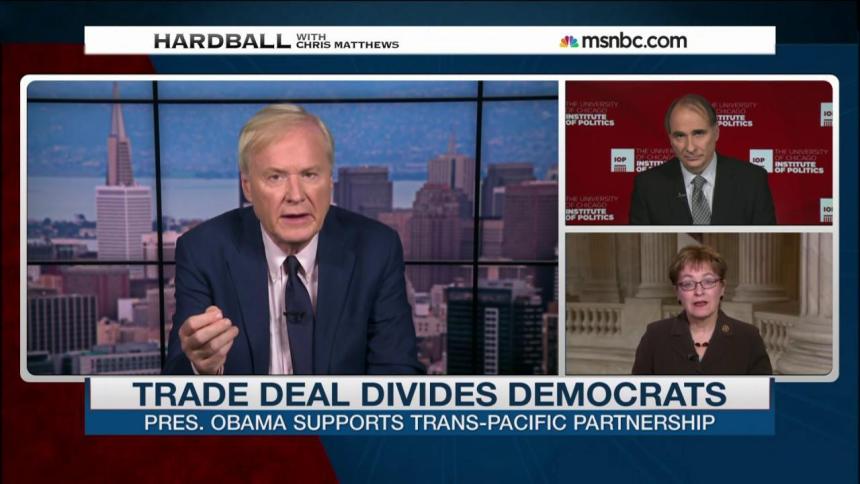
The careful statement, while laying down some real limitations on her support and expressing deep concerns about the new Trans Pacific Partnership treaty, did not go far enough for some on the left. And it quickly became the basis of the first real policy fight of the 2016 Democratic primary.
The camp of former Maryland Gov. Martin O’Malley, who is considering a run against Clinton, suggested Clinton’s stance was too vague. “No hedging here,” said O’Malley spokesperson Lis Smith, while pointing reporters to her boss’ comments on trade from the night before.
“We must stop entering into bad trade deals — bad trade deals like the Trans-Pacific Partnership – that hurt middle class wages and ship middle class jobs overseas. And we certainly shouldn’t be fast tracking failed deals,” O’Malley said during an appearance at Harvard University Wednesday evening.
The former governor also sent an email to supporters asking them to join him in opposing the trade pact. “We must stop entering into bad trade deals that hurt middle class wages and ship middle class jobs overseas. And we certainly shouldn’t be fast tracking failed deals,” he said in the email sent Friday afternoon.
RELATED: Congress strikes deal to fast-track controversial trade bill
CREDO, a grassroots progressive group said Clinton had not gone far enough. “We’re glad that Secretary Clinton is voicing concerns about the Trans-Pacific Partnership,” said the group’s Deputy Political Director Murshed Zaheed. “But to stop secret trade deals like the TPP, Secretary Clinton must speak out forcefully against Fast Track Trade Promotion Authority now while the debate is playing out in Congress.”
A huge swath of congressional Democrats, including leaders like Sen. Harry Reid, last year opposed giving president Obama Trade Promotion Authority. But with Republicans now in control of both chambers of Congress, the issue is moving ahead quickly. The AFL-CIO, still smarting over NAFTA, recently suspended all political donations to focus the full might of its financial resources on fighting the White House on this issue. And a range of other progressive groups, from environmentalists to privacy activists are girding for a fight. The free trade agenda has broad and deep support in the political center and among the business community of all stripes. And the White House says TPP is the most progressive trade deal in history, and that it would improve NAFTA but putting in strict new labor and environmental standards. But Sen. Bernie Sanders, a Vermont Independent who is considering a presidential run as a Democrat, has long opposed the treaty and said Friday that Clinton needs to take a more forceful position. “My strong hope is that Secretary Clinton and all candidates, Republicans and Democrats, will make it clear that the Trans-Pacific Partnership should be rejected and that we must develop trade policies that benefit working families, not just Wall Street and multi-national corporations,” Sanders said in a statement. Another potential Democratic presidential candidate, former Sen. Jim Webb, told msnbc’s Lawrence O’Donnell Thursday night that he had serious concerns about the transparency around the negotiations of TPP, but would support it as long as he liked the final deal. Members of Congress “haven’t seen the document, and that’s not the way the executive branch should be treating the Congress,” Webb said. But, he continued, “If an agreement was fair and good for us, I would move to have it go forward.” As secretary of state, Clinton worked to advance the president’s free trade agreement globally and wrote about its potential benefits in “Hard Choices.” In a 2011 speech, for instance, she called TPP “a cutting edge multilateral free trade agreement” that will “push the envelope on open, free, transparent, and fair trade across the Pacific basin.” Clinton will visit New Hampshire Monday and Tuesday, a state where NAFTA still occasionally crops up in political fights, and can expect to be asked more about her stance.
Alex Seitz-Wald Recommended


