








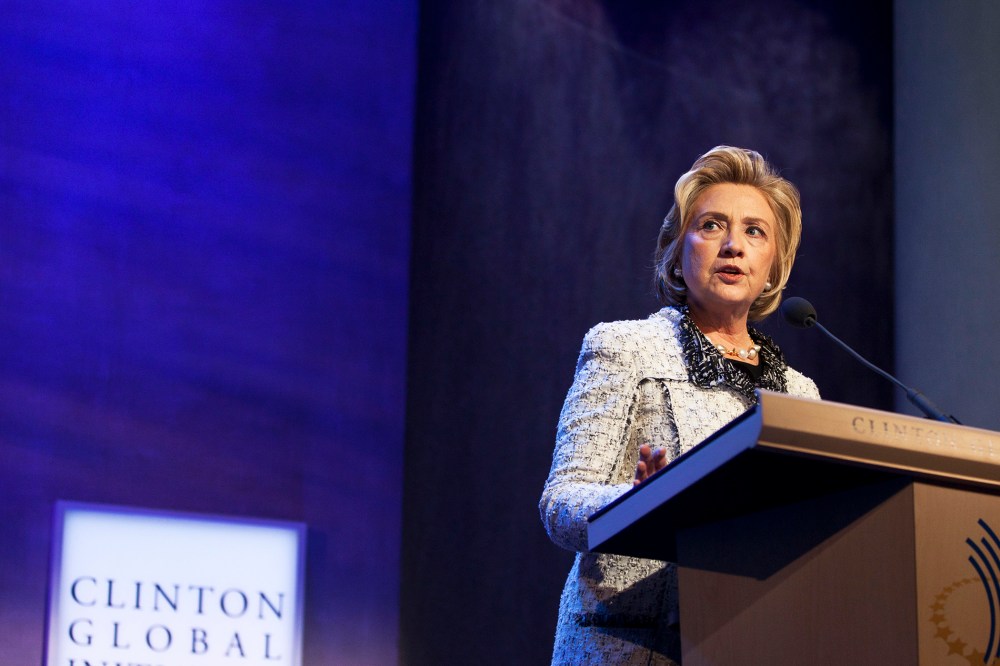
The controversy over Hillary Clinton’s email is not going away anytime soon.
Instead of using an official government email account, Clinton appears to have set up and run an email server of her own making at her New York state home to handle all of her email communications as secretary of state, raising new questions about the security and legality of the all-but-declared presidential candidate’s email habits.
The personal email server, uncovered by the Associated Press Wednesday, was registered to the apparent pseudonym “Eric Hoteham” and could have helped give Clinton an unusually sophisticated means to legally shield her emails from public disclosure.
RELATED: For Hillary, a haven amid a storm
The revelations about her email, sparked by a New York Times report Monday, are the most potentially damaging controversy Clinton has encountered since stepping down as secretary of state in 2013, and comes just weeks before a potential 2016 presidential campaign launch.
Clinton exclusively used private email as secretary of state, leading Republicans to accuse Clinton of skirting federal records laws and Democrats to privately fret about the political fallout, even on the sidelines of Clinton’s otherwise uplifting speech Tuesday night to a friendly crowd in Washington where she did not address the controversy.
Without an official campaign apparatus, Clinton herself has been slow to respond aggressively. Her allies, and in particular groups started by Democratic operative David Brock, have dismissed the story a “tempest in a teapot” and “the latest chapter in the Benghazi hoax,” referring to the controversy over the 2012 terror attack in Libya. The private email accounts were discovered by a House committee investigating the attack.
Sen. Chris Murphy, a young up-and-coming Democrat, told msnbc’s Jose Diaz Balart Wednesday morning that the controversy was “blown out of proportion” and urged people to judge Clinton based on her record, not this controversy.

Brock himself appeared on msnbc’s “Morning Joe” Wednesday to defend Clinton, calling the Times report “wrong,” “really sloppily done,” and “based on a false premise.” “I would concede that it’s a legitimate issue to raise,” Brock said. The paper reported that Clinton’s email system may have violated federal record laws, which Brock says is flat wrong. “The whole premise of it has fallen apart, that Hillary Clinton violated the law here. And the source they have on it says she didn’t.”
He was referring to Jason Baron, the former head of litigation at the National Archives and Records Administration (NARA), who was quoted by the Times calling Clinton’s private email usage highly unusual. But he told CNN Tuesday that the former secretary of state did not violate the law.
In 2013, Archivist of the United States David Ferriero told a House investigative panel that while the Records Administration discourages the use of personal email accounts, there is “nothing in the law that prohibits them.” The important thing is that the important records get saved one way or another. “We don’t care how many accounts you have as long as those on which you’re doing federal business are captured,” he added.
A law President Obama signed in 2014 cracked down on the use of personal email accounts, as did a 2013 ruling from the Records Administration, but both went into effect after Clinton left the government. The State Department said yesterday that Clinton turned over 55,000 pages of emails they requested and complied with the new requirements.
Defenders of Clinton have also pointed to the fact that many other public officials use private email. Former Florida Republican Gov. Jeb Bush, who is preparing for his own presidential run, also owns his own email servers and turned over only hand-selected emails to state archives, as msnbc reported.
RELATED: Jeb Bush owns his own email server
Clinton allies passed around an ABC News story Wednesday morning noting that Rep. Jason Chaffetz, who chairs the House Oversight Committee, lists a gmail address on his business card.
Rep. Trey Gowdy, who chairs the House Select Committee on Benghazi, uses both an official and private email account for different purposes, an aide told msnbc. “Chairman Gowdy has a work email and a personal email like Ranking Member [Elijah] Cummings does and nearly all Americans who use email,” said spokesperson Jamal Ware. Paul Begala, a longtime Clinton aide, noted that members of Congress are exempt from the Freedom of Information Act — an exemption lawmakers included when they wrote the law. “As one who has worked both on the Hill and in the White House, I have long been struck by how loose the rules are on the Hill compared with the executive branch,” he told msnbc. “Why the hell shouldn’t FOIA apply to the courts and Congress? [Justice Antonin] Scalia and [House Majority Whip Steve] Scalise have a lot more power than the Assistant Deputy Secretary of Agriculture.” Mitt Romney, Sarah Palin, Chris Christie, Scott Walker and many other GOP leaders have been dinged for using personal accounts to conduct political or official business. Still, there are major differences between state government and the State Department, which is subject to strict federal record laws and deals with sensitive national security information. And even if Clinton didn’t violate any laws or regulations, the lengths she went to in setting up a personal email system raise a host of important questions, according to the Sunlight Foundation, which works to promote government transparency. And unlike previous secretaries of state, Clinton appears to have relied on email extensively. In a 2011 interview, NBC’s Savannah Guthrie asked Clinton if she used a smartphone to stay in touch with friends and family. “I have a lot of security restraints on what I can and can’t do. But I do try to stay in touch as much as possible, and electronically is by far the easiest way to do that,” Clinton replied. At a conference in Silicon Valley last week, Clinton said she uses an iPhone, BlackBerry and iPad to stay in touch. As America’s top diplomat, she was often and famously photographed using her smartphone. One question is of security. While Clinton’s home, where her private email servers were reportedly stored, is protected by Secret Service, it is still presumably less secure than the U.S. government’s IT systems built for national security purposes. And the AP reported that Clinton used Google as a backup system, even as she publicly expressed concern that China was trying to hack into the Google mail accounts of top U.S. officials. But the most enduring question will likely be political. Why did Clinton do this? Was Clinton trying to hide something? That’s already what Republicans are asking, and it’s the one House investigators intend to pursue indefinitely, ensuring the issue is not going away anytime soon.
Alex Seitz-Wald Recommended


