








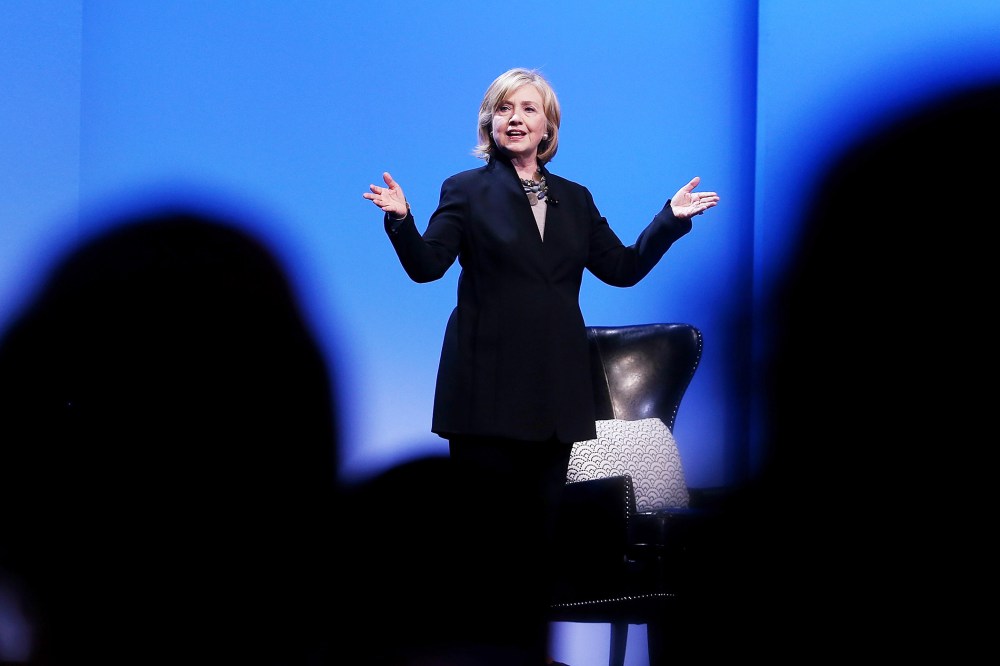
SAN FRANCISCO — Tech execs paid $245 to hear Hillary Clinton keynote a women’s tech conference in Silicon Valley Tuesday, but Clinton has as much to learn from her audience as they have to gain from her.
As the former secretary of state prepares for a second presidential run, she’s hoping Silicon Valley will rub off on her – and fill her campaign coffers.
Advisors have compared Clinton’s all-but-declared campaign to a “startup,” hoping a Brooklyn or Queens headquarters location and a flatter management structure will imbue the campaign with a youthful vitality and agility that was often lacking in her last attempt at a presidential run.
In 2008, the tech world rallied to Barack Obama and helped him defeat Clinton. But she’s worked hard to make inroads and shown a serious understanding and commitment to tech issues, which seems to have paid off.
When Clinton takes the stage Tuesday evening at the “Lead On” conference in Santa Clara, organized by Watermark, it will be her fourth high-profile public pilgrimage to Bay Area tech scene in the past 12 months.
In April, she spoke at conference hosted by Marketo, a marketing software firm. In July, she made the rounds to Facebook, Twitter and Google and took questions from CEOs and employees. And in October, she keynoted a conference sponsored by Salesforce, whose co-founder Marc Benioff has donated thousands of dollars to the pro-Clinton super PAC Ready for Hillary.
At every stop, Clinton has spoken passionately about the power of new technologies to connect people and her exuberance for the entrepreneurial vigor of the industry.
It’s a courtship Clinton started as secretary of state. Under the goal of what she called 21st Century Statecraft, Clinton worked to harness the online power of the State Department and insert Internet policy into American foreign policy. In a major speech in 2011, she said the “freedom to connect” should be as important as more established rights like freedom of speech.
The State Department also created a partnership with tech companies like Google and Microsoft aimed at helping “the next billion people come online,” as Clinton said. And she courted tech leaders individually, inviting Google exec Eric Schmidt and Twitter founder Jack Dorsey to a private dinner in 2010 with other industry insiders.
In 2009, Clinton’s staff intervened to prevent Twitter from going down for scheduled maintenance just as Iranian activists were using the social network to organize protests against the regime.
“Digital diplomacy was a big priority for Clinton when she was at State and hopefully her potential 2016 campaign will have a similar focus on building genuine engagement online,” said Adam Smith, a Democratic strategist who created the viral hit “Texts from Hillary,” which portrayed Clinton as smart-phone wielding boss.
Since stepping down as secretary of state, Clinton has expanded her personal online profile. She started a Twitter account and adopted the “Texts from Hillary” persona.
Lately, her Twitter account has been her primary – and often only – means of communication with the outside world. Clinton has not spoken publically for over a month, and it a month before that to her previous engagement. But her Twitter account weighs in on hot-button news of the day, stakes major policy positions, and personalizes the most famous woman in the world.
For Clinton, the benefits in wooing Silicon Valley are clear. Twitter’s initial public offering alone created an estimated 1,600 new millionaires, and there are plenty more deep pockets in the Bay Area where that came from. She’ll also need their talent and wisdom to help run what will likely be the most technologically sophisticated campaign of all time, and would like some of the industry’s values and image to imbue her campaign. Obama pretty much had a lock on Silicon Valley in 2008, but Clinton allies say 2016 is different. “From both a fundraising and talent standpoint, Secretary Clinton is poised to tap the same Silicon Valley mojo that President Obama benefited from during his race,” Luther Lowe, an Arkansas native who is now the director of public policy director at Yelp, told msnbc. Lowe sees enthusiasm in the tech world at events like one helped organize last fall featuring California Lt. Gov. Gavin Newsom and retired General Wesley Clark, where young tech workers “packed in shoulder to shoulder – we almost had to call the fire Marshall.” But even if she’s getting a better reception than in 2008, not everyone is on board. David Segal, an Internet freedom activist who co-founded the group Demand Progress with the late Aaron Swartz, said Clinton’s record on tech issues is acceptable, but uninspiring. “I do not see much evidence of a meaningful progressive record on issues of Internet freedom or other tech policy considerations. It’s analogous to where she is on pretty much every other issue,” he told msnbc. While he credited her for speaking out against the Stop Online Piracy Act, the controversial legislation better known as a SOPA that hundreds of major websites protested in 2012, he said Clinton has been reluctant to stick her neck out when it could have mattered most on issues like net neutrality or government surveillance. Clinton also ruffled some feathers in the tech world by saying Edward Snowden’s leaks helped terrorists. As with Democratic primary overall, these concerns have not stopped Clinton’s support in the tech sector. “The internet is ready for Hillary,” said Smith.
Alex Seitz-Wald Recommended


