msnbc is celebrating black history by profiling game-changing black musicians and film directors throughout February.
Joey Bada$$ is a renowned lyricist from Brooklyn, New York who dropped a timeless mixtape, “1999“, at the age of 17 and most recently a debut studio album, “B4.DA.$$.” that reached the top five in the Billboard 200 charts. He recently chatted with msnbc about President Obama, numerology, and his latest video “Like me.”
%22All%20the%20year%20is%20black%20history.%20All%20life%20is%20black%20history.%20Black%20history%20eternity%2C%20that%27s%20how%20I%20feel.%20I%27m%20always%20black%20history.%22′
Describe who you are and what you do in one breath:
I am an international artist from Brooklyn, New York with dreams to change the world through my music.
Describe some of the sights, sounds, and tastes from your childhood and how they have influenced your music?
Growing up in Brooklyn is pretty much a diversified area when it comes to black people. It’s all different types of cultures, a whole Caribbean Island mixture and African-American. I heard a lot of reggae and steel pans coming up. I’ve seen a lot of poverty and things like that—regular street stuff.
Who or where do you draw creative inspiration from?
Pretty much everything and anything. Anyone can inspire me. Anything from just my life experiences is what often inspires me: walking down the street; talking to certain people; or traveling to certain places.
Many people like to compare you to Nas, Biggie, Jay Z, and MF Doom. Who do you think your sound/style is closest to?
My sound is closet to me, Joey. When I first came out at 17 [years old] I would say my influences were closer to those styles but it was imperative to me that I move into my own area, my own style, my own mind, basically. There’s nothing else that sounds like what I’m making, because it’s me. There is no one else like me.
How would you describe that Joey flavor?
Pretty spontaneous. The thing about me is, I don’t have a flavor, it’s always different. Anything that I kick, anything that I cut, is going to be different than the last piece. That’s what I like to aim for.
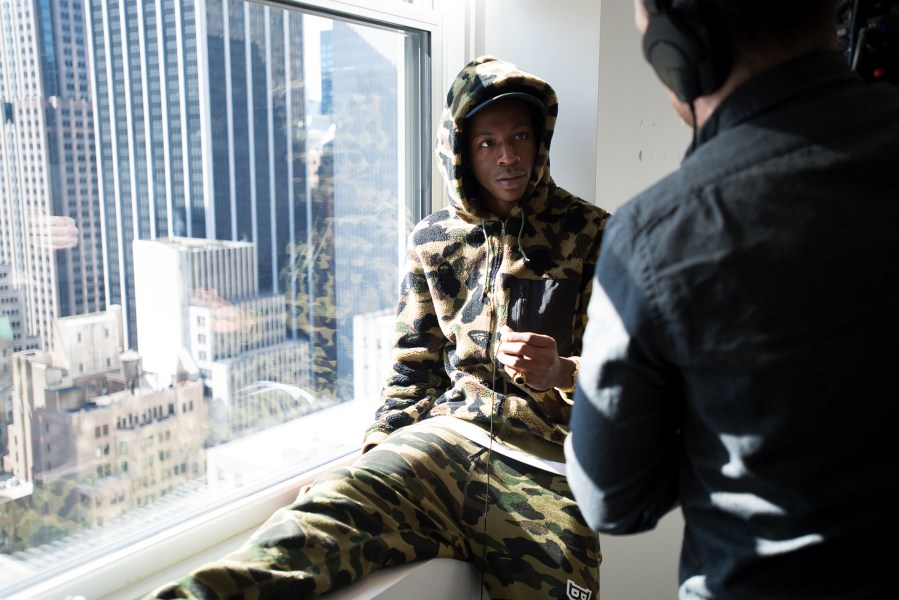
Can you speak more to Pro Era and that brotherhood that you’re building?
The biggest part of this whole picture is the brotherhood that we are building. We started a family. We are always going to look out after each other, there’s always love there … not only do they know you for the true you, but genuine love and support.
Do you imagine having any women involved?
T’nah Apex was the first lady of Pro Era but she’s pretty much doing her own thing now. She pretty much set the standard. We not going find anyone better than T’nah — no one is on her caliber. It would be absurd to recruit anyone not as good as T’nah.
What’s the importance of remaining independent?
It’s very important. In this day and age, major labels wouldn’t know what to do with Pro Era. Only Pro Era knows what to do with Pro Era. What the majors do is they are looking to follow the status quo and sound like everyone else. And us — we’re rebels, we’re controversial, everything a major label doesn’t want to deal with. Also, we’re young minds. So, it’s better off letting our creativity flow and not being cut off and stumped by labels.
Recently you said on Twitter: “Hate telling people I’m a rapper because they underestimate my brilliance and degrade my character.” Were you referring to a specific instance or is that a general experience?
It’s funny, the other day I was in the airport in Philly and I was getting some food with Nyck Caution. This lady asked, “What do you guys do”? We said, “We are musicians, we rap … We actually have the number one hip-hop album out.” She said, “I’m a christian, I listen to gospel, so I wouldn’t like your music.” And I was like, “How do you know you wouldn’t like our music … it ain’t about b-tches and h-es and money and sh-t.” And then one of her co-workers came out and was like, “Oh sh-t that’s Joey Bada$$.” It’s just funny how they think of you … it’s always been weird. I always had a high stature for myself. In elementary school, I was most likely to become president.
Can you tell me about your latest video you just dropped “Like me” about police brutality, and how that came about artistically?
All praises due to J Dilla. He made that beat, he made that whole idea possible. I pretty much had that song for over a year. It was one of my favorite songs right away. Not only because it was a J Dilla beat, but to me, it’s one of the realest messages that I had put into a song, thus far. I’ve been premeditating my vision for the video for over a year and for a long time people asked me what my idea for the video was and I tried to explain it, but it was only something I was seeing, it wasn’t something I could explain in words … the visual is my statement. I really want people to take it for what they see and decipher it themselves.
Walk me through that feeling you get when you hear the perfect beat:
It feels like a soothing sensation of the soul. When I hear the perfect beat it’s like ahh. I’m indulged into it and it takes over my mind, my body, and my soul, and it’s like “rap to me” or “sing.” It strikes a chord within.
If you could collaborate with any artist, dead or alive:
Tupac
One Joey Bada$$ song the world should hear:
“Like me” If you had to choose two films and two songs to play on repeat … forever (only one can be yours): “City of God”/ “La Haine” Tupac “Temptations” / Joey Bada$$ “Like me” You use numbers in expressing your song titles. Can you say more about that style of communication? Often, I find that there’s more messages behind them. For example, the other day my phone was ringing all day—weird numbers, unidentified numbers. At some point, there was this one number that called, and it was all sevens … so I was like, out of all the numbers that called me today, I’m going to pick up this one. Because you know seven represents god. When I picked up, it was my brother in jail. So it was a calling. I was like wow, the one message that I answered today is my brother. What are you most proud of at this moment? Staying true to myself. Me continuing to be independent. Me not ever signing to a major. Putting my first album out independently. Just doing everything pretty much by ourselves. I’m most proud of the fact that we challenged ourselves and we did it on our own. So about the alleged photo of Malia Obama wearing a Pro Era T-shirt … I was so surprised … It was definitely the biggest co-sign I ever received. If you had a chance to speak to President Obama, what would you say? I want to ask him a question that is well thought out but, for the most part, just be myself, just be regular like, “Hey, how you doing Mr. President … Let’s play some ball.” If you had to rewrite history … My answer is too deep. I don’t want to say. I want to keep that for my mental. What are your memories of Black History Month as a child? What do you make of it today? As a child, I remember doing projects on black people for that time period. But now, to me all year is black history. All life is black history … black history eternity, that’s how I feel. I’m always black history. Keep up with Joey on Twitter, @joeyBADASS. For more profiles, check out Jean Grae is no longer exclusive with hip-hop
Alicia Maule Recommended